PROVENANCE OF THE COPY SCANNED. The volume carries the bookplate of Sidney Edward Bouverie-Pusey, printed above the title page and here trimmed out of the reading text along with the scanner debris around it. It is recorded rather than discarded: it says whose copy of the 1782 Tableau naturel this archive is reading from, which is a fact about the artefact even though it is not a fact about the book.
Louis-Claude de Saint-Martin
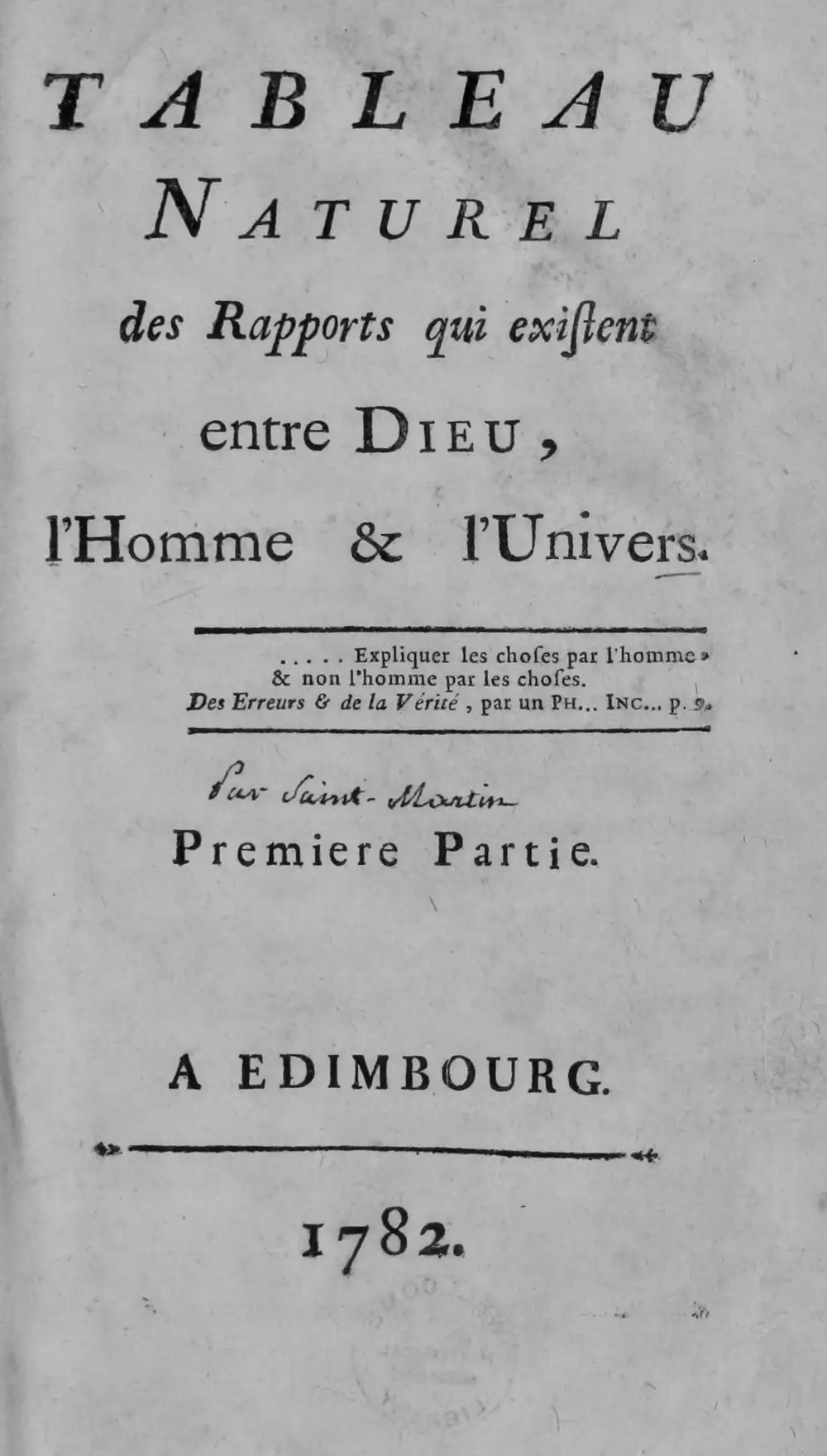
Tableau naturel des rapports qui existent entre Dieu, l'homme et l'univers
Open to all
machine-assisted · checkedpage 1
T A B L E A U
Natural
of the Relations which exist
between God, Man & the Universe.
Explain things by man,
& not man by things.
Of Errors & of Truth, by an Unk... Ph... p. s»
First Part.
AT EDINBURGH.
♦»
I782.
-
HI9T0B'CM- J
MEOIU'-
Publishers' Notice.
Upon the margins of the Manuscript of this Work, which we hold from a person unknown 3 there existed a great number of Additions in a different hand. Having observed that not only did these Additions fail to bind the discourse 3 but that sometimes they even interrupted its thread; that moreover they were of a particular kind which seems to differ from that of the Work 3 we have thought it right to mark them by quotation marks placed at the beginning & at the end of the several passages of this kind: so that if they are not the Author's, if they were added by someone to whom he had entrusted his Manuscript, anyone may easily discern them.
Table.
First Part.
I
Page x
2
18
5
37
4
5»
>.
76
6
93
7
3
s
133
9
160
192
1 1
219
2
2-45
Second Part.
3
«
14
28
lî
26
77
37
101
18
129
9
54
20
17a
21
i ' 1
204
22
•
W
TABLEAU
Natural
Of the Relations which exist between GOD >
Man & the Universe.
I .
Truths fruitful & luminous would exist less for the happiness of man than for his torment, if the attraction he feels toward them were an inclination he could never satisfy. It would even be an inexplicable contradiction, in the first Mover, upon which these Truths radically depend, that having wished to withdraw them from our sight, he should have written them in all that surrounds us, as he has done in the living force of the elements; in the order & the harmony of all the actions of the universe, & more clearly still, in the distinctive character which constitutes man.
11 is far more conformable to the laws of that primitive Cause, to think that it has not multiplied before our eyes the rays of its own
A
2 light, in order to forbid us the knowledge & the use of it; & that if it has placed near us, & within ourselves so many instructive objects, it is to give them to us to meditate upon & to understand; & in order to bring us, by their means, to results brilliant & general, which might calm our disquiets & our desires.
These Truths would cease to appear to us inaccessible, if by attentive & intelligent care, we knew how to seize the thread which is unceasingly held out to us; because that thread, running from the light to us, would then fulfil the principal object which it proposes, which is doubtless to bring us nearer to it, & to reunite the two extremes.
To assist toward an end so important, let us begin by dispelling the doubts which have arisen upon the true nature of man, because it is from this that the knowledge of the laws & of the nature of other Beings must result.
Man can give existence to no material work without proceeding therein by acts which are, so to speak, its creative Powers, & which, although they operate inwardly & in a manner invisible, are nevertheless as easy to distinguish by their successive rank as by their different properties: for example, before raising a building, I have conceived the plan or the thought of it, I have adopted that plan, & lastly I have made choice of the means proper to realise it.
It is evident that the invisible faculties by which I had the power to produce this work are, by their nature, far superior to their result, & that they are wholly independent of it. For that building might not have received existence, without the faculties which made me capable of giving it to the building being thereby altered. Since it has received existence, they retain the same superiority, since having the power to destroy it, not to destroy it is in some sort to continue its existence; lastly, were it to perish, the faculties which gave it Being would remain after it what they were before, & during its duration.