Practice 1 of 4
The open practice: swipe, or use the arrow keys, for the next
Paschimottanasana — seated forward bend
Part 1 of 2
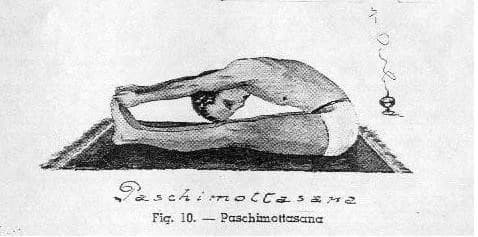
Paschimottanasana. — The seventh Asana bears the name Paschimottanasana [Glossary 74]. Technique. — Sit on the floor with the legs stretched out and rigid; then breathe out deeply and, bending the trunk slowly forward, grasp the great toes with the thumbs, index and middle fingers of the hands, while the forehead comes to touch the knees. Remain in this position some seconds and then return, always slowly, to the starting position. The breath must be held throughout the exercise, and only after returning to the original position does one begin to breathe again. Figure 10 shows clearly what has been said. The Paschimottanasana may be practised at first for 5 minutes, and afterwards, increasing the time progressively by one minute a day, we reach a maximum of 10 minutes. To facilitate the bending of the trunk it is recommended to contract the abdominal muscles until the belly is drawn in as far as possible, and to perform the bending of the trunk slowly, to avoid the abrupt distension of the muscles and tendons brought into action in performing the Paschimottanasana. It must never be forgotten that the end the Yogis propose to attain in performing the Asanas is to obtain a maximum of bodily benefits, simultaneously with the mental and spiritual ones, by a minimum of physical effort; and that is why all the movements should be effected slowly and without strain. Young persons, whose dorsal joints are, on account of their age, tolerably elastic, may at the first attempt touch the knees with the forehead; whereas older persons, whose dorsal joints are logically less elastic through lack of exercise, will find greater difficulty in performing this Asana.
On the other hand, obese persons will also find much difficulty at first in bending the trunk; but as, with exercise, the excess fat is burned away and the joint movements become ampler, they will be able to perform this Asana with greater ease and to reach its perfect execution. To all those who, through lack of elasticity, obesity and so forth, cannot reach the perfect performance of the Paschimottanasana, we recommend that at first they perform the half posture — that is, bend the trunk and grasp the great toe of one foot with the corresponding hand, alternating the exercise to right and to left. When after a certain time the joints have become more elastic, they will be able to perform the whole Asana. Results. — The beneficial effects of the Paschimottanasana may be summarised thus: 1) Activation of the fluidic current by the so-called Sushumna or Brahma Nadi [Glossary 75]. 2) Activation of the “gastric fire”, which allows the digestive functions to be intensified and harmonised. 3) Increase of the “tone” of the liver and spleen. We all know that the sun floods us with its heat, light and colour, and that it is the source of our life. Our body lives by absorbing solar energy, and one of the functions of the etheric part of the spleen is precisely to absorb this energy and, transforming it, to individualise it into human life. The vital force, invisible to our physical eyes but perfectly visible to yogis and seers, manifests as an infinity of etheric particles in continual vibration which, on being absorbed by the spleen, take on a pale rose colour and, once entered into the body, are channelled in all directions. In a healthy man the spleen functions actively and the vital force can be completely individualised and radiated in all directions; otherwise this function is not fully performed, and in consequence the organism suffers from weakening or want of this vital force. The Paschimottanasana activates the first process and so relieves all the dysfunctions of the spleen and the liver. 4) Oxidation of the excess fats in the various organic deposits, especially in the belly. 5) Increase of the tone and elasticity of all the muscles brought into action — the abdominals, those of the spinal column, of the thighs, the legs and the arms — and therefore an increase of the blood circulation. 6) Toning of the smooth muscles of the intestinal wall, with the consequent increase of the peristaltic movements and gradual disappearance of constipation. 7) Increase of the activity of the thyroid gland and toning of the muscles of the neck, with the consequent gradual disappearance of the wrinkles of the skin of the neck, especially in women. 8) Cure of inflammations of the liver and of gastritis due to hyperchlorhydria. 9) Cure of lumbago and of rheumatic pains due to poor circulation of the blood in the affected regions.
Posture 1 of 3
"Progressive Course of Asana Yoga," Asuri Kapila, S∴I∴ — La Iniciación, Año 2, Nº 10 (1943), p.8