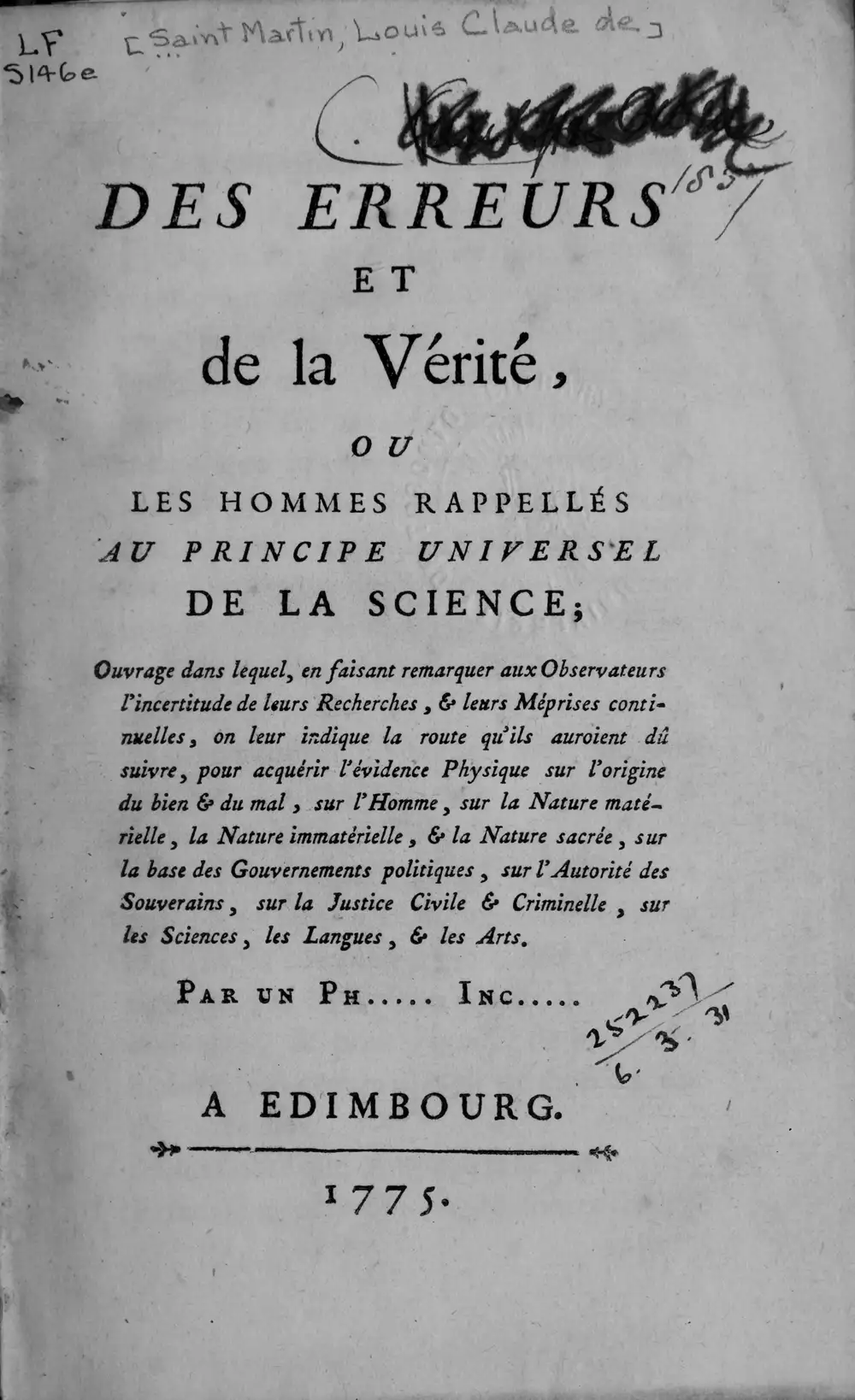
A Work in which, by pointing out to Observers the uncertainty of their Researches, and their continual Mistakes, they are shown the route they ought to have followed, to acquire Physical evidence concerning the origin of good and of evil, concerning Man, concerning material Nature, immaterial Nature, and sacred Nature, concerning the basis of political Governments, concerning the Authority of Sovereigns, concerning Civil and Criminal Justice, concerning the Sciences, the Languages, and the Arts.
By a Ph In
s'y
-A
^
AT EDINBURGH.
l77$
■k
#
>I«H , . t V \ W
The Work I offer to men is by no means a collection of conjectures; it is not a system that I present to them — I believe I am giving them a more useful gift. It is not, however, Science itself that I come to bring them: I know too well that it is not from man that man must expect it — it is merely a ray of their own torch that I rekindle before them, so that it may enlighten them concerning the false ideas they have been given of Truth, as well as concerning the weak and dangerous weapons that unsteady hands have employed to defend it.
I have been keenly affected, I confess, on casting my eyes upon the present state of Science; I have seen how greatly mistakes have disfigured it, I have seen the hideous veil with which it has been covered, and, for the sake of my fellow men, I believed it my duty to tear it away.
Doubtless such an undertaking requires more than ordinary resources;
i # •> > 1 1 «-
resources: but, without explaining myself as to those I employ, it will suffice to say that they belong to the very nature of men, that they have always been known to some among them since the origin of things 3 and that they shall never be entirely withdrawn from the face of the Earth, so long as there are Thinking Beings.
It is there that I have drawn the evidence and the conviction of the truths whose pursuit occupies the whole Universe.
After this admission, were I still accused of teaching an unknown Doctrine 7, one could at least not suspect me of being its inventor, since, if it belongs to the nature of men, not only does it not come from me, but it would even have been impossible for me to establish solidly any other.
And indeed, if the Reader does not pass judgment upon the Work, before having perceived its whole and its connection; if he allows himself the time to feel the weight and the chain of the principles I set before him, he will grant that they are the true key to every Allegory and to the Mysterious Fables
♦-» 1 1 1 «...mysterious Fables of every People, the first source of every kind of institution, the very model of the Laws that govern the Universe and that constitute all Beings; that is to say, that they serve as the basis for everything that exists and for everything that takes place, whether within man and by the hand of man, or outside of man and independently of his will; and that, consequently, outside of these Principles, there can be no true Science.
From this he will understand still more easily why one sees among men a universal variety of Dogmas and of Systems, why one perceives that innumerable multitude of Philosophical, Political, and Religious Sects, each of which agrees as little with itself as with all the other Sects; why, despite the efforts the Heads of these different Sects make every day to form for themselves a stable Doctrine upon the most important points, and to reconcile their particular opinions, they can never succeed in it; why,
Saint-Martin in French. The archive holds three Saint-Martin issues and, separately, his French translation of Boehme’s Three Principles as boehme:11 — so the same man appears here as author and there as translator, which is the relation worth carrying between the two shelves.