‘Striking a decisive blow’ for 果, taken from Julien, gives the skilful commander a more violent action than the chapter needs. The word speaks of achieving a result, and the paragraph’s weight falls on stopping there, without vanity or wish for mastery. Legge’s English keeps the restraint but adds a blow the Chinese does not strike, in a chapter titled against war.
The Tâo Teh King — Sacred Books of China Part I, SBE Vol. 39 (trans. James Legge, 1891)
Open to all
page 73
No image is selected for this page; its own page image is shown.
page 73
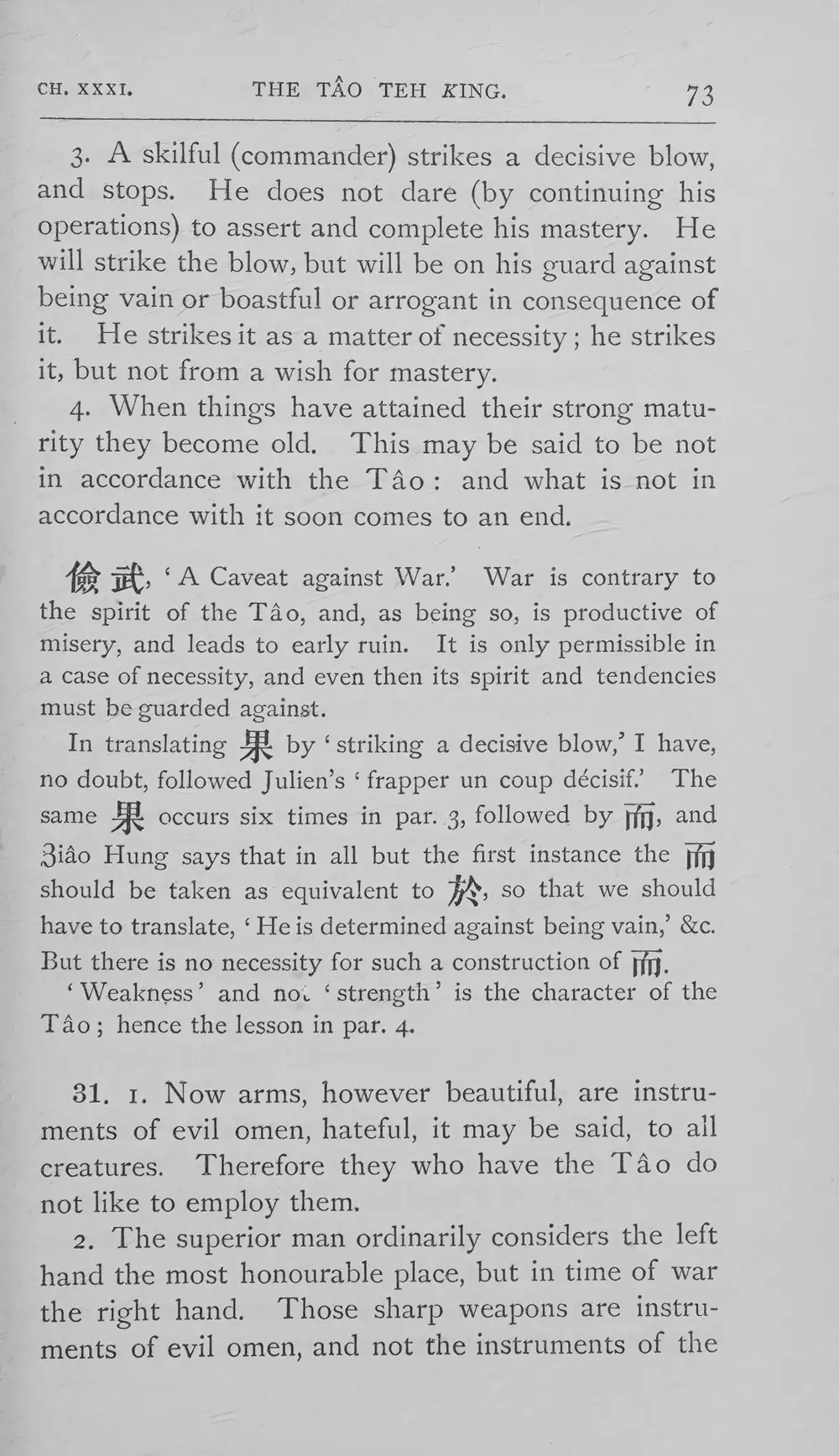
3. A skilful (commander) strikes a decisive blow, and stops. He does not dare (by continuing his operations) to assert and complete his mastery. He will strike the blow, but will be on his guard against being vain or boastful or arrogant because of it. He strikes it as a matter of necessity; he strikes it, but not from a wish for mastery.
4. When things have reached their strong maturity, they grow old. This may be said to be not in accordance with the Tâo; and what is not in accordance with it soon comes to an end.
儉武, ‘A Caveat against War.’ War is contrary to the spirit of the Tao, and, being so, produces misery and leads to early ruin. It is permissible only in a case of necessity, and even then its spirit and tendencies must be guarded against.
In translating 果 by ‘striking a decisive blow,’ I have no doubt followed Julien’s ‘strike a decisive blow’ (frapper un coup décisif). The same 果 [Press: resolute; to carry through decisively] occurs six times in par. 3, followed by 而 [Press: a connective particle (‘and’, ‘yet’)], and Ȝiâo Hung says that in every instance but the first the 而 [Press: a connective particle (‘and’, ‘yet’)] should be taken as equivalent to 於 [Press: a preposition (‘in’, ‘against’, ‘than’)], so that we should have to translate, ‘He is determined against being vain,’ etc. But there is no need for such a construction of 而 [Press: a connective particle (‘and’, ‘yet’)].
‘Weakness,’ and not ‘strength,’ is the character of the Tao; hence the lesson in par. 4.
31. 1. Now arms, however beautiful, are instruments of evil omen, hateful, it may be said, to all creatures. Therefore those who have the Tao do not like to use them.
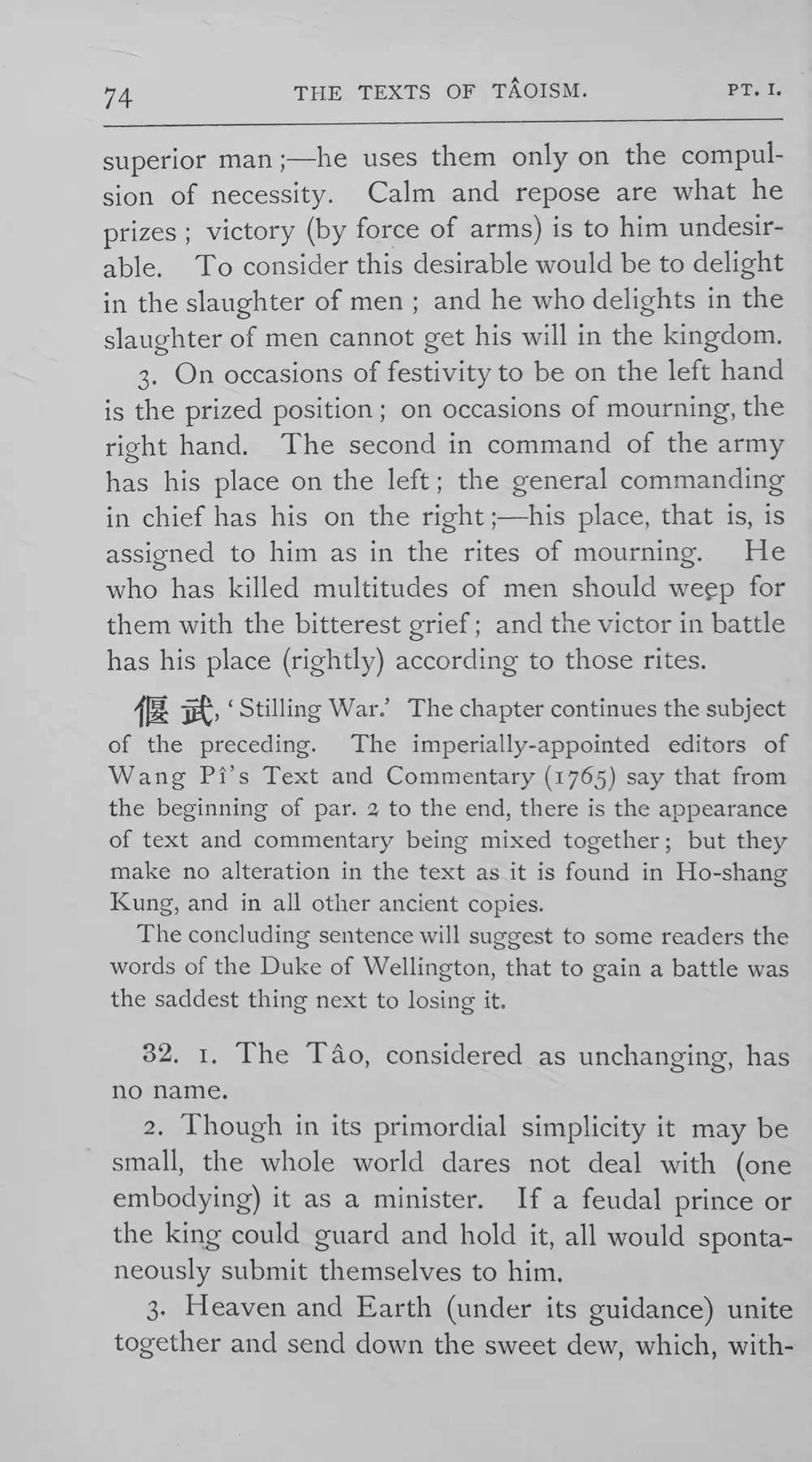
2. The superior man ordinarily considers the left hand the most honourable place, but in time of war the right hand. Those sharp weapons are instruments of evil omen, and not the instruments of the superior man; he uses them only under the compulsion of necessity. Calm and repose are what he prizes; victory (by force of arms) is to him undesirable. To consider it desirable would be to delight in the slaughter of men; and he who delights in the slaughter of men cannot get his will in the kingdom.