The editors of 1765 suspected that from par. 2 of chapter 31 text and commentary are mixed. The page bears them out: the left-hand and right-hand places are explained twice, in par. 2 and again in par. 3, much as a gloss repeats what it explains. Legge reports the suspicion and leaves the text as all the old copies have it, the right course when no copy separates the two.
The Tâo Teh King — Sacred Books of China Part I, SBE Vol. 39 (trans. James Legge, 1891)
Open to all
page 74
No image is selected for this page; its own page image is shown.
page 74
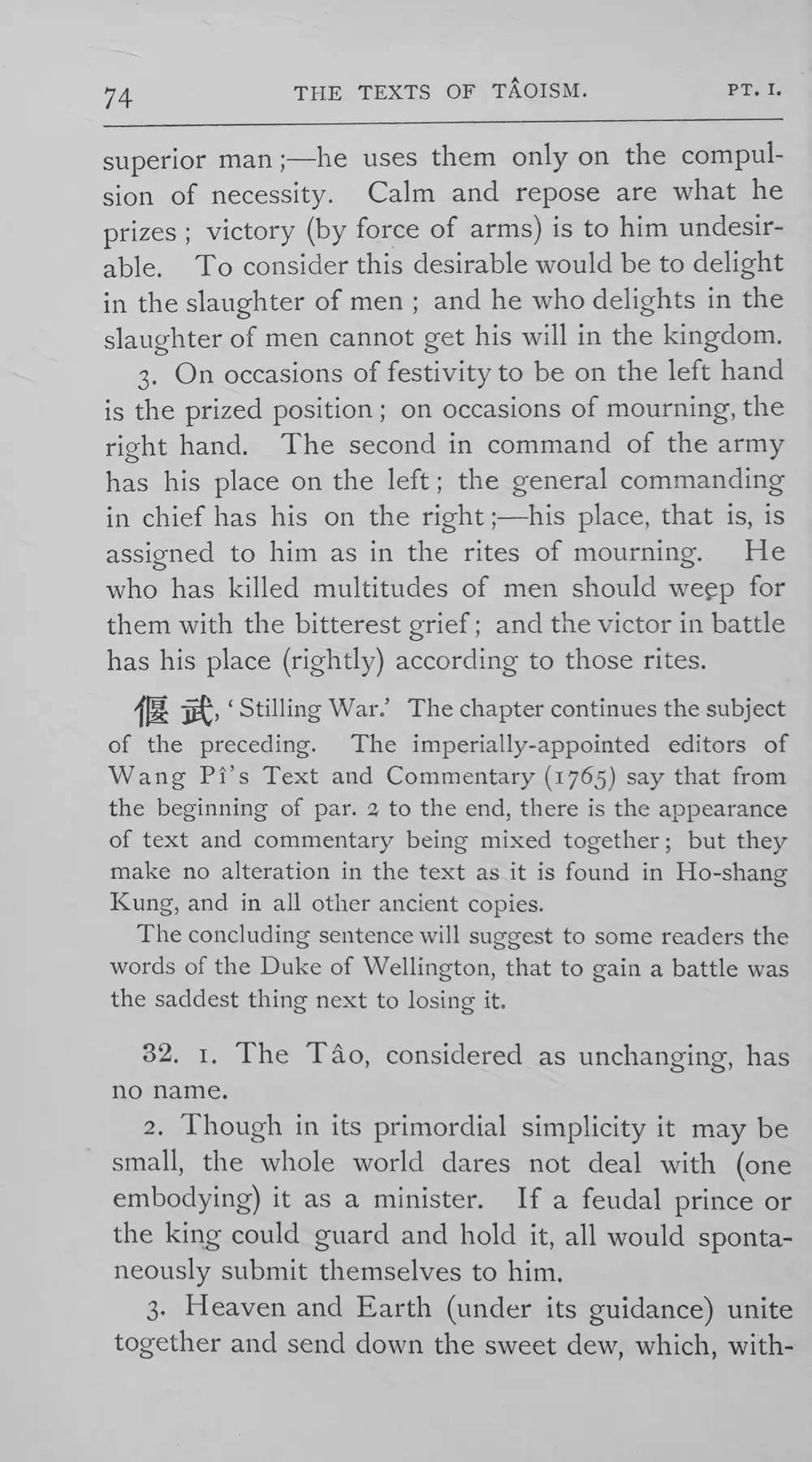
3. On occasions of festivity the left hand is the prized position; on occasions of mourning, the right hand. The second in command of the army has his place on the left; the general in chief command has his on the right: his place, that is, is assigned to him as in the rites of mourning. He who has killed multitudes of men should weep for them with the bitterest grief; and the victor in battle has his place (rightly) according to those rites.
偃武, ‘Stilling War.’ The chapter continues the subject of the preceding one. The imperially appointed editors of Wang Pi’s Text and Commentary (1765) say that from the beginning of par. 2 to the end, text and commentary appear to be mixed together; but they make no change to the text as it is found in Ho-shang Kung and in all other ancient copies.
The closing sentence will remind some readers of the words of the Duke of Wellington, that to win a battle was the saddest thing next to losing one.
32. 1. The Tao, considered as unchanging, has no name.
2. Though in its primordial simplicity it may be small, the whole world dares not treat (one who embodies) it as a minister. If a feudal prince or the king could guard and hold it, all would submit to him of their own accord.
3. Heaven and Earth (under its guidance) unite together and send down the sweet dew, which, without the direction of men, reaches everywhere equally, as of its own accord.