Legge here translates from Wang Pi and calls Ho-shang Kung’s text ‘inexplicable’; in chapters 26 and 39 he prefers Ho-shang Kung. He chooses witnesses passage by passage, so the English King follows Wang Pi in one chapter and Ho-shang Kung in the next. The notes say so each time, which is to his credit, but a reader should not take the translation as one edition.
The Tâo Teh King — Sacred Books of China Part I, SBE Vol. 39 (trans. James Legge, 1891)
Open to all
page 75
No image is selected for this page; its own page image is shown.
page 75
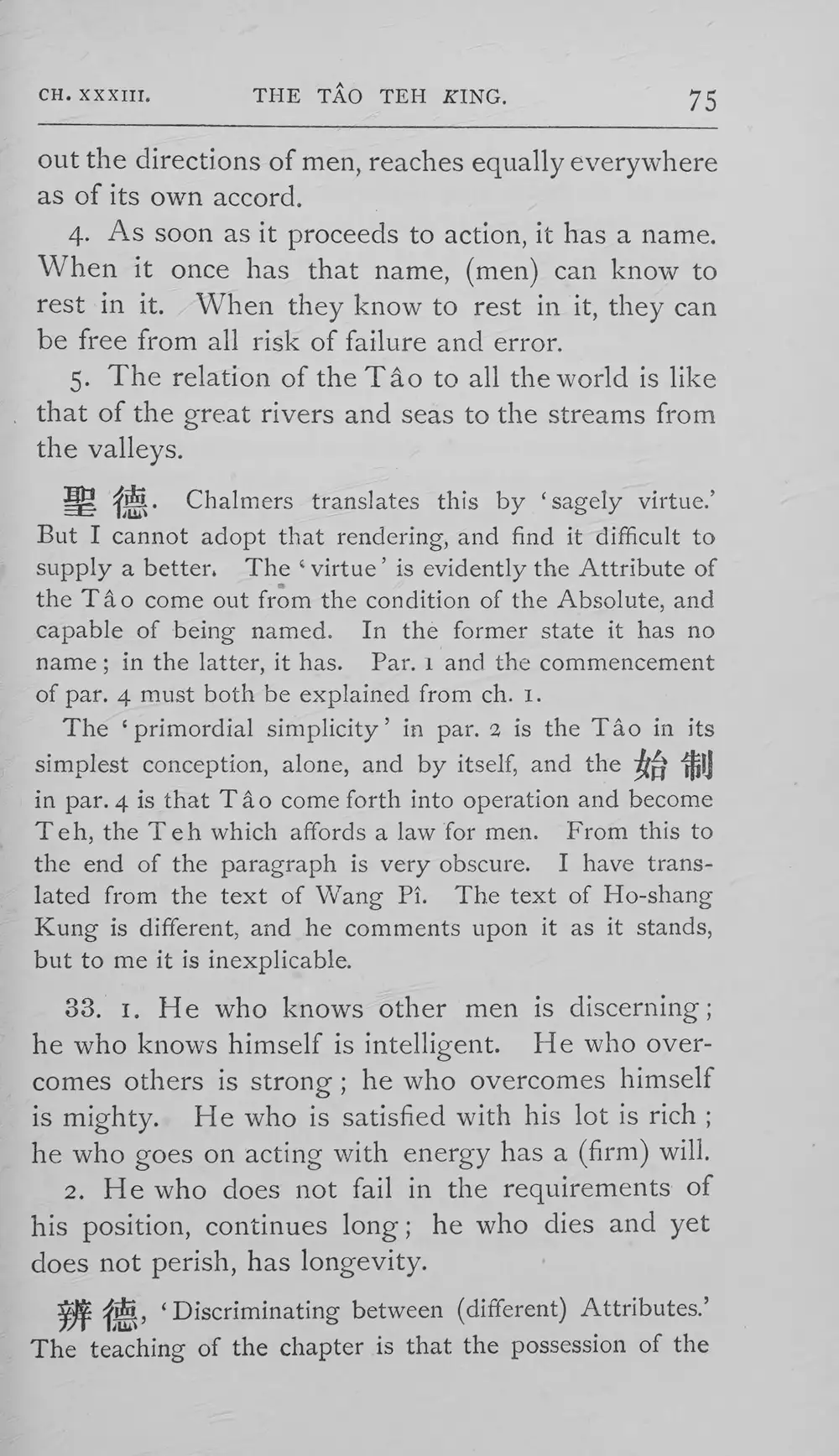
4. As soon as it proceeds to action, it has a name. Once it has that name, (men) can know to rest in it. When they know to rest in it, they can be free from all risk of failure and error.
5. The relation of the Tao to the whole world is like that of the great rivers and seas to the streams from the valleys.
聖德 [Press: the sage's virtue]. Chalmers translates this as ‘sagely virtue.’ But I cannot adopt that rendering, and find it difficult to supply a better one. The ‘virtue’ is evidently the Attribute of the Tâo come out from the condition of the Absolute and capable of being named. In the former state it has no name; in the latter, it has. Par. 1 and the beginning of par. 4 must both be explained from ch. 1.
The ‘primordial simplicity’ in par. 2 is the Tao in its simplest conception, alone and by itself, and the 始制 [Press: the first regulating, the beginning of order] in par. 4 is that Tâo come forth into operation and become Teh, the Teh which provides a law for men. From this point to the end of the paragraph is very obscure. I have translated from Wang Pi’s text. Ho-shang Kung’s text is different, and he comments on it as it stands, but to me it is inexplicable.
33. 1. He who knows other men is discerning; he who knows himself is intelligent. He who overcomes others is strong; he who overcomes himself is mighty. He who is content with his lot is rich; he who goes on acting with energy has a (firm) will.
2. He who does not fail in the requirements of his position lasts long; he who dies and yet does not perish has longevity.
辨德, ‘Discriminating between (different) Attributes.’ The teaching of the chapter is that the possession of the Tâo confers the various attributes that are most distinguished here. It has been objected that elsewhere the Tao is represented as associated with dullness and not intelligence, and with weakness and not strength. But these seem to be qualities seen from without, acting on what lies beyond itself. Inwardly its qualities are the very opposite, and its action has the effect of enlightening what is dark and overcoming what is strong.