The text asks the sage to keep to ‘the female’; Legge’s rhyme makes it ‘his female feebleness’. The added noun turns a figure of receptiveness into weakness, a value the chapter does not assign. Elsewhere the King calls the soft and weak victorious (ch. 36, 43), so ‘feebleness’ is at best a half-truth about what the female stands for here.
The Tâo Teh King — Sacred Books of China Part I, SBE Vol. 39 (trans. James Legge, 1891)
Open to all
page 71
No image is selected for this page; its own page image is shown.
page 71
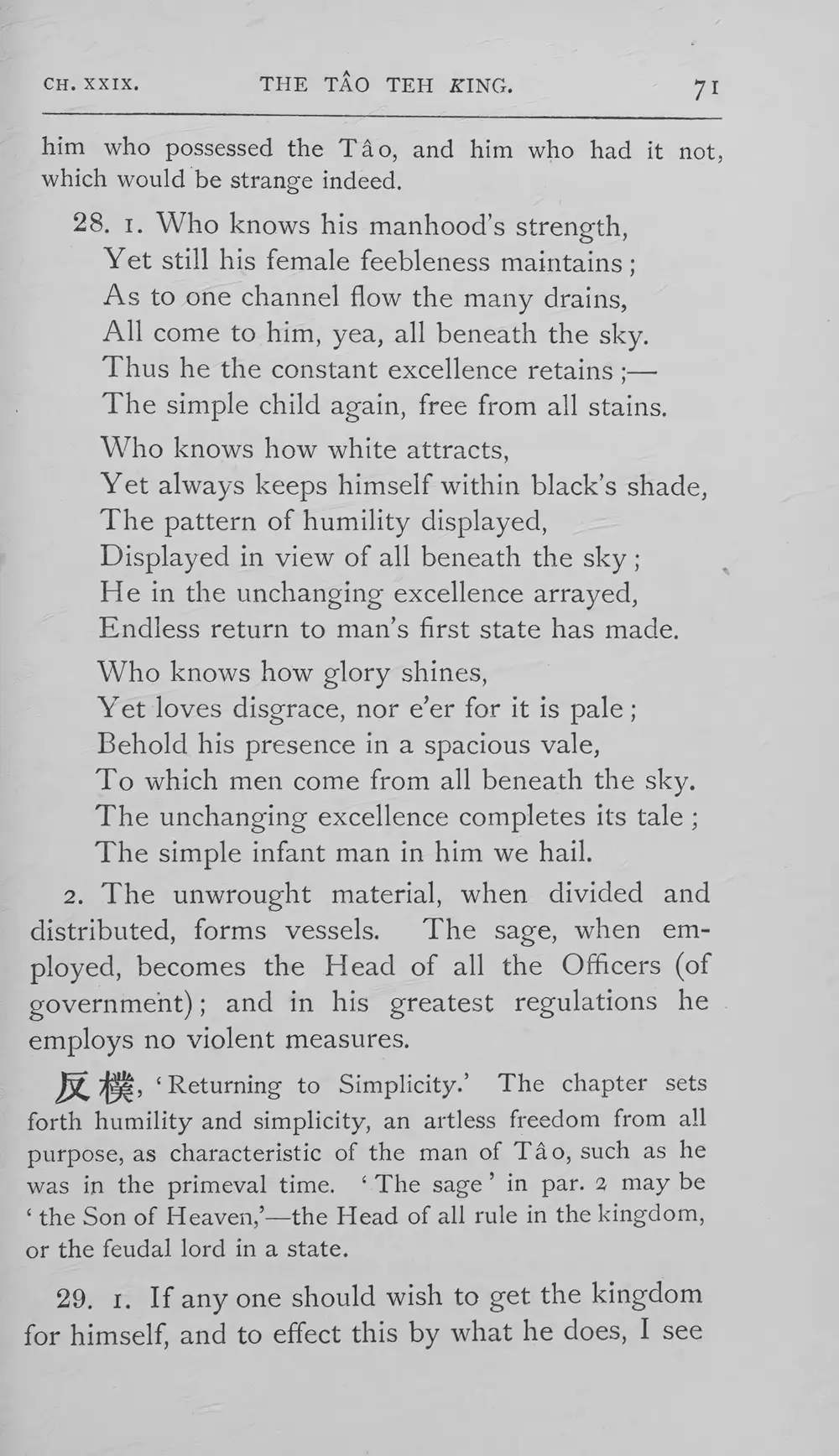
28. 1. He who knows his manhood’s strength, yet still maintains his female weakness, is like the one channel into which the many drains flow: all come to him, yes, all beneath the sky. So he keeps the constant excellence; he is the simple child again, free of every stain.
He who knows how white attracts, yet always keeps himself within black’s shade, displays the pattern of humility in view of all beneath the sky; arrayed in the unchanging excellence, he has made the endless return to man’s first state.
He who knows how glory shines, yet loves disgrace and never turns pale at it: behold his presence, like a spacious valley to which men come from all beneath the sky. The unchanging excellence completes its tale; in him we hail the simple infant man.
2. The unwrought material, when divided up and distributed, forms vessels. The sage, when employed, becomes the Head of all the Officers (of government); and in his greatest regulations he uses no violent measures.
反樸, ‘Returning to Simplicity.’ The chapter sets out humility and simplicity, an artless freedom from all purpose, as characteristic of the man of the Tao, as he was in the primeval time. ‘The sage’ in par. 2 may be ‘the Son of Heaven,’ the Head of all rule in the kingdom, or the feudal lord of a state.
29. 1. If anyone should wish to get the kingdom for himself, and to bring this about by what he does, I see that he will not succeed. The kingdom is a spirit-like thing, and cannot be got by active doing. He who would win it in that way destroys it; he who would hold it in his grasp loses it.