Legge will not follow Julien’s ‘vase divin’ for the kingdom as a ‘spirit-like vessel’: ‘I always shrink from translating 神 by ‘divine.’’ His reason is good, that the point is spirit’s freedom from ordinary handling, which makes the throne something force cannot hold. The reluctance is also theological: he keeps ‘divine’ for his God, as he keeps ‘God’ for Ti.
The Tâo Teh King — Sacred Books of China Part I, SBE Vol. 39 (trans. James Legge, 1891)
Open to all
page 72
No image is selected for this page; its own page image is shown.
page 72
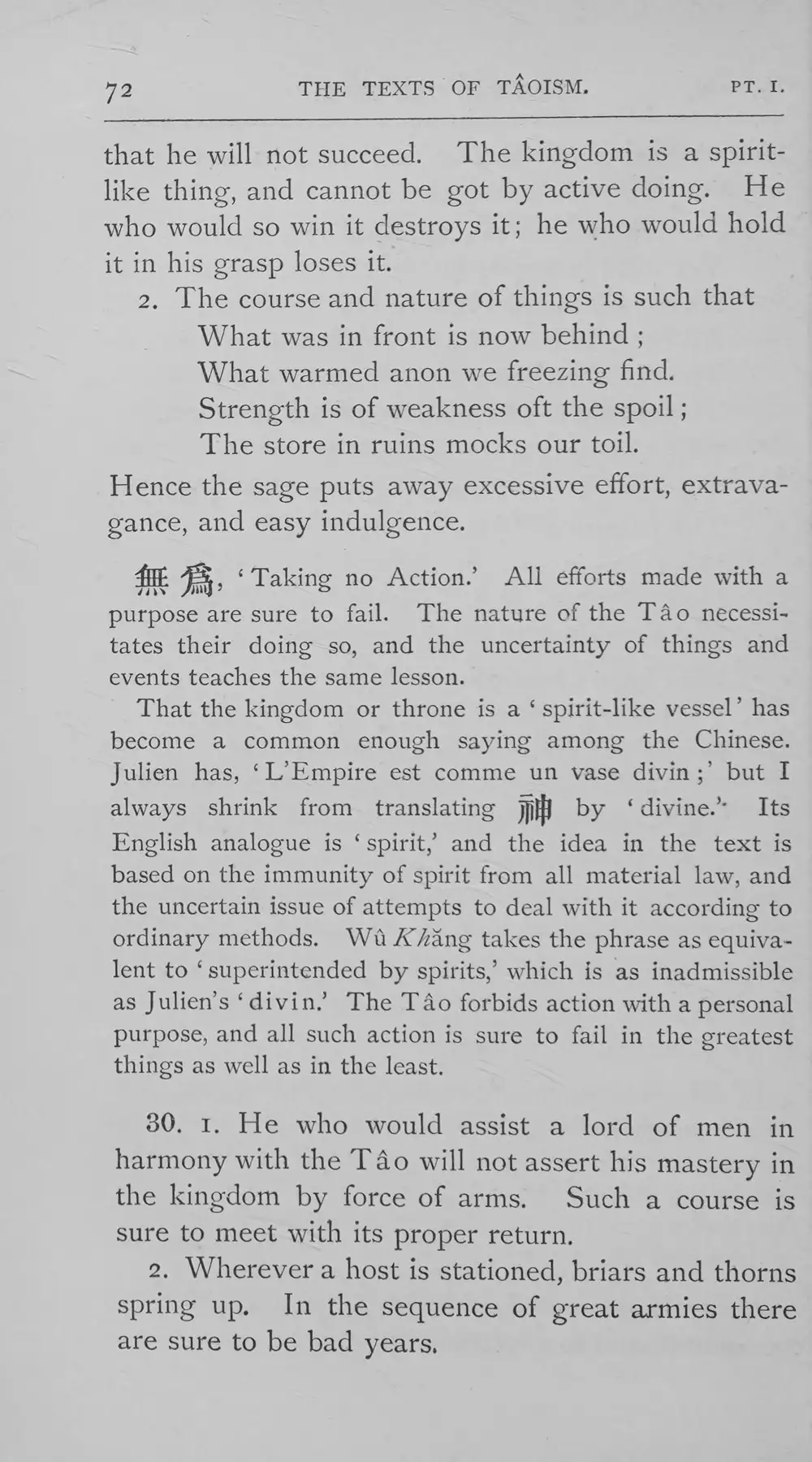
2. The course and nature of things is such that what was in front is now behind; what warmed us a moment ago we find freezing; strength is often the spoil of weakness; the store in ruins mocks our toil. Hence the sage puts away excessive effort, extravagance, and easy indulgence.
無爲, ‘Taking no Action.’ All efforts made with a purpose are sure to fail. The nature of the Tao makes them do so, and the uncertainty of things and events teaches the same lesson.
That the kingdom or throne is a ‘spirit-like vessel’ has become a common enough saying among the Chinese. Julien has ‘The Empire is like a divine vessel’; but I always shrink from translating 神 [Press: spirit; spirit-like] by ‘divine.’ Its English counterpart is ‘spirit,’ and the idea in the text rests on the immunity of spirit from all material law, and on the uncertain outcome of attempts to deal with it by ordinary methods. Wû Khăng takes the phrase as equivalent to ‘superintended by spirits,’ which is as inadmissible as Julien’s ‘divine’ (divin). The Tâo forbids action with a personal purpose, and all such action is sure to fail in the greatest things as well as in the least.
80. 1. He who would assist a lord of men in harmony with the Téo will not assert his mastery in the kingdom by force of arms. Such a course is sure to bring its proper return.
2. Wherever an army is stationed, briars and thorns spring up. In the wake of great armies there are sure to be bad years.