Legge says the call to renounce sageness is ‘repeated ad nauseam’ by Kwang-ȝze, whose books he translates in this same volume. A translator’s impatience with his author is worth knowing, because it colours how he weighs the repetitions; to Kwang-ȝze the repetition is the argument, each story testing the claim against a new case. The reader of the Kwang-ȝze that follows should hold the verdict lightly.
The Tâo Teh King — Sacred Books of China Part I, SBE Vol. 39 (trans. James Legge, 1891)
Open to all
page 62
No image is selected for this page; its own page image is shown.
page 62
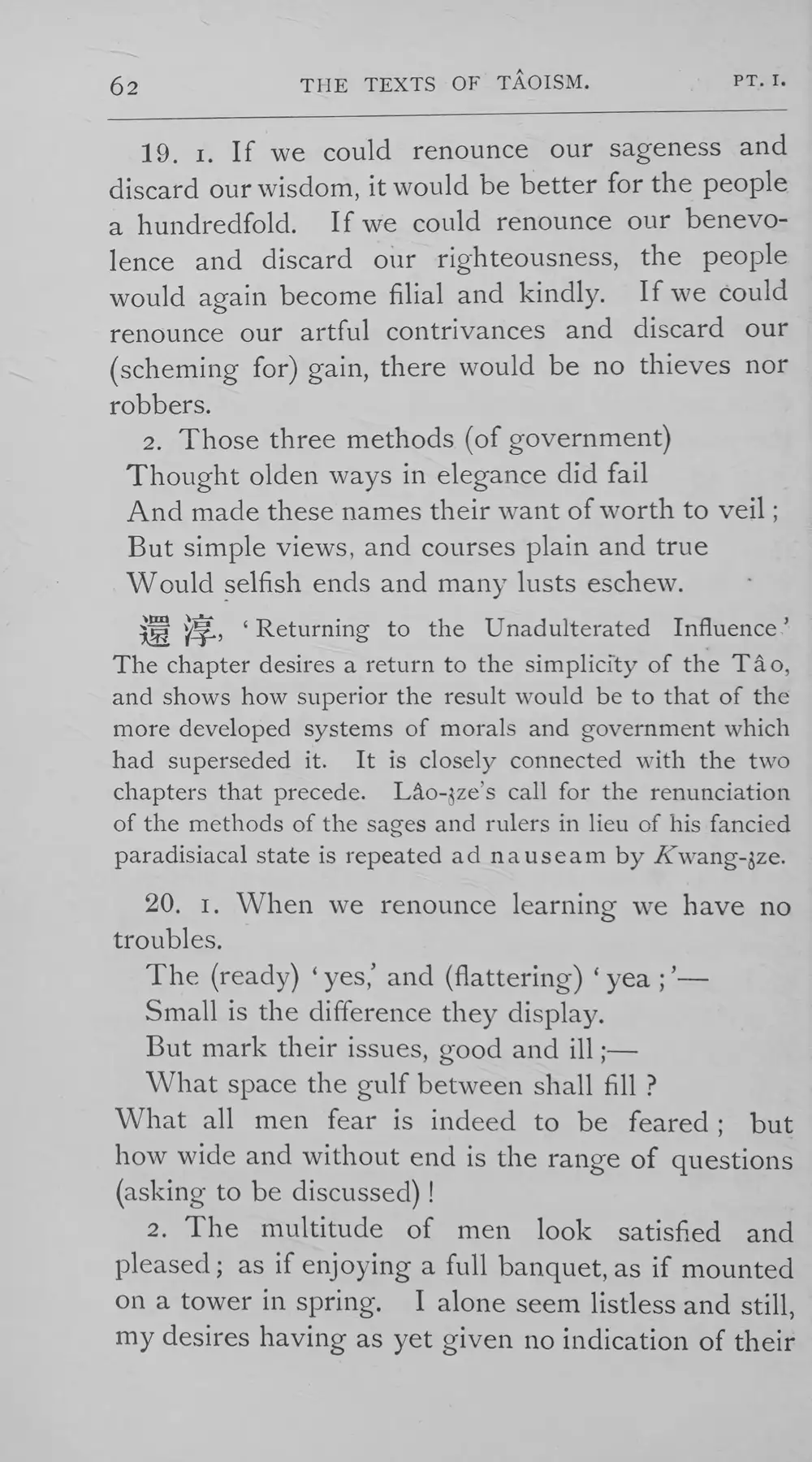
19. 1. If we could renounce our sageness and discard our wisdom, it would be a hundred times better for the people. If we could renounce our benevolence and discard our righteousness, the people would again become filial and kindly. If we could renounce our clever contrivances and discard our (scheming for) gain, there would be no thieves or robbers.
2. Those three methods (of government) thought that the old ways fell short in elegance, and made these names to veil their own lack of worth; but simple views and plain, true courses would shun selfish ends and many desires.
還淳, ‘Returning to the Unadulterated Influence.’ The chapter calls for a return to the simplicity of the Tao, and shows how much better the result would be than that of the more developed systems of morals and government which had superseded it. It is closely connected with the two chapters before it. Lâo-ȝze’s call to renounce the methods of the sages and rulers in favour of his imagined paradisal state is repeated by Kwang-ȝze to the point of tedium.
20. 1. When we give up learning, we have no troubles.
The (ready) ‘yes’ and the (flattering) ‘yea’: how small the difference between them seems! But look at their outcomes, good and ill: how wide is the gulf that lies between! What all men fear is indeed to be feared; but how wide and endless is the range of questions (asking to be discussed)!
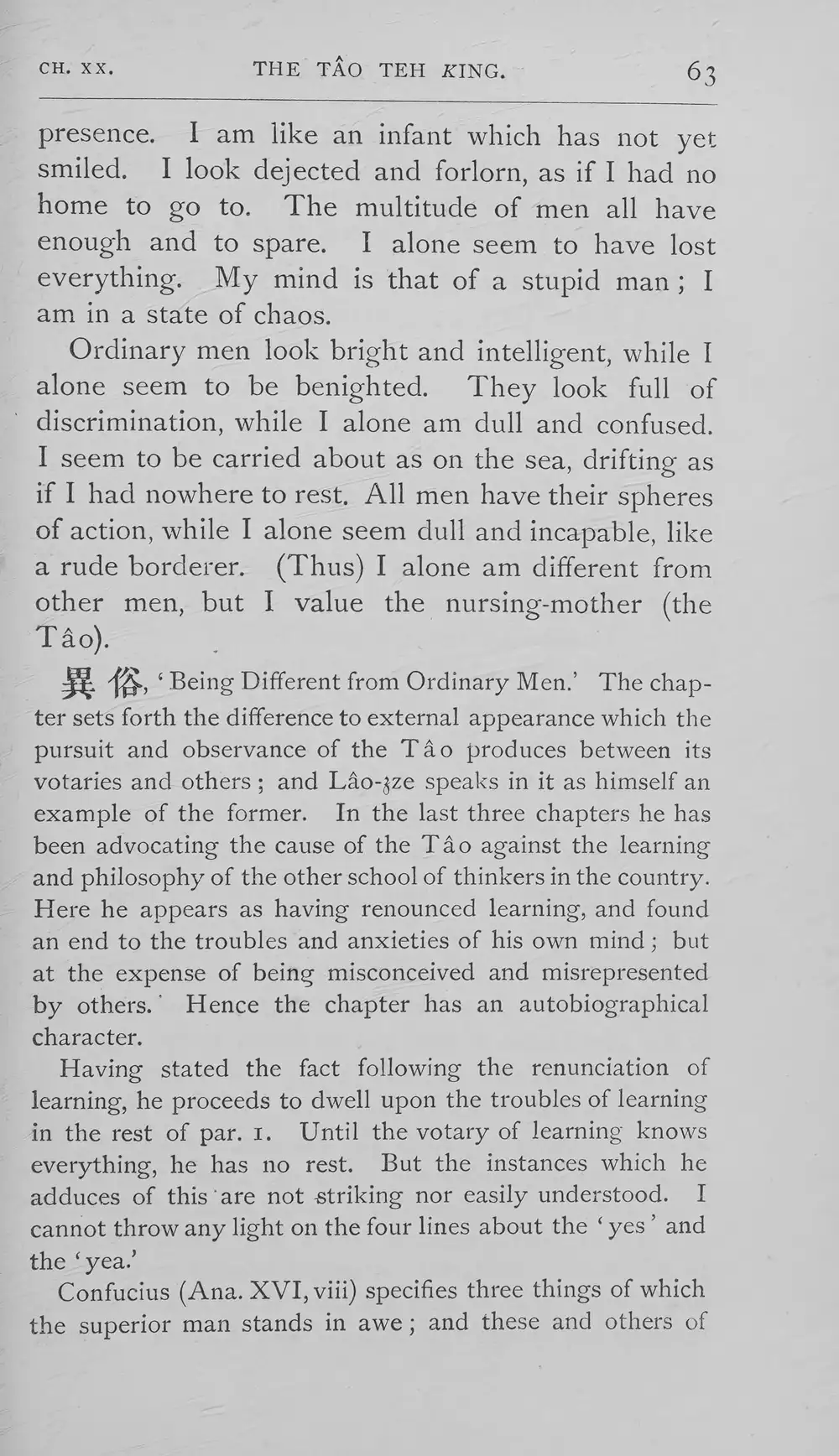
2. The multitude of men look satisfied and pleased, as if enjoying a full banquet, as if they had climbed a tower in spring. I alone seem listless and still, my desires having as yet given no sign of their presence. I am like an infant that has not yet smiled. I look dejected and forlorn, as if I had no home to go to. The multitude of men all have enough and to spare. I alone seem to have lost everything. My mind is that of a stupid man; I am in a state of chaos.