Legge says rendering 德 as ‘virtue’, as Julien and Chalmers do, ‘only serves to hide the meaning’ in this chapter, where it is the Tao in operation. At chapter 38 (p. 81) he concedes it is hard to use any other English word than ‘virtue’. The two notes together show the problem is real: no single English word covers the moral and the operative senses at once.
The Tâo Teh King — Sacred Books of China Part I, SBE Vol. 39 (trans. James Legge, 1891)
Open to all
page 64
No image is selected for this page; its own page image is shown.
page 64
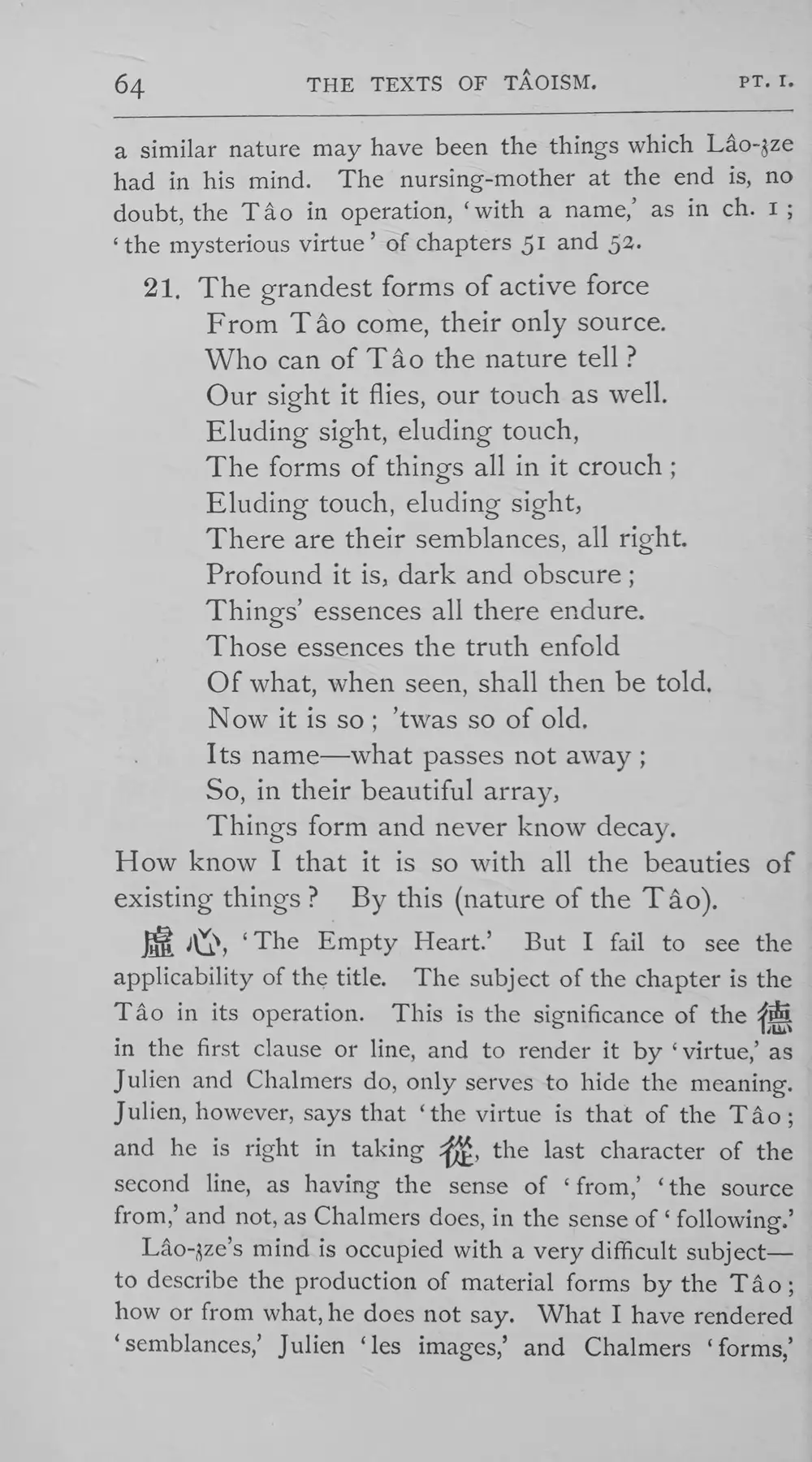
21. The grandest forms of active force come from the Tao, their only source. Who can tell the nature of the Tâo? It escapes our sight, and our touch as well. Eluding sight, eluding touch, the forms of things all lie hidden in it; eluding touch, eluding sight, their semblances are all there, rightly. Profound it is, dark and obscure; the essences of things all endure there. Those essences hold the truth of what, when seen, shall then be told. Now it is so; it was so of old. Its name is what does not pass away; and so, in their beautiful array, things take form and never know decay. How do I know that it is so with all the beauties of existing things? By this (nature of the Tao).
虛心, ‘The Empty Heart.’ But I fail to see how the title applies. The subject of the chapter is the Tâo in its operation. This is the significance of the 德 [Press: virtue, power] in the first clause or line, and to render it by ‘virtue,’ as Julien and Chalmers do, only hides the meaning. Julien, however, says that ‘the virtue is that of the Tâo’; and he is right in taking 從, the last character of the second line, in the sense of ‘from,’ ‘the source from,’ and not, as Chalmers does, in the sense of ‘following.’
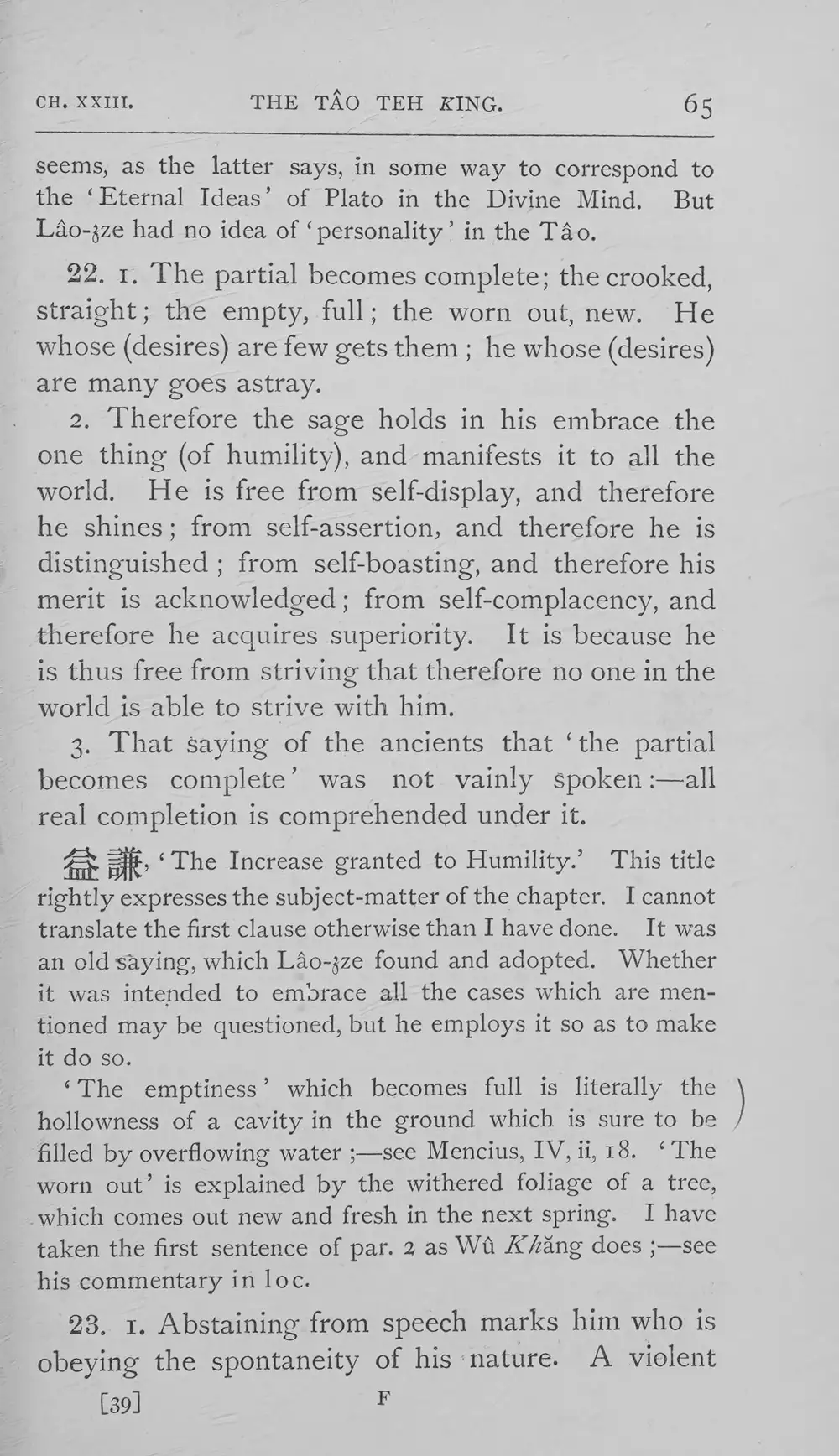
Lâo-ȝze’s mind is occupied with a very difficult subject: describing the production of material forms by the Tâo, though how, or from what, he does not say. What I have rendered ‘semblances’ (Julien ‘les images’, the images; Chalmers ‘forms’) seems, as the latter says, in some way to correspond to the ‘Eternal Ideas’ of Plato in the Divine Mind. But Lâo-ȝze had no idea of ‘personality’ in the Tao.
The comparison Legge relays, that the ‘semblances’ correspond to Plato’s ‘Eternal Ideas … in the Divine Mind’, already carries a later Platonism: setting the Ideas in a divine mind belongs to Plato’s Christian and late-antique readers rather than to Plato. The comparison thus brings in the theism Legge then says Lâo-ȝze lacked. His closing caveat, no ‘personality’ in the Tao, is the safer claim.