Legge reads the officer’s ‘report’ (復命) of a fulfilled charge well, then concludes that things are the Tao’s ‘impassive instruments, having no will or purpose of their own’. The image argues the other way. An officer who receives a commission and reports its execution is an agent who completes a task, not a tool; the chapter says things fulfil their end, which is more than being moved.
The Tâo Teh King — Sacred Books of China Part I, SBE Vol. 39 (trans. James Legge, 1891)
Open to all
page 60
No image is selected for this page; its own page image is shown.
page 60
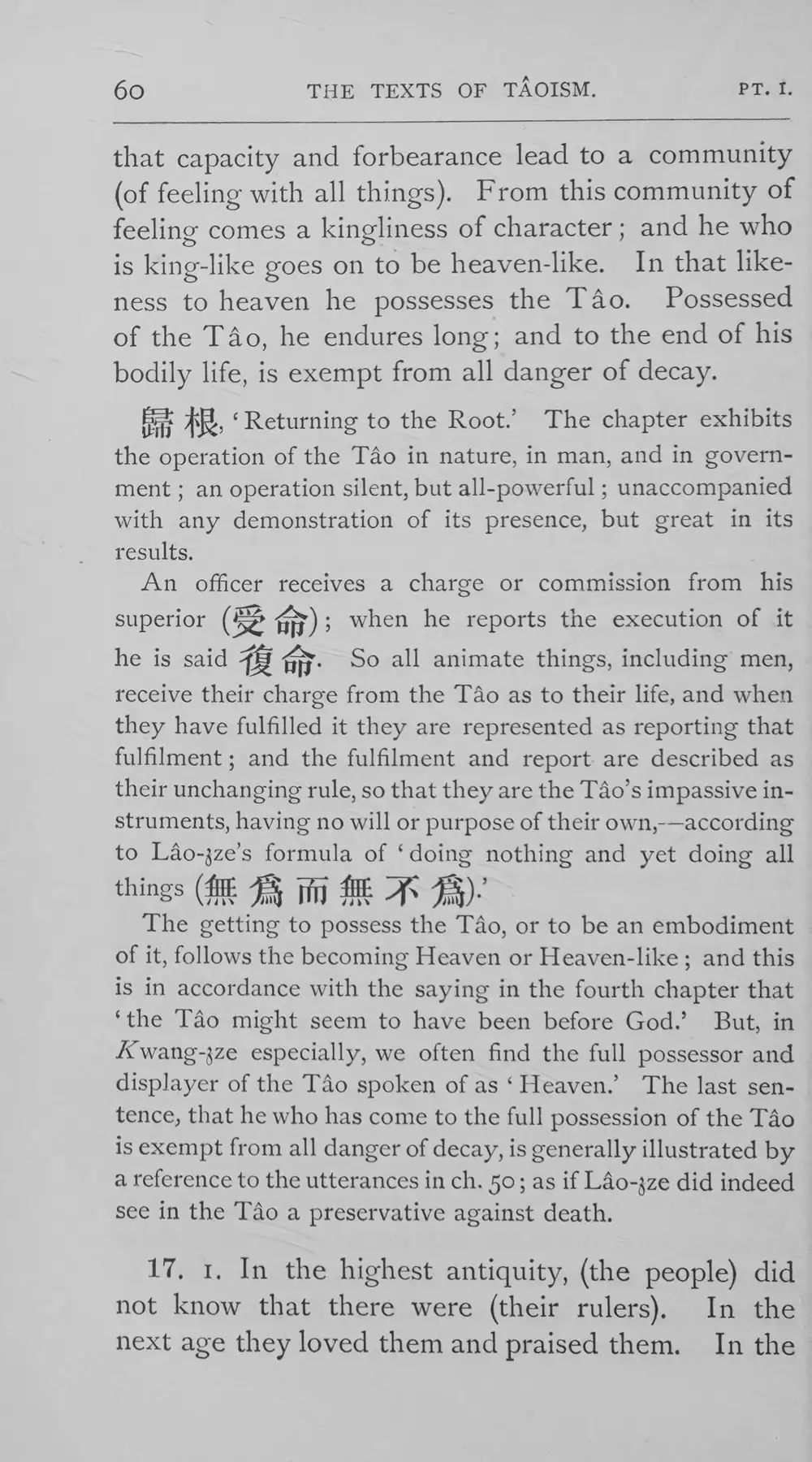
歸根, ‘Returning to the Root.’ The chapter shows the operation of the Tao in nature, in man, and in government: an operation silent but all-powerful, unaccompanied by any display of its presence, but great in its results.
An officer receives a charge or commission from his superior (受命); when he reports having carried it out he is said to 復命. So all living things, men included, receive their charge as to their life from the Tao, and when they have fulfilled it they are represented as reporting that fulfilment; and the fulfilment and the report are described as their unchanging rule, so that they are the Tao’s impassive instruments, with no will or purpose of their own, in keeping with Lâo-ȝze’s formula of ‘doing nothing and yet doing all things (無爲而無不爲).’
Coming to possess the Tao, or to be an embodiment of it, follows on becoming Heaven or Heaven-like; and this accords with the saying in the fourth chapter that ‘the Tao might seem to have been before God.’ But in Kwang-ȝze especially we often find the full possessor and displayer of the Tao spoken of as ‘Heaven.’ The last sentence, that he who has come into full possession of the Tao is exempt from all danger of decay, is generally illustrated by a reference to the sayings in ch. 50, as if Lâo-ȝze did indeed see in the Tao a preservative against death.
17. 1. In the highest antiquity (the people) did not know that there were (rulers over them). In the next age they loved them and praised them. In the next they feared them; in the next they despised them. Thus it was that when faith (in the Tao) was lacking (in the rulers), a lack of faith in them followed (in the people).