Legge glosses the phrase that they made their words ‘valuable or precious’ as ‘they seldom spake’ and points to 1 Sam. iii. 1, where the word of the Lord was precious, meaning rare. The parallel fixes the sense of ‘precious’ neatly. It also shows his frame: he calls the earliest age ‘paradisiacal’ here and again on p. 62, Eden’s vocabulary for an age the text presents as one of rulers the people barely noticed.
The Tâo Teh King — Sacred Books of China Part I, SBE Vol. 39 (trans. James Legge, 1891)
Open to all
page 61
No image is selected for this page; its own page image is shown.
page 61
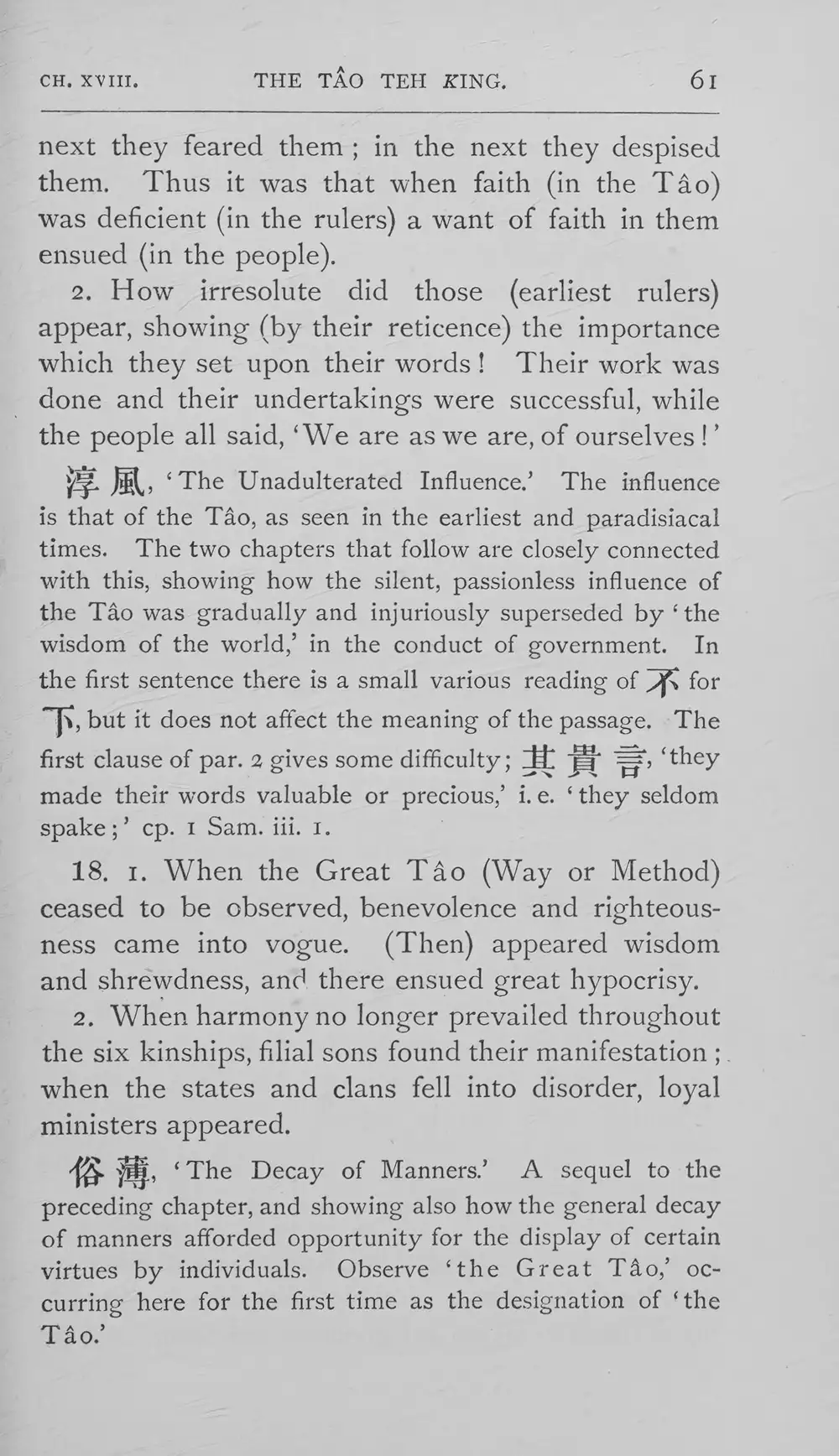
2. How irresolute those (earliest rulers) appeared, showing (by their reticence) the importance they set on their words! Their work was done and their undertakings succeeded, while the people all said, ‘We are as we are, of ourselves!’
淳風, ‘The Unadulterated Influence.’ The influence is that of the Tao, as seen in the earliest and paradisal times. The two chapters that follow are closely connected with this one, showing how the silent, passionless influence of the Tao was gradually and harmfully superseded by ‘the wisdom of the world’ in the conduct of government. In the first sentence there is a small variant reading of 不 [Press: not] for 下 [Press: below, beneath], but it does not affect the meaning of the passage. The first clause of par. 2 gives some difficulty; 其貴言, ‘they made their words valuable or precious,’ i.e. ‘they seldom spoke’; compare 1 Sam. iii. 1.
18. 1. When the Great Tao (Way or Method) ceased to be observed, benevolence and righteousness came into fashion. (Then) wisdom and shrewdness appeared, and great hypocrisy followed.
2. When harmony no longer prevailed among the six kinships, filial sons made their appearance; when the states and clans fell into disorder, loyal ministers appeared.
俗薄, ‘The Decay of Manners.’ A sequel to the preceding chapter, also showing how the general decay of manners gave individuals the opportunity to display certain virtues. Notice ‘the Great Tao,’ occurring here for the first time as the designation of ‘the Tao.’