Legge writes ‘I cannot throw any light’ on the lines about the ‘yes’ and the ‘yea’. Yet his rhymed version on the previous page already interprets them, supplying ‘(ready)’ and ‘(flattering)’, which makes the couplet a contrast between frank and obsequious assent. The note disclaims an understanding the translation has quietly adopted.
The Tâo Teh King — Sacred Books of China Part I, SBE Vol. 39 (trans. James Legge, 1891)
Open to all
page 63
No image is selected for this page; its own page image is shown.
page 63
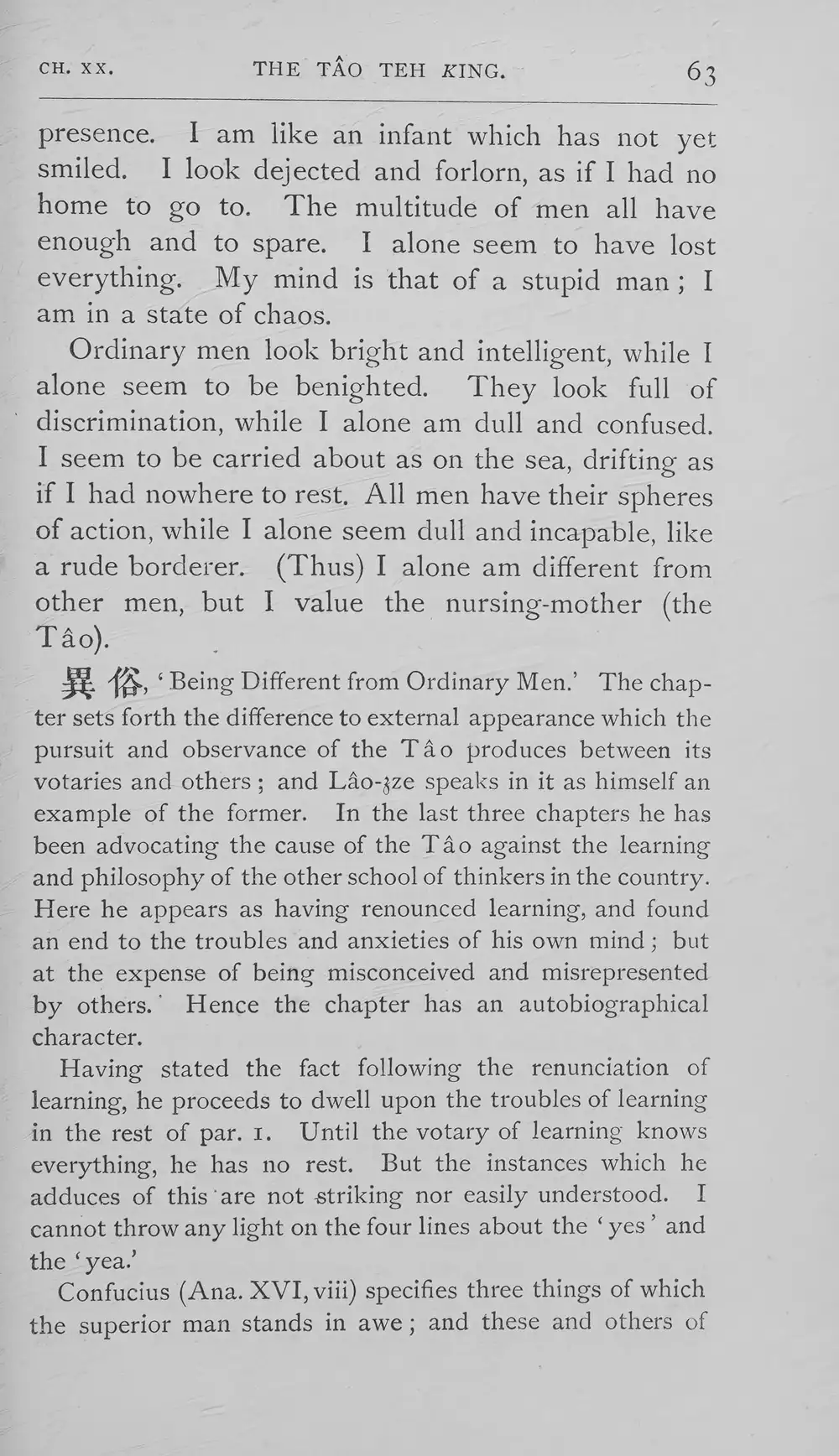
Ordinary men look bright and intelligent, while I alone seem benighted. They look full of discernment, while I alone am dull and confused. I seem to be carried about as on the sea, drifting as if I had nowhere to rest. All men have their spheres of action, while I alone seem dull and incapable, like a rough borderer. (Thus) I alone am different from other men, but I value the nursing-mother (the
T Ao).
異俗, ‘Being Different from Ordinary Men.’ The chapter sets out the difference in outward appearance that the pursuit and observance of the Tao produces between its devotees and others; and Lâo-ȝze speaks in it as himself an example of the former. In the last three chapters he has been pleading the cause of the Tao against the learning and philosophy of the country’s other school of thinkers. Here he appears as one who has renounced learning and found an end to the troubles and anxieties of his own mind, but at the cost of being misunderstood and misrepresented by others. Hence the chapter has an autobiographical character.
Having stated the fact that follows the renunciation of learning, he goes on in the rest of par. 1 to dwell on the troubles of learning. Until the devotee of learning knows everything, he has no rest. But the instances he gives of this are neither striking nor easily understood. I cannot throw any light on the four lines about the ‘yes’ and the ‘yea.’
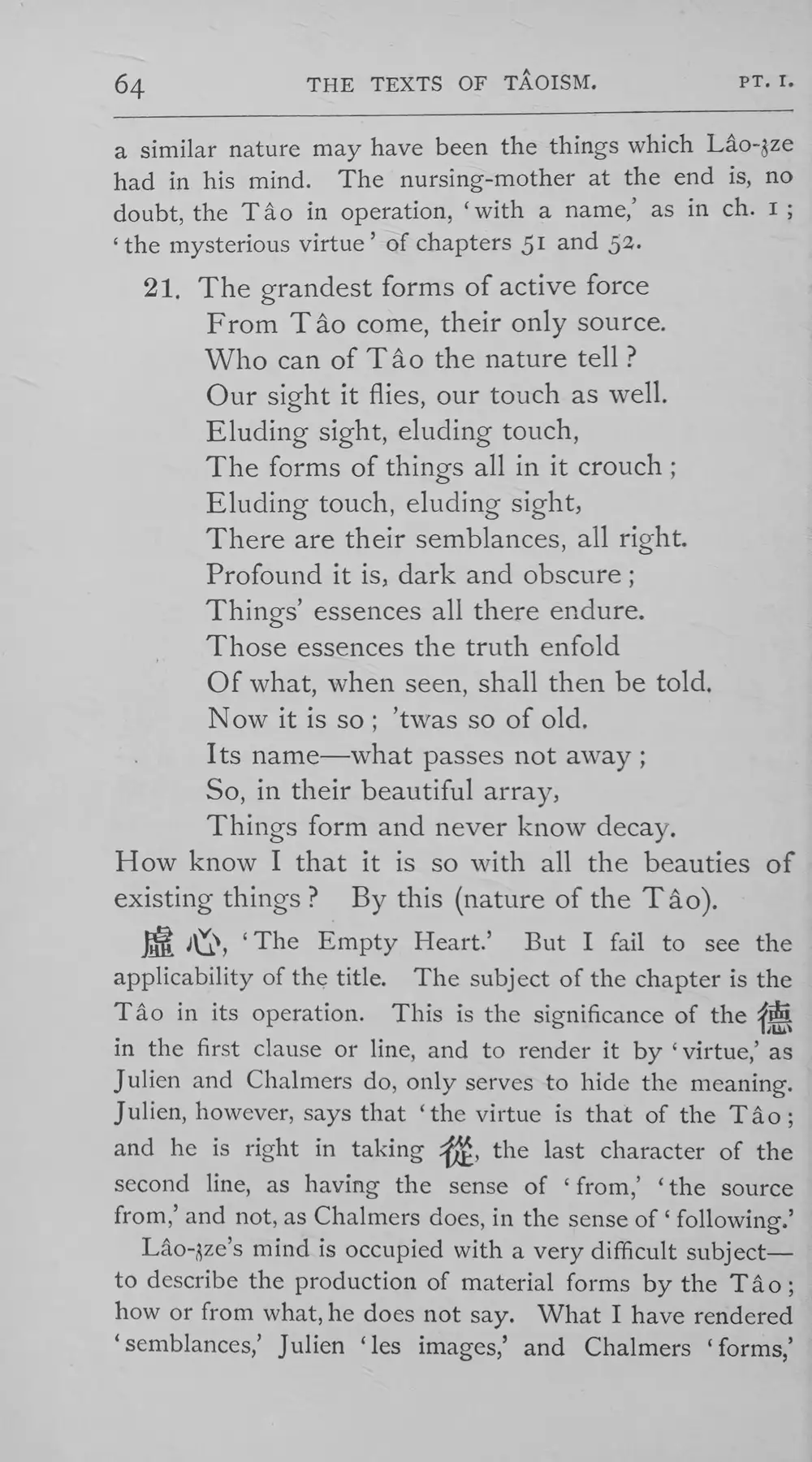
Confucius (Ana. XVI, viii) specifies three things of which the superior man stands in awe; and these and others of a similar nature may have been the things which Lâo-ȝze had in his mind. The nursing-mother at the end is, no doubt, the Tâo in operation, ‘with a name’, as in ch. 1; ‘the mysterious virtue’ of chapters 51 and 52.