La Iniciación: Mensuario del Grupo Independiente de Estudios Esotéricos
The Initiation: Monthly of the Independent Group of Esoteric Studies
La Iniciación · Año V, Nº 47 · March 1946
Gate passedSeeker and aboveModern transcription — not a facsimileGIDEE / Orden Martinista de América del SurOperator ruling: no copyright implications asserted for this work. Uruguay life+50 (Leo d. 1970 → PD 2020); US URAA restoration assessed at ~2041 in the collection plan and overridden by the operator.362 of 362 segments translated · 23 ppsha 38963b0984e2…
primary
derivedpage 21
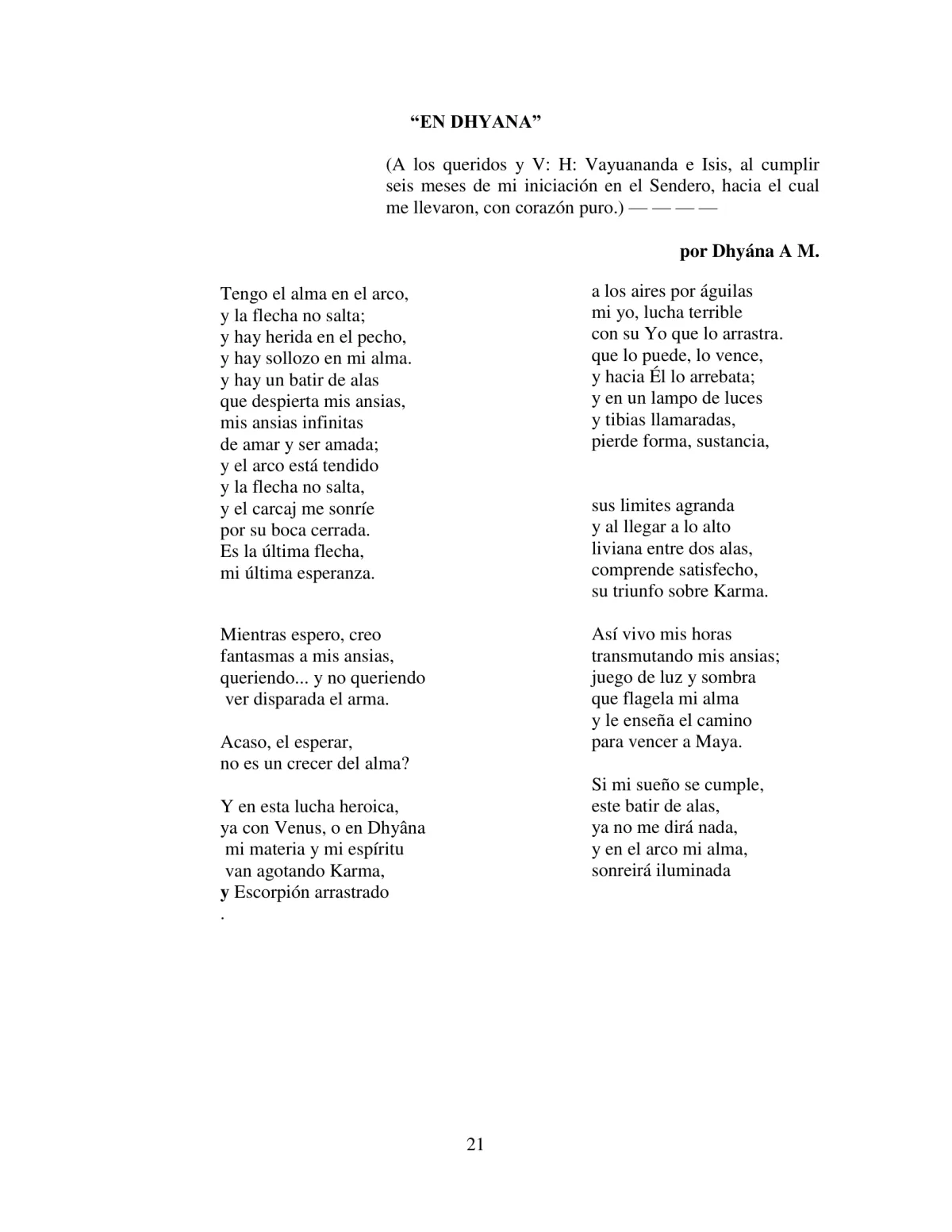
121 ―IN DHYANA‖ (To the beloved V: H: Vayuananda and Isis, on completing six months since my initiation into the Path, toward which they led me, with pure heart.) — — — — by Dhyána A M. My soul is in the bow, and the arrow does not leap; and there is a wound in the breast, and there is sobbing in my soul. and there is a beating of wings that awakens my longings, my infinite longings to love and be loved; and the bow is drawn and the arrow does not leap, and the quiver smiles at me with its closed mouth.
2It is the last arrow, my last hope.
3While I wait, I make phantoms of my longings, wishing... and not wishing to see the weapon loosed.
4Is not waiting, perhaps, a growing of the soul?
5And in this heroic struggle, now with Venus, now in Dhyâna, my matter and my spirit go on exhausting Karma, and Scorpion borne into the air by eagles, my “i”, struggles terribly with its “I” that draws it upward. that masters it, conquers it, and toward Itself sweeps it away; and in a flash of lights and warm flarings, it loses form, substance, enlarges its limits, and on reaching the height, weightless between two wings, understands, satisfied, its triumph over Karma.
6Thus I live my hours transmuting my longings; a play of light and shadow that scourges my soul and teaches it the way to conquer Maya.
7If my dream is fulfilled, this beating of wings will tell me nothing more, and in the bow my soul will smile, illumined .
Our translation, period-faithful. Citable as our translation, never as the source.
Commentarywhole issue ·
Historical[P-V]ini:5.47:1:003
Nº 47 closes the run's fifth year with the sunburst cover unchanged since the redesign. The issue is dominated by a single work: Hipatía's twelve-page memorial monograph on Saint-Yves d'Alveydre, the longest single study of a European occultist the review had yet printed.
Historical[P-V]ini:5.47:2:001
The inside cover is entirely reset this month. The long roster of pseudonymous collaborators with their degree-strings (SEVAKA, JEHEL, ASURI KAPILA…) that had run since the early volumes is replaced by a single collective formula — 'Instructors and Brothers of Orders' — and the page now leads with a currency notice: Uruguayan banks were taking a full gold peso in commission on foreign remittances, and the overseas price rises from 1.20 to 1.80 dollars. A small window onto the postwar exchange-control economy as experienced by a Montevideo esoteric monthly.
Historical[P-V]ini:5.47:3:001
The SUMARIO shows the issue's proportions: the Saint-Yves memorial fills pages 3–14, Guénon's Demiurge serial and the chromotherapy course share the scientific section, and the literary pages carry a visit to the poet Ángel Falco and a member's initiation-anniversary poem.
Historical[P-V]ini:5.47:4:001
The monograph was read at 'Papus Centre N. 5' on 5 February 1946 — the thirty-seventh anniversary, to the day, of Saint-Yves d'Alveydre's death at Versailles on 5 February 1909. The Montevideo group kept the French Martinist commemorative calendar: Papus had venerated Saint-Yves as his 'intellectual master', and the centre named for Papus honoured the master of its namesake.
Historical[P-V]ini:5.47:4:013
The biographical frame is accurate: Joseph Alexandre Saint-Yves was born in Paris on 26 March 1842 (the lecture says the 28th — sources differ on the day), son of Guillaume-Alexandre Saint-Yves, a physician of the asylum world ('alienist' is the period term for psychiatrist). The hour of birth is given because the whole monograph is structured as a horoscope reading — each life-period opens with the astrological configuration said to govern it.
Historical[P-V]ini:5.47:5:003
'De Metz' is Frédéric-Auguste Demetz (1796–1873), the reforming magistrate who founded the agricultural penal colony of Mettray near Tours in 1839 — a famous experiment in redemptive rather than punitive detention. Saint-Yves was sent there as an unruly adolescent, and his own later writings credit Demetz exactly as the lecture does: the man who turned obedience from subjection into assent. The motto quoted — 'Everything for liberty, nothing by obligation' — is the germ the lecture finds in his whole social doctrine.
Historical[P-V]ini:5.47:6:014
The intellectual genealogy given here is the standard French esoteric lineage: Court de Gébelin's 'synthetic school' of the late eighteenth century, transmitted through Antoine Fabre d'Olivet (1767–1825), whose 'La Langue hébraïque restituée' and 'Histoire philosophique du genre humain' furnished Saint-Yves with both his linguistic method and his panoramic view of civilisations. The lecture is candid about the debt — 'Fabre d'Olivet gave the material for the work' — a debt Saint-Yves himself was slower to acknowledge.
Cross-estate[P-V]documentsini:5.47:21:001
The dedication names Vayuananda — the lodge-name of the teacher whose course materials survive in this estate as the Vayu corpus. The poem is dated evidence of his initiating activity in the Montevideo group in late 1945–early 1946.
→ vayu
Cross-estate[P-V]parallelsini:5.47:6:014
The lineage traced here — Court de Gébelin → Fabre d'Olivet → Saint-Yves — is the second great French filiation beside the one this review had studied in Nº 41: Martinez de Pasqually → Saint-Martin. The two streams meet in Papus, who claimed both the Martinist succession and Saint-Yves' synarchic teaching, and whose order the Montevideo group continued.
→ thread:stmartin_tableau_naturel
Historical[P-V]ini:5.47:7:020
The early titles are real: 'Les Clefs de l'Orient' (1877) and the youthful poetry preceded the Missions. The 1870 episode — rushing back from Jersey to serve in the Franco-Prussian war — and the deaths of his mother, brother and Demetz in the 1870s are drawn from the memorial tradition established by his disciples' obituaries.
Historical[P-V]ini:5.47:8:012
The Countess of Keller was Marie-Victoire de Riznitch (1827–1895), widow of Count de Keller, whom Saint-Yves married in 1877; her fortune and connections made the Missions possible, and after her death he called her 'the angel of the Archeometer'. The statement that she was 'the morganatic widow of Tsar Alexander II' belongs to the hagiographic legend, not to the record — Alexander II's morganatic wife was Catherine Dolgorukova. The lecture transmits the tradition as the Martinist circle received it.
Historical[P-V]ini:5.47:9:001
The bibliography with dates is exact: Mission des Souverains (1882), Mission des Ouvriers (1882), Mission des Juifs (1884), La France vraie (1887), Jeanne d'Arc victorieuse (1890, given here as 1889). The footnote apparatus on this page — the numbered opuscules and royal poems — reproduces the lecture's own scholarly notes, a rarity in the review's pages.
Comparative[P-V]ini:5.47:10:009
At this point the lecturer steps beyond Saint-Yves: 'going even further, we would say' — the synarchy of humanity requires the synarchy of each man, the trinitarian law applied inside the triple constitution of body, soul and spirit. This inward turn — reading a social doctrine as a discipline of the person — is the review's characteristic move, the same one it performs on astrology, colour and number throughout the run.
Historical[P-V]ini:5.47:11:010
The Agartha episode: after the Mission des Juifs appeared, Saint-Yves received Sanskrit lessons in 1885–86 from a teacher he called Hardjji Scharipf, from whom the Agartha and Vattan material derives. The 'Mission de l'Inde' was printed in 1886 and immediately destroyed by its author — one copy survived, and the book only appeared posthumously in 1910. The lecture's account — 'withdrawn at once, fearing to compromise his Guru' — is Saint-Yves' own stated reason.
Historical[P-V]ini:5.47:12:017
'La Théogonie des Patriarches' and 'L'Archéomètre' were both posthumous, assembled by the 'Amis de Saint-Yves' — the circle around Papus — and published in 1909–1911. The Archeometer itself, the circular 'measure of the principle' correlating alphabets, planets, zodiac, colours, notes and numbers, became the master-diagram of French occult correspondence-science; the review's own colour and astrology courses stand in its shadow.
Historical[P-V]ini:5.47:13:011
The seaweed venture is genuine biography: in the 1880s Saint-Yves took patents on some twenty industrial applications of marine algae ('goémon'), hoping to fund the synarchic programme by production rather than patronage. The maxim quoted — 'utility is the last word of wisdom' — is his; the lecture makes it the bridge from the Missions to the applied Archeometer.
Historical[P-V]ini:5.47:14:003
Saint-Yves died at Versailles on 5 February 1909; the tomb 'built according to the living key of the Archeometer' stands in the Gonards cemetery. The closing invocation to IEVE-IESUS — the archeometric name of the Word — turns the lecture into liturgy: the Centre's commemoration ends by praying the prayer with which Saint-Yves closed his own Mission.
Historical[P-V]ini:5.47:15:001
'Palingenius' is René Guénon (1886–1951): 'El Demiurgo' is a Spanish rendering of 'Le Démiurge', Guénon's first published essay, which opened the journal La Gnose in November 1909 under that pen-name. The review is serialising, in 1946 Montevideo, the debut text of the century's most influential traditionalist — the kabbalistic frame (Adam Kadmon, Nahash, the tunic of skin) is Guénon's own.
Comparative[P-V]ini:5.47:16:004
Guénon's image of the Demiurge as a 'tenebrous and inverted reflection' — the two opposed triangles of the Seal of Solomon, the two old men of the Zohar — restates the review's constant teaching that evil has no substance of its own: separation is real only in the measure we realise it. Compare the Demiurge sections in the preceding instalments, where the same argument was built from the distinction of Good and Evil.
Historical[P-V]ini:5.47:17:007
The chromotherapy serial resumes with its experimental dossier: plant germination under coloured light, Henri Mager's coloured dowsing-rods ('radiotellurists' is the period word for dowsers reading earth-currents), and the astrological correspondence of iron, red and Mars offered as confirmation — the review's signature braid of laboratory report and hermetic doctrine.
Historical[P-V]ini:5.47:18:008
The authorities cited are real and datable: the battleship Liberté exploded at Toulon on 25 September 1911, and Regnault's blue-walled wards at Saint-Mandrier hospital are reported in the medical press of the time; Albert Abrams (1863–1924) is the San Francisco physician whose 'Electronic Reactions' founded radionics; Giuseppe Calligaris (1876–1944) held a chair in Rome and published 'Le meraviglie dell'eteroscopia' (1934) on his skin-plaque experiments. The review reproduces their claims without distance — eteroscopia promised exactly the trained clairvoyance the esoteric curriculum sought.
Cross-estate[P-V]parallelsini:5.47:19:004
The twenty-point synthesis maps colour onto the three-body constitution — physical, astral, mental, each with its own colours acting in resonance or dissonance with the 'personal vibration'. This is the same colour-vibration physics that structures the Hermetic teaching of The Light of Egypt, where colour, planet and soul-state form one continuous scale.
→ thread:light_of_egypt_v1
Historical[P-V]ini:5.47:20:001
Ángel Falco (1885–1971) was a celebrated Uruguayan poet — famous young for revolutionary verse ('Cantos rojos', 1906), later a diplomat and, as this visit records, a spiritual seeker. Maya's portrait of him as 'a new Zarathustra' descending with the message of the Idea documents the review's traffic with the national literary world, not only with the lodges.
Historical[P-V]ini:5.47:21:001
A member's poem marking six months since initiation, dedicated to the 'V∴ H∴' (Venerable Brothers) Vayuananda and Isis who brought her to the Path. The imagery — the drawn bow whose arrow will not leap, the little 'i' wrestled upward by the 'I', Scorpio borne aloft by eagles — versifies the review's yoga of transmutation in a personal register: the run's community writing its own inner history.
Historical[P-V]ini:5.47:22:001
The G∴E∴I∴D∴E∴ plate continues with Sister UPASIKA's course on 'the doctrine of the Buddha' still on the roster — the curriculum's eastward expansion, first seen in Nº 45, holds steady alongside Kabbalah, alchemy and judicial astrology.
Historical[P-V]ini:5.47:23:001
The back cover's two lists mark the group's publishing reach through Buenos Aires houses: the Martinist Library at Publicidad 'Ateneo' now carries four titles with Schuré's 'The Divine Evolution' added, and the Kabbalistic Rose Cross library at Editorial Kier pairs Sevaka's own novel with Sédir and Franz Hartmann — the local circle selling itself beside the European canon.