October 1945; the last surviving number of Year IV.
→ ini:4.41
Fetching
One moment.
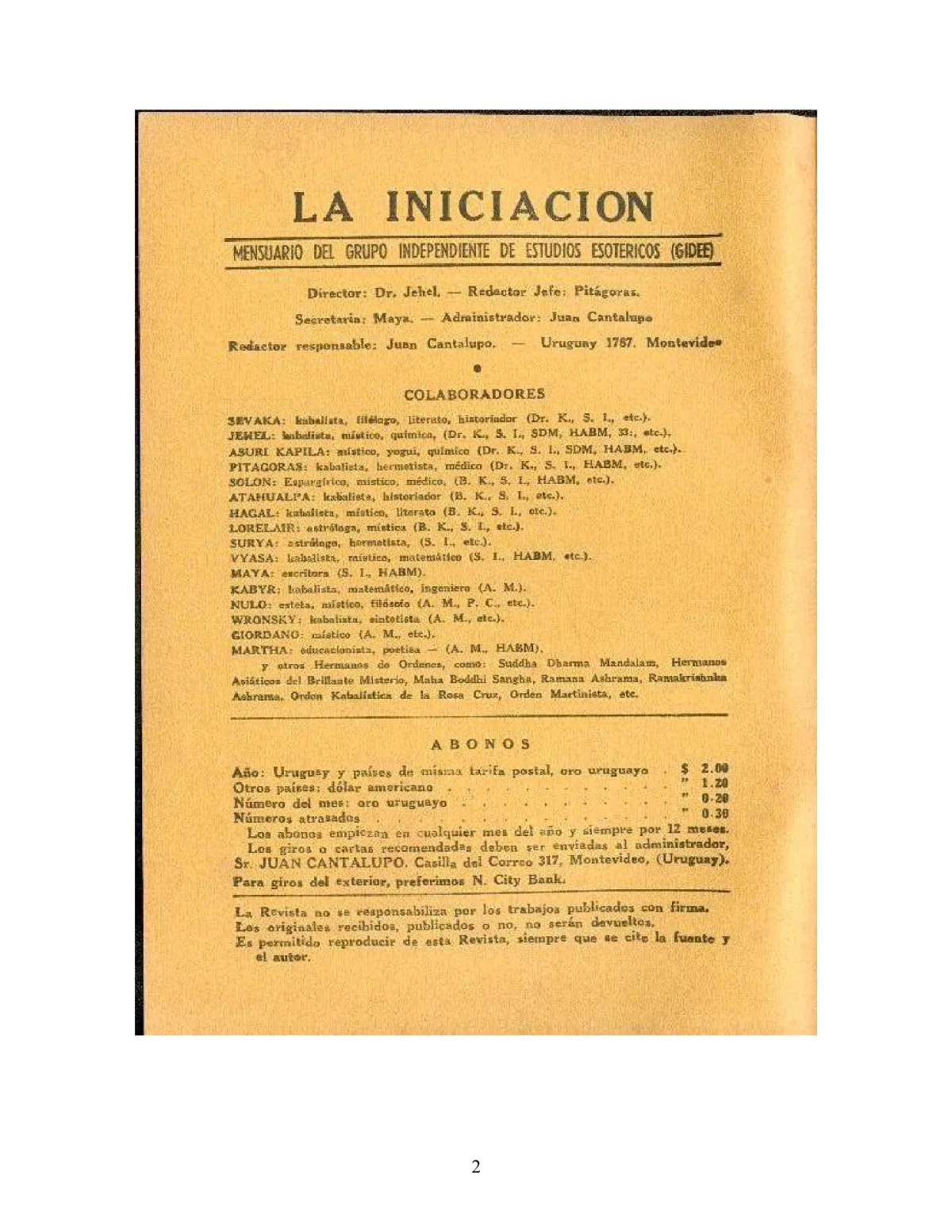
1LA INICIACIÓN — MONTHLY OF THE INDEPENDENT GROUP OF ESOTERIC STUDIES (GIDEE)
2Director: Dr. Jehel. — Chief Editor: Pitágoras. Secretary: Maya. — Administrator: Juan Cantalupo. Responsible editor: Juan Cantalupo. — Uruguay 1787, Montevideo
3CONTRIBUTORS
4SEVAKA: kabbalist, philologist, man of letters, historian (Dr. K., S∴I∴, etc.).
5JEHEL: kabbalist, mystic, chemist, (Dr. K., S∴I∴, SDM, HABM, 33:, etc.).
6ASURI KAPILA: mystic, yogi, chemist (Dr. K., S∴I∴, SDM, HABM, etc.).
7PITAGORAS: kabbalist, hermetist, physician (Dr. K., S∴I∴, HABM, etc.).
8SOLON: Spagyrist, mystic, physician, (B. K., S∴I∴, HABM, etc.).
9ATAHUALPA: kabbalist, historian (B. K., S∴I∴, etc.).
10HAGAL: kabbalist, mystic, man of letters (B. K., S∴I∴, etc.).
11LORELAIR: astrologer, mystic (B. K., S∴I∴, etc.).
12SURYA: astrologer, hermetist, (S∴I∴, etc.).
13VYASA: kabbalist, mystic, mathematician (S∴I∴, HABM, etc.).
14MAYA: writer (S∴I∴, HABM).
15KABYR: kabbalist, mathematician, engineer (A. M.).
16NULO: aesthete, mystic, philosopher (A. M., P. C., etc.).
17WRONSKY: kabbalist, synthesist (A. M., etc.).
18GIORDANO: mystic (A. M., etc.).
19MARTHA: educationist, poetess — (A. M., HABM),
20and other Brothers of Orders, such as: Suddha Dharma Mandalam, Asiatic Brothers of the Brilliant Mystery, Maha Boddhi Sangha, Ramana Ashrama, Ramakrishnka Ashrama [Sic: printed Ramakrishnka, for Ramakrishna], Kabbalistic Order of the Rose Cross, Martinist Order, etc.
21SUBSCRIPTIONS — Year: Uruguay and countries of the same postal tariff, Uruguayan gold $ 2.00. Other countries: American dollar » 1.20. Current month’s number: Uruguayan gold » 0.20. Back numbers » 0.30.
22Subscriptions begin in any month of the year and always run for 12 months. Money orders or registered letters must be sent to the administrator, Mr. JUAN CANTALUPO, Casilla del Correo 317, Montevideo, (Uruguay).
23For remittances from abroad, we prefer N. City Bank.
24The Review takes no responsibility for signed contributions. Originals received, whether published or not, will not be returned. Reproduction from this Review is permitted, provided the source and the author are cited.
Our translation, period-faithful. Citable as our translation, never as the source.
October 1945; the last surviving number of Year IV.
→ ini:4.41
Masthead stereotype unchanged.
Six articles; Lorelair returns to open the number with her prophecy's reckoning.
The forecast scored: Lorelair's June 1944 prediction — peace visible only "from the end of September to October of this year onward" — is recalled and claimed, the war having ended in August-September 1945. The Nº 29 loading already carries the forward edge to this article; here is its landing. The SUMARIO drops Neptune from her title; the article restores it.
→ ini:3.29:4:004
The article's injunction after victory: "Nor must he permit feelings of defeat or of victory. Only one word must reign: PEACE!" — the review's first postwar number setting reconciliation as practice, closing on "Love one another".
The SUN through the twelve houses — the fourth planet of the reference series; the sixth house named its worst seat, the tenth its surest.
The twelfth house's close: the Sun there "also inclines toward occultism" — the series' habit of ending each planet on the esoteric register.
"Desire" closes on the four powers: TO WILL TO KNOW, TO WILL TO KEEP SILENT, TO WILL TO DARE, TO WILL TO WILL — the Sphinx's to-know/to-dare/to-will/to-keep-silent recast with QUERER as the operator; Mabel Collins's "Light on the Path" quoted; signed only "La Plata".
The Astral Plane page's meditation text — "The Initiator is not a human Being, and the Path is the perfect way of living" — with its two purifying practices in capitals; the praxis layer carries the passage.
The Gita Bashya synthesis resumes: the three invocation verses, Krishna and Arjuna as members of the Spiritual Hierarchy, and AHAMSA — "I AM THAT" — as the Prachina Hamsas' office.
→ ini:4.41
Why does Vyasa visit the blind King? Compassion for his son, and the Master's duty — the introduction's narrative frame treated as initiation-doctrine: the King as the disciple who cannot yet be taken directly.
The three discipleship grades return with their full Sanskrit apparatus (Jnana Dipa, Viveka, Vairagya, Tapas) and Arjuna's "I am THY disciple. Save me, O Lord" — the number's central practice text, carried by the praxis layer.
Sanjaya's tutorship of the King — Aparaprakriti and Paraprakriti, the Gayatri as the key, the war as "an incident already foreseen" — the S.D.M.'s Gita reading turning the epic's frame-story into a manual of spiritual direction.
The unsigned coda states the three aims of Yoga — know Brahman, know the purpose of individual existence, co-operate in the divine plan — the tidiest summary of the Mandalam's programme the run has printed.
Jollivet Castelot arrives: Papus's collaborator, President of the Alchemical Society of France, translated from Le Voile d'Isis (April 1925) with a full editorial biography — Hyperchimie, Le Rose Croix, La synthèse de l'or. The estate's French-occult shelf gains its chemistry wing; the run's alchemy coverage now has an author with a laboratory.
→ martinez-de-pasqually
Becquerel's physics folded back into Hermes: "present-day science returns to the ancient doctrine of the hermetists… the Grand Man of the Kabbalah" — Castelot's standing move, and the reason the review adopted him.
Castelot's polemical voice survives translation intact: "My God, how clear all this is! And yet, when one of these gentlemen sees white, another sees black" — the alchemist mocking the physicists' confusion over disintegration, 1925.
The hermetist atom: structure as masculine-feminine affinity, "the primordial and absolutely universal law" — set beside Thomson and Rutherford as an equal hypothesis; atoms and stars under identical laws.
The five recipes for gold — thallium minus one alpha, lead minus two alphas and a beta — Rutherford's transmutation results rewritten as alchemical recipes, then dismissed for their "deplorable" yield in favour of the chemical way.
The Lestrade letter, Lyon, 28 November 1924: 125 grammes of virgin silver, orpiment and kermes, the furnace at 1150/1200º, and an assayer's verdict of unweighable traces "approximately 1/4 of a gramme" — the run's most detailed laboratory protocol, printed as testimony.
The Appeal to the Young Chemists: distrust "fashionable theories, algebrism à outrance and the magister dixit… The future of Chemistry is not confined, thank God, to the laboratories of the Sorbonne" — Castelot's manifesto closing the last surviving number of Year IV.
Castelot's critique of infinite divisibility — "the ion and the electron: might they not correspond rather to vital manifestations… of the atomic being?" — hylozoism offered as physics; the era's occult-scientific frontier in one question.
GIDEE prospectus stereotype at page 23.
→ ini:3.30
Library back cover and imprint close Year IV's surviving run.