Legge gives the ‘I’ of par. 3 to a prince or king speaking in the first person, ‘unless’ it is Lâo-ȝze personating one. In chapter 20 (p. 63) he took the ‘I’ as the author himself and called the chapter autobiographical. The King’s first person is the same in both places; Legge decides its speaker by context each time, and the reader should know the attribution is his.
The Tâo Teh King — Sacred Books of China Part I, SBE Vol. 39 (trans. James Legge, 1891)
Open to all
page 79
No image is selected for this page; its own page image is shown.
page 79
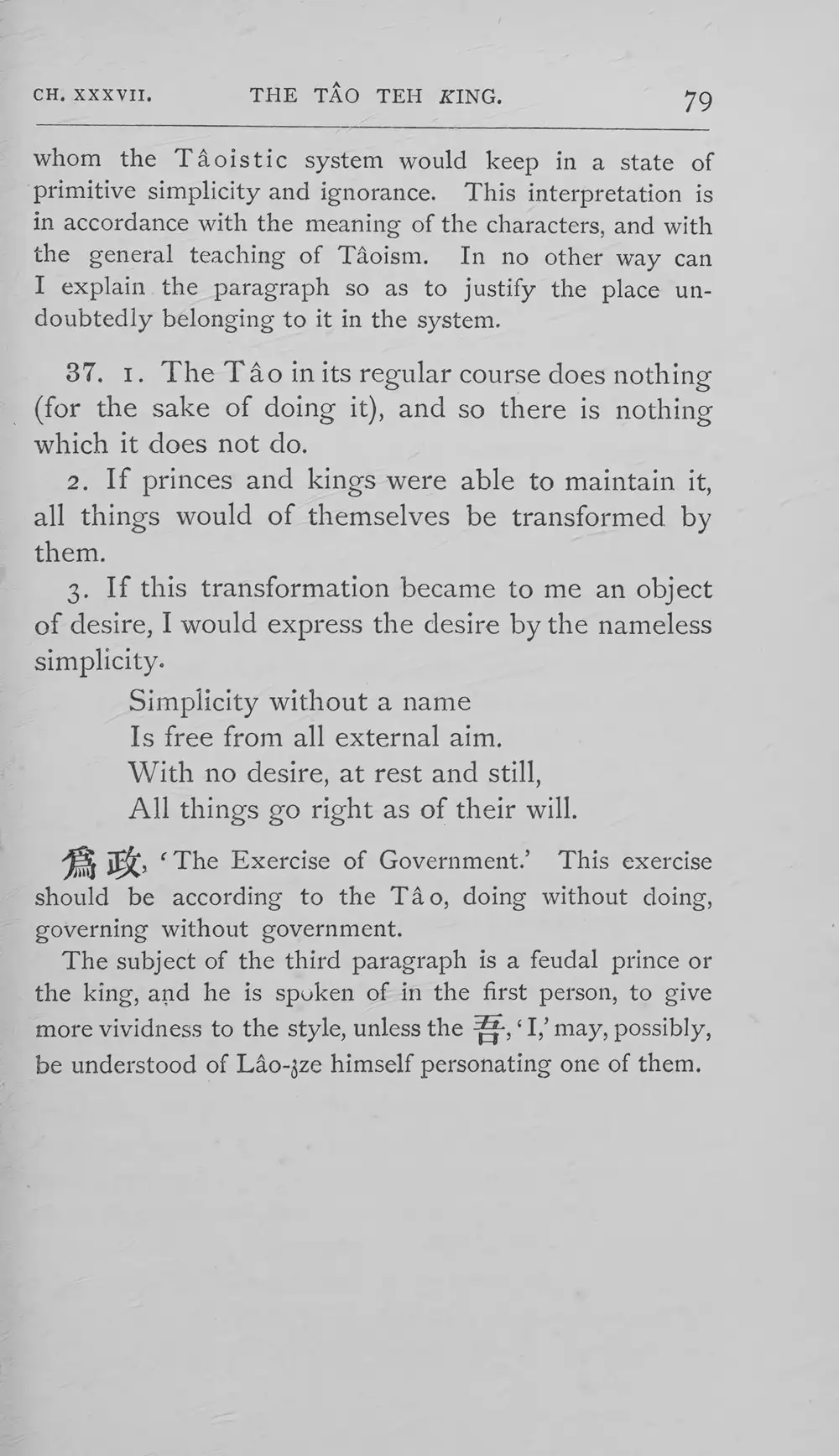
37. 1. The Tâo in its regular course does nothing (for the sake of doing it), and so there is nothing it does not do.
2. If princes and kings were able to maintain it, all things would be transformed by them of their own accord.
3. If this transformation became an object of desire to me, I would express the desire through the nameless simplicity.
Simplicity without a name is free from every outward aim. With no desire, at rest and still, all things go right as if of their own will.
爲政, ‘The Exercise of Government.’ It should be exercised according to the Tao: doing without doing, governing without government.
The subject of the third paragraph is a feudal prince or the king, and he is spoken of in the first person to give the style more vividness, unless the 吾, ‘I,’ may possibly be understood of Lâo-ȝze himself, impersonating one of them.