Legge sets out two constructions of 天下往, the world coming to the holder of the Great Image, or the holder going through the world teaching the Tao, and calls both defended by good commentators. His translation silently takes the first. Since the chapter’s next sentence has men resorting to him, the first fits the context better, but the alternative should not vanish from the English.
The Tâo Teh King — Sacred Books of China Part I, SBE Vol. 39 (trans. James Legge, 1891)
Open to all
page 77
No image is selected for this page; its own page image is shown.
page 77
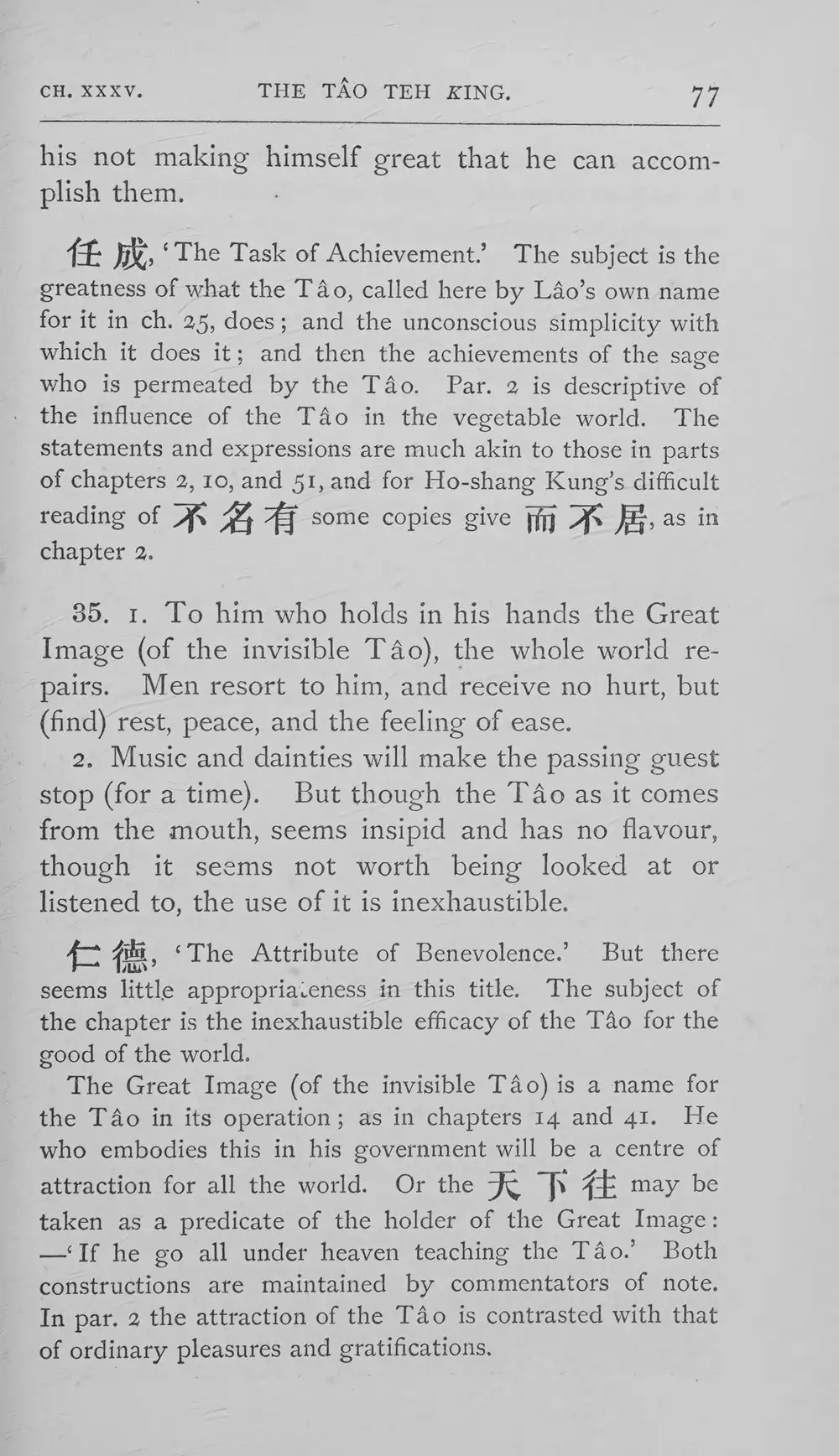
任成, ‘The Task of Achievement.’ The subject is the greatness of what the Tâo, here called by Lâo’s own name for it in ch. 25, does, and the unconscious simplicity with which it does it; and then the achievements of the sage who is permeated by the Tao. Par. 2 describes the influence of the Tao in the vegetable world. Its statements and expressions are closely akin to those in parts of chapters 2, 10, and 51, and for Ho-shang Kung’s difficult reading of 不名有 [Press: does not call (them) its own] some copies give 而不居 [Press: and does not claim (the merit)], as in chapter 2.
35. 1. To him who holds in his hands the Great Image (of the invisible Tâo), the whole world resorts. Men come to him and receive no harm, but (find) rest, peace, and a feeling of ease.
2. Music and dainties will make the passing guest stop (for a while). But though the Tâo, as it comes from the mouth, seems insipid and has no flavour, though it seems not worth looking at or listening to, the use of it is inexhaustible.
仁德, ‘The Attribute of Benevolence.’ But this title seems hardly appropriate. The subject of the chapter is the inexhaustible efficacy of the Tao for the good of the world.
The Great Image (of the invisible Tâo) is a name for the Tâo in its operation, as in chapters 14 and 41. He who embodies it in his government will be a centre of attraction for all the world. Or the 天下往 [Press: all under heaven goes (to him)] may be taken as a predicate of the holder of the Great Image: ‘If he goes all under heaven teaching the Tao.’ Both constructions are held by commentators of note. In par. 2 the attraction of the Tao is contrasted with that of ordinary pleasures and gratifications.