Legge will not read par. 1 as strategy, though it says plainly that one who means to weaken another first strengthens him, because it ‘would be injurious to Lâo-ȝze to suppose’ he meant it. That is a judgement of the author’s character, not of the words. Han Fei, whom he cites, read the lines as statecraft; whether they are counsel or description of how things fall, the text leaves open.
The Tâo Teh King — Sacred Books of China Part I, SBE Vol. 39 (trans. James Legge, 1891)
Open to all
page 78
No image is selected for this page; its own page image is shown.
page 78
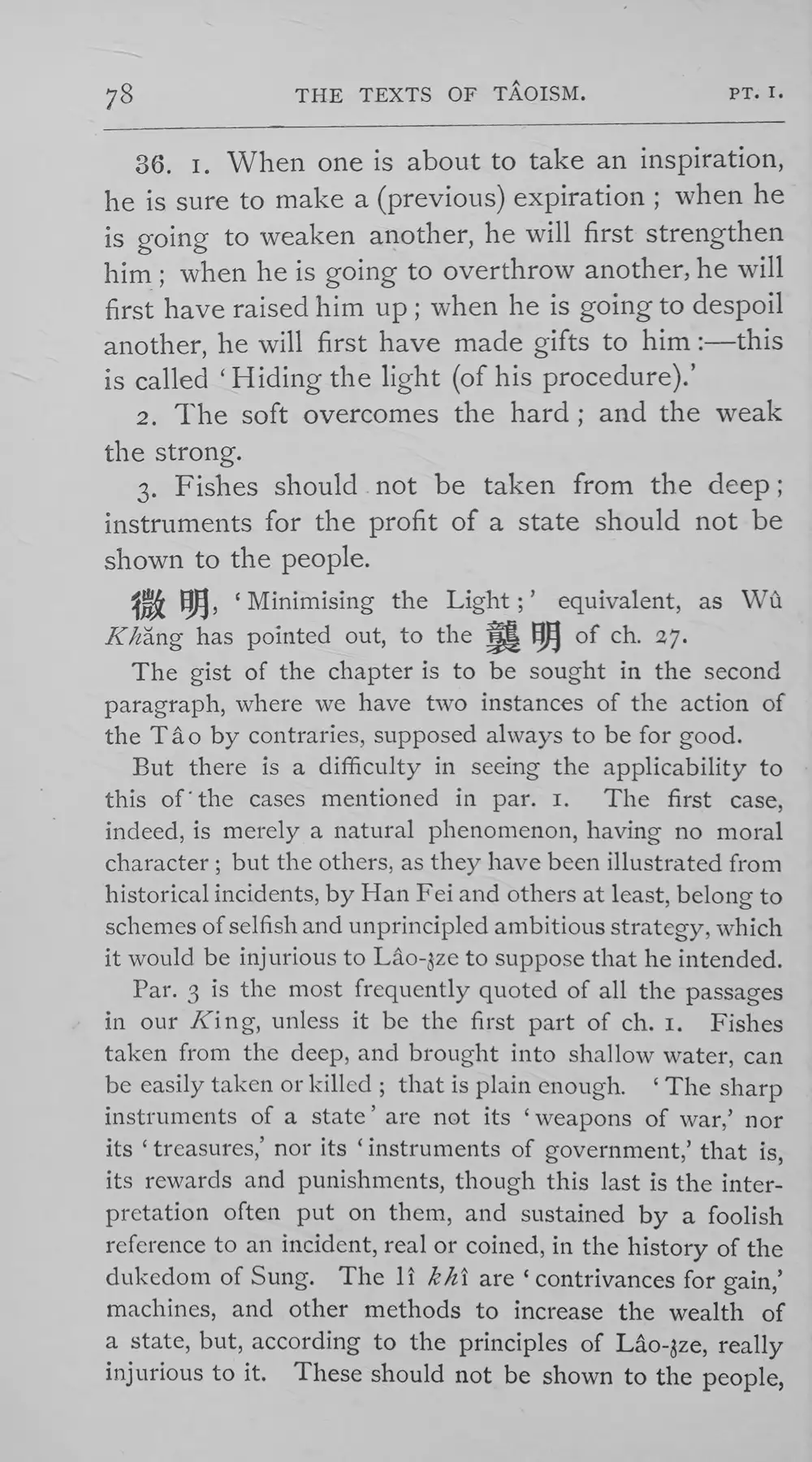
36. 1. When one is about to breathe in, he is sure to make a (previous) breath out; when he is going to weaken another, he will first strengthen him; when he is going to overthrow another, he will first have raised him up; when he is going to despoil another, he will first have given him gifts: this is called ‘Hiding the light (of his procedure).’
2. The soft overcomes the hard, and the weak the strong.
3. Fish should not be taken from the deep; the instruments for the profit of a state should not be shown to the people.
微明, ‘Minimising the Light,’ which is equivalent, as Wû Khăng has pointed out, to the 襲明 [Press: practising (concealing) the light] of ch. 27.
The gist of the chapter is to be looked for in the second paragraph, where we have two instances of the Tao acting by contraries, which is supposed always to be for good.
But it is difficult to see how the cases mentioned in par. 1 apply to this. The first case, indeed, is merely a natural phenomenon with no moral character; but the others, as they have been illustrated from historical incidents, by Han Fei and others at least, belong to schemes of selfish and unprincipled ambitious strategy, which it would wrong Lâo-ȝze to suppose he intended.
Par. 3 is the most frequently quoted of all the passages in our King, unless it is the first part of ch. 1. Fish taken from the deep and brought into shallow water can easily be caught or killed; that is plain enough. ‘The sharp instruments of a state’ are not its ‘weapons of war,’ nor its ‘treasures,’ nor its ‘instruments of government,’ that is, its rewards and punishments, though this last is the interpretation often put on them, supported by a foolish reference to an incident, real or invented, in the history of the dukedom of Sung.
The lî khî are ‘contrivances for gain,’ machines and other methods to increase the wealth of a state, but, according to the principles of Lâo-ȝze, really injurious to it. These should not be shown to the people, whom the Taoist system would keep in a state of primitive simplicity and ignorance. This interpretation accords with the meaning of the characters and with the general teaching of Taoism. In no other way can I explain the paragraph so as to justify the place that undoubtedly belongs to it in the system.
Legge takes the ‘sharp instruments’ of a state as ‘contrivances for gain’ kept from the people, and says no other reading justifies the paragraph’s place. The reading is consistent with his note on chapter 3 (p. 49) about keeping the people in simplicity. He rejects the punitive reading not on the characters but on ‘a foolish reference’ to a Sung incident, which is a judgement on a commentator’s evidence.