‘PART II’ begins at chapter 38, following the old division of the King into a part on the Tao (chs. 1–37) and a part on its Teh (chs. 38–81). The new part opens with 德 itself, which Legge renders ‘the attributes (of the Tâo)’. The division is the tradition’s, not the author’s, and Legge marks it without comment.
The Tâo Teh King — Sacred Books of China Part I, SBE Vol. 39 (trans. James Legge, 1891)
Open to all
page 80
No image is selected for this page; its own page image is shown.
page 80
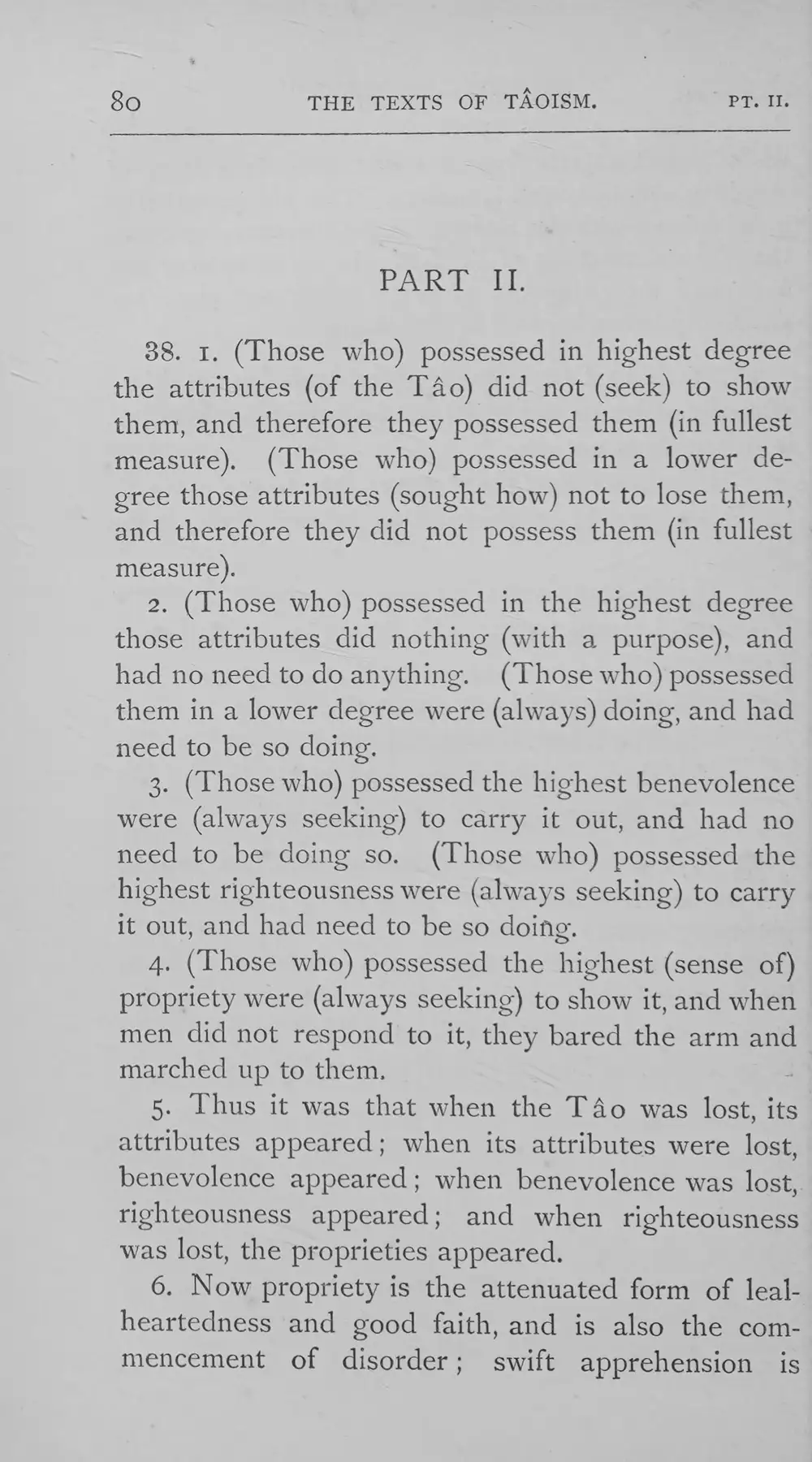
p. 80p. 80PART II.
38. 1. (Those who) possessed the attributes (of the Tâo) in the highest degree did not (seek) to show them, and so they possessed them (in fullest measure). (Those who) possessed those attributes in a lower degree (sought how) not to lose them, and so they did not possess them (in fullest measure).
2. (Those who) possessed those attributes in the highest degree did nothing (with a purpose), and had no need to do anything. (Those who) possessed them in a lower degree were (always) doing, and needed to be so doing.
3. (Those who) possessed the highest benevolence were (always seeking) to carry it out, and had no need to be doing so. (Those who) possessed the highest righteousness were (always seeking) to carry it out, and needed to be so doing.
4. (Those who) possessed the highest (sense of) propriety were (always seeking) to show it, and when men did not respond to it, they bared their arms and marched up to them.
5. So it was that when the Tâo was lost, its attributes appeared; when its attributes were lost, benevolence appeared; when benevolence was lost, righteousness appeared; and when righteousness was lost, the proprieties appeared.
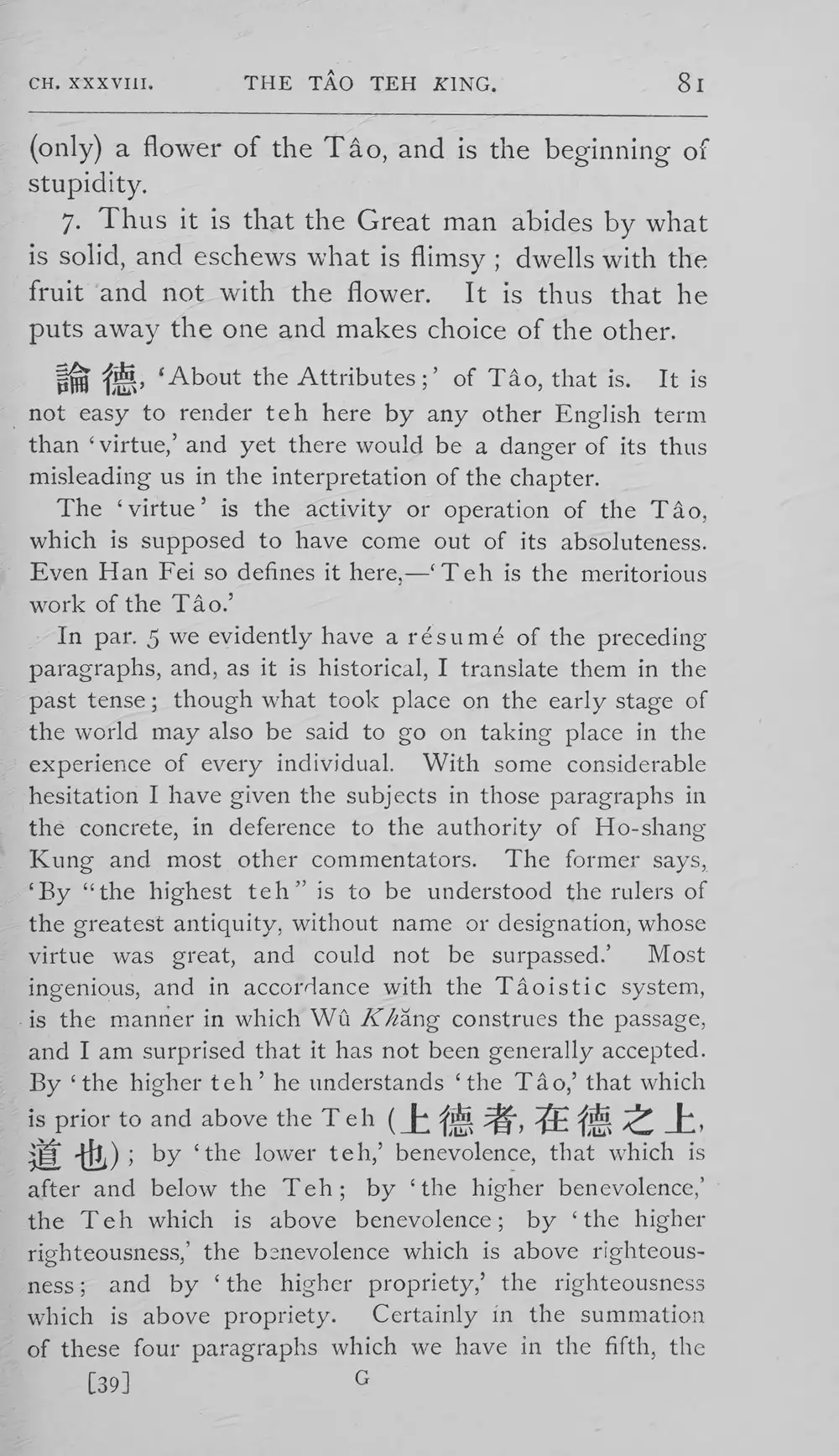
6. Now propriety is the thinned-out form of loyalty of heart and good faith, and is also the beginning of disorder; swift apprehension is (only) a flower of the Tâo, and is the beginning of stupidity.
Every ‘(Those who)’ on this page is Legge’s. The Chinese speaks of ‘the highest teh’ and ‘the lower teh’; he makes them people, ‘with some considerable hesitation’ (p. 81), after Ho-shang Kung. Read without the brackets, the chapter ranks qualities rather than persons, which is how Wû Khăng took it and how Legge himself finds most ingenious.