Legge resolves ‘It returns’ into omnipresence: flowing far and coming back together mean ‘It is everywhere’. The King itself points elsewhere. Chapter 16 has all things return to their root, and chapter 40 (p. 83) says the Tao moves by contraries; both describe a cycle of going out and coming back, not simple ubiquity. The verb names a motion his paraphrase flattens.
The Tâo Teh King — Sacred Books of China Part I, SBE Vol. 39 (trans. James Legge, 1891)
Open to all
page 69
No image is selected for this page; its own page image is shown.
page 69
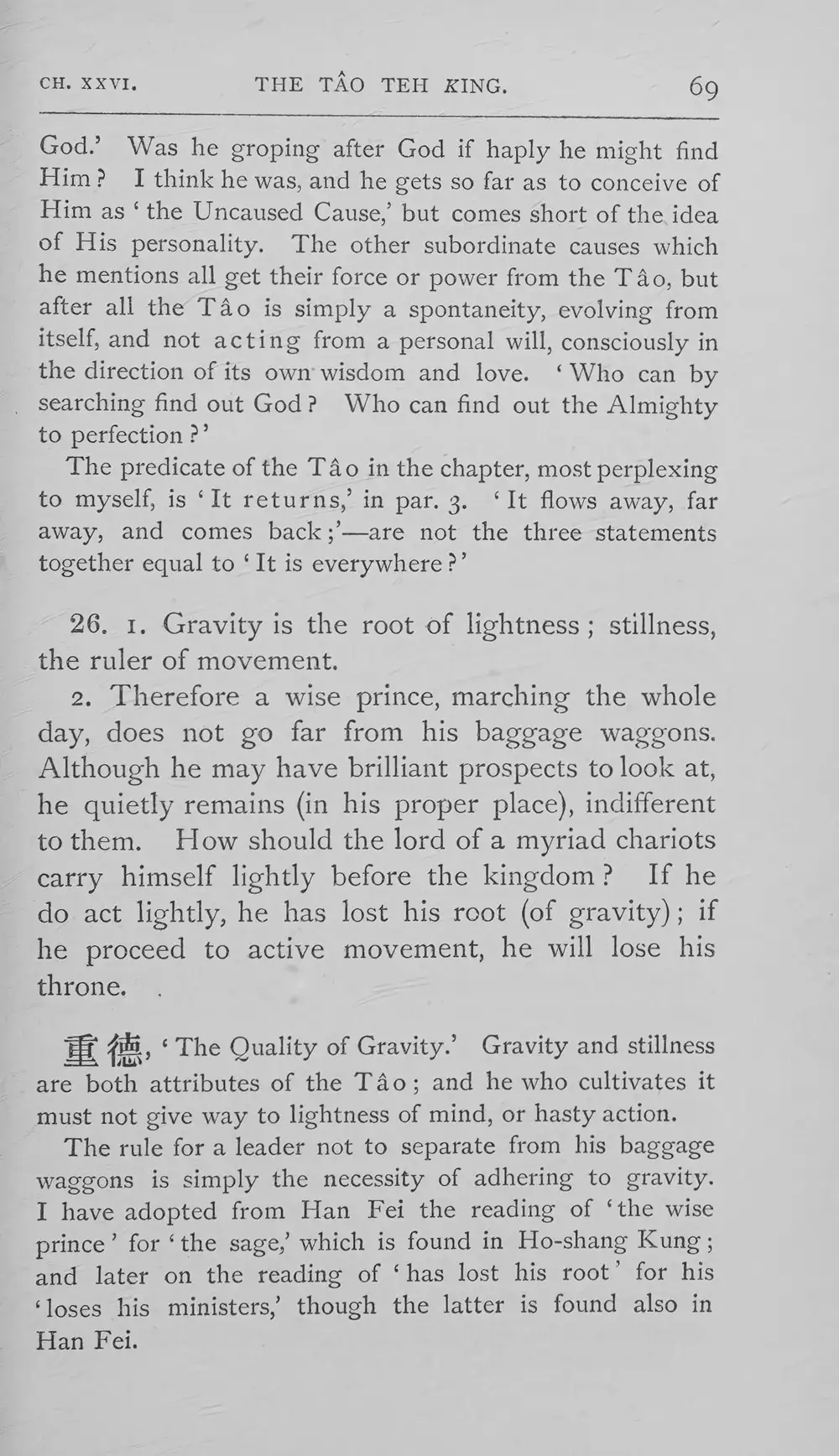
The predicate of the Tao in this chapter that most perplexes me is ‘It returns,’ in par. 3. ‘It flows away, far away, and comes back’: do the three statements together not amount to ‘It is everywhere’?
26. 1. Gravity is the root of lightness; stillness is the ruler of movement.
2. Therefore a wise prince, marching all day, does not go far from his baggage wagons. Although he may have brilliant prospects to look at, he quietly remains (in his proper place), indifferent to them. How should the lord of a myriad chariots carry himself lightly before the kingdom? If he acts lightly, he has lost his root (of gravity); if he proceeds to active movement, he will lose his throne.
重德, ‘The Quality of Gravity.’ Gravity and stillness are both attributes of the Tao; and he who cultivates it must not give way to lightness of mind or hasty action.
The rule that a leader should not separate himself from his baggage wagons is simply the necessity of holding to gravity. I have adopted from Han Fei the reading ‘the wise prince’ for ‘the sage,’ which is found in Ho-shang Kung; and later on the reading ‘has lost his root’ for ‘loses his ministers,’ though the latter is also found in Han Fei.
Legge takes ‘the wise prince’ from Han Fei against Ho-shang Kung, then rejects Han Fei’s ‘loses his ministers’ though he finds it there. Choosing among witnesses by sense, line by line, is defensible, but it means the English follows no single ancient text. Read with pp. 75 and 83, where he moves between Wang Pi and Ho-shang Kung, it is clear his King is a composite of his own choosing.