The Tâo Teh King — Sacred Books of China Part I, SBE Vol. 39 (trans. James Legge, 1891)

Open to allEdited by F. Max Müller; translated by Müller, Legge, Bühler, West, Darmesteter, Palmer, Telang, Thibaut, Jolly, Rhys Davids, Oldenberg, Jacobi, Bloomfield and others1850 segments · 383 pp
page 67

No image is selected for this page; its own page image is shown.

The Tâo Teh King — Sacred Books of China Part I, SBE Vol. 39 (trans. James Legge, 1891), photo of the original · p. 67
Photo of the original · p. 67
The Tâo Teh King — Sacred Books of China Part I, SBE Vol. 39 (trans. James Legge, 1891), photo of the original · p. 68
Photo of the original · p. 68
page 67

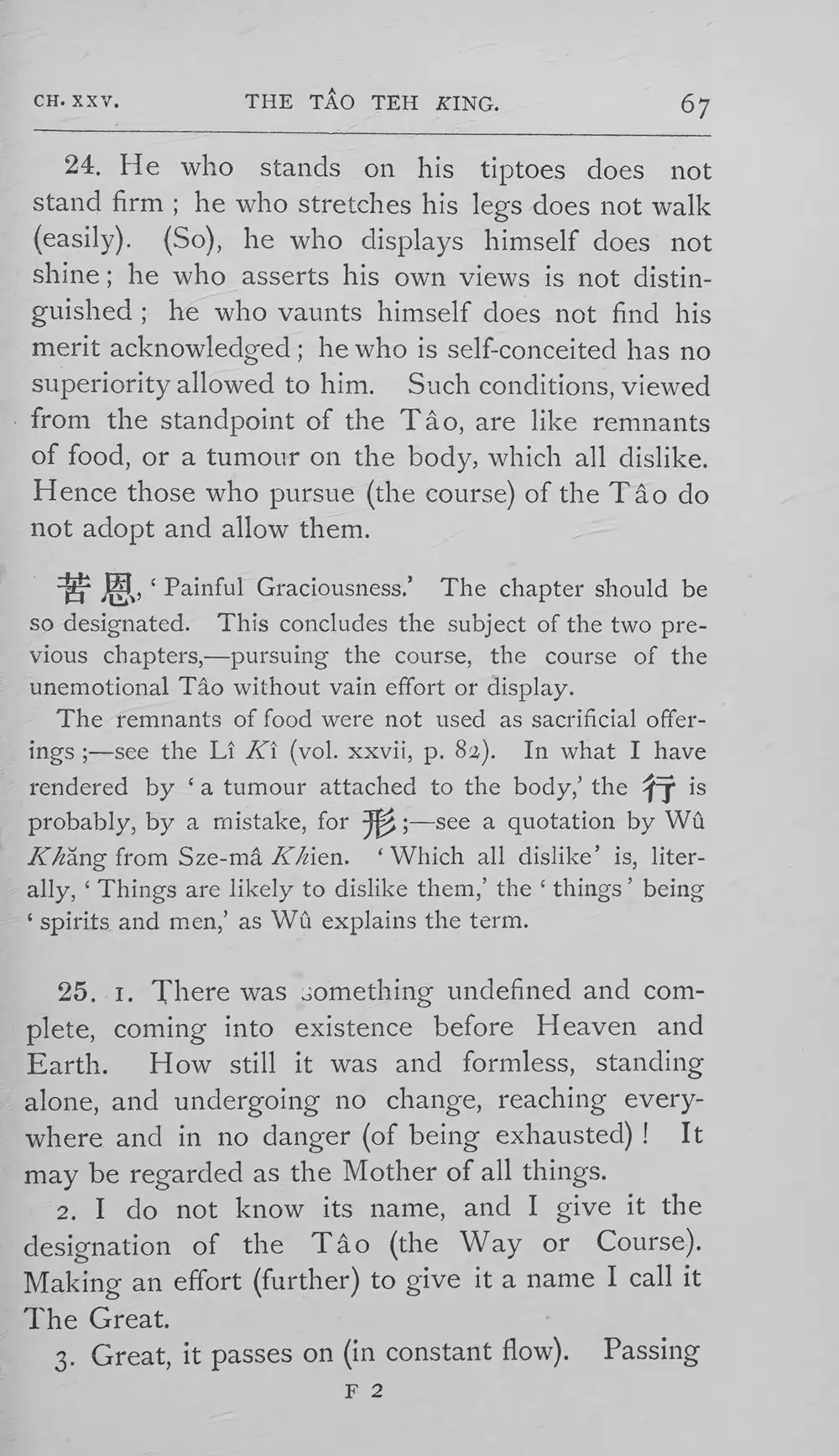
24. He who stands on tiptoe does not stand firm; he who stretches his legs does not walk (easily). (So), he who displays himself does not shine; he who asserts his own views is not distinguished; he who boasts of himself does not find his merit acknowledged; he who is self-conceited is allowed no superiority. Such conditions, viewed from the standpoint of the Tao, are like remnants of food, or a tumour on the body, which all dislike. Hence those who pursue (the course) of the Tao do not adopt and allow them.

苦恩, ‘Painful Graciousness.’ So the chapter should be named. This concludes the subject of the two previous chapters: pursuing the course, the course of the unemotional Tao, without vain effort or display.

Leftover food was not used for sacrificial offerings; see the Li Ki (vol. xxvii, p. 82). In what I have rendered ‘a tumour attached to the body,’ the 行 [Press: to go; conduct] is probably a mistake for 形 [Press: bodily form]; see a quotation by Wû Khang from Sze-ma Khien. ‘Which all dislike’ is literally ‘Things are likely to dislike them,’ the ‘things’ being ‘spirits and men,’ as Wû explains the term.

25. 1. There was something undefined and complete, coming into existence before Heaven and Earth. How still it was, and formless, standing alone and undergoing no change, reaching everywhere and in no danger (of being exhausted)! It may be regarded as the Mother of all things.

2. I do not know its name, and I give it the designation of the Tao (the Way or Course). Making an effort (further) to give it a name, I call it The Great.

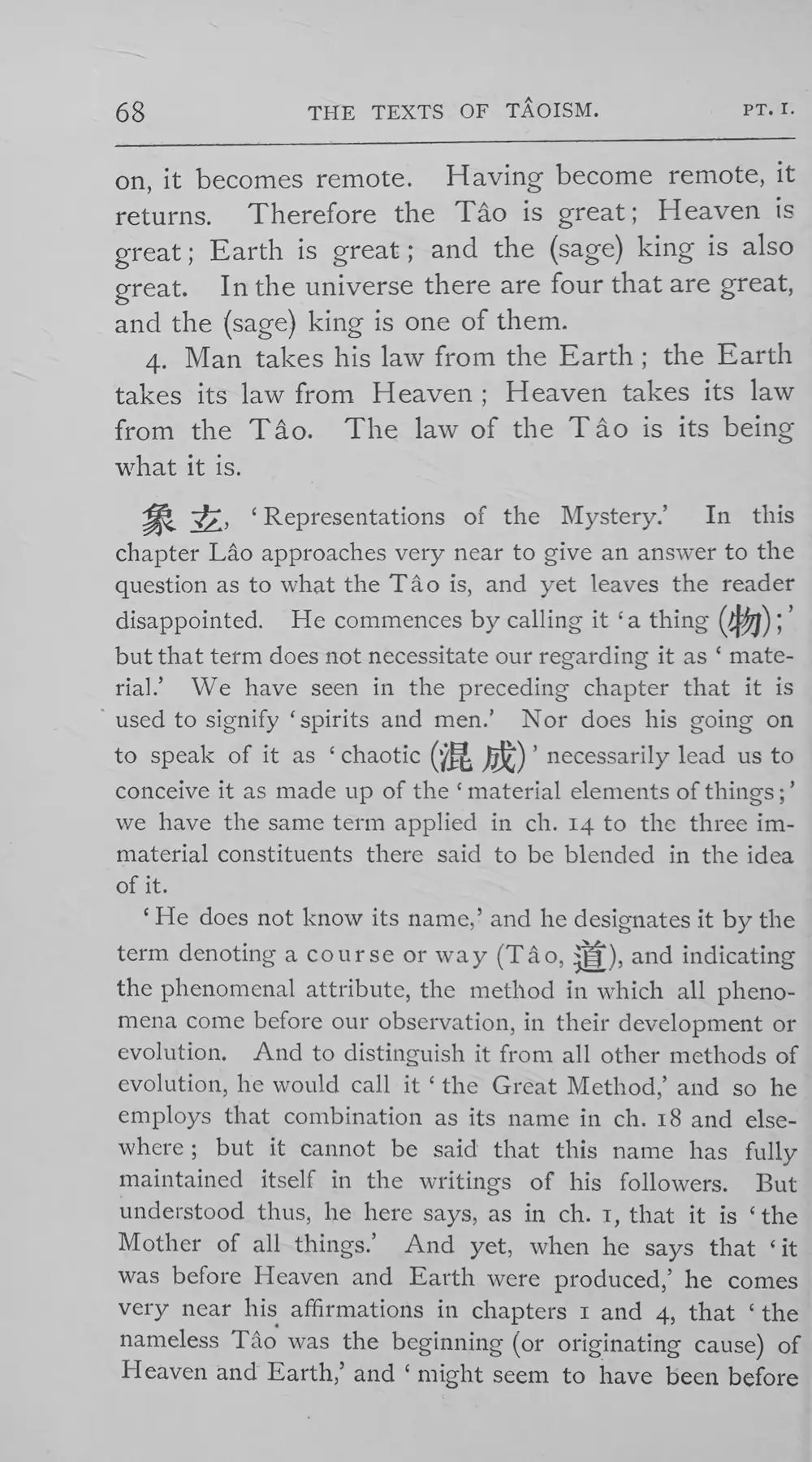
3. Great, it passes on (in constant flow). Passing on, it becomes remote. Having become remote, it returns. Therefore the Tao is great; Heaven is great; Earth is great; and the (sage) king is also great. In the universe there are four that are great, and the (sage) king is one of them.

Commentary
page 67 ·