‘Was he groping after God if haply he might find Him?’ echoes Acts 17, and the page closes with Job. Legge measures the chapter against a personal God and finds it ‘comes short’. His own analysis, that the Tao is ‘simply a spontaneity, evolving from itself’, is the accurate description; the sense of falling short belongs to the translator’s frame, not to a text that never aimed at a personal Creator.
The Tâo Teh King — Sacred Books of China Part I, SBE Vol. 39 (trans. James Legge, 1891)
Open to all
page 68
No image is selected for this page; its own page image is shown.
page 68
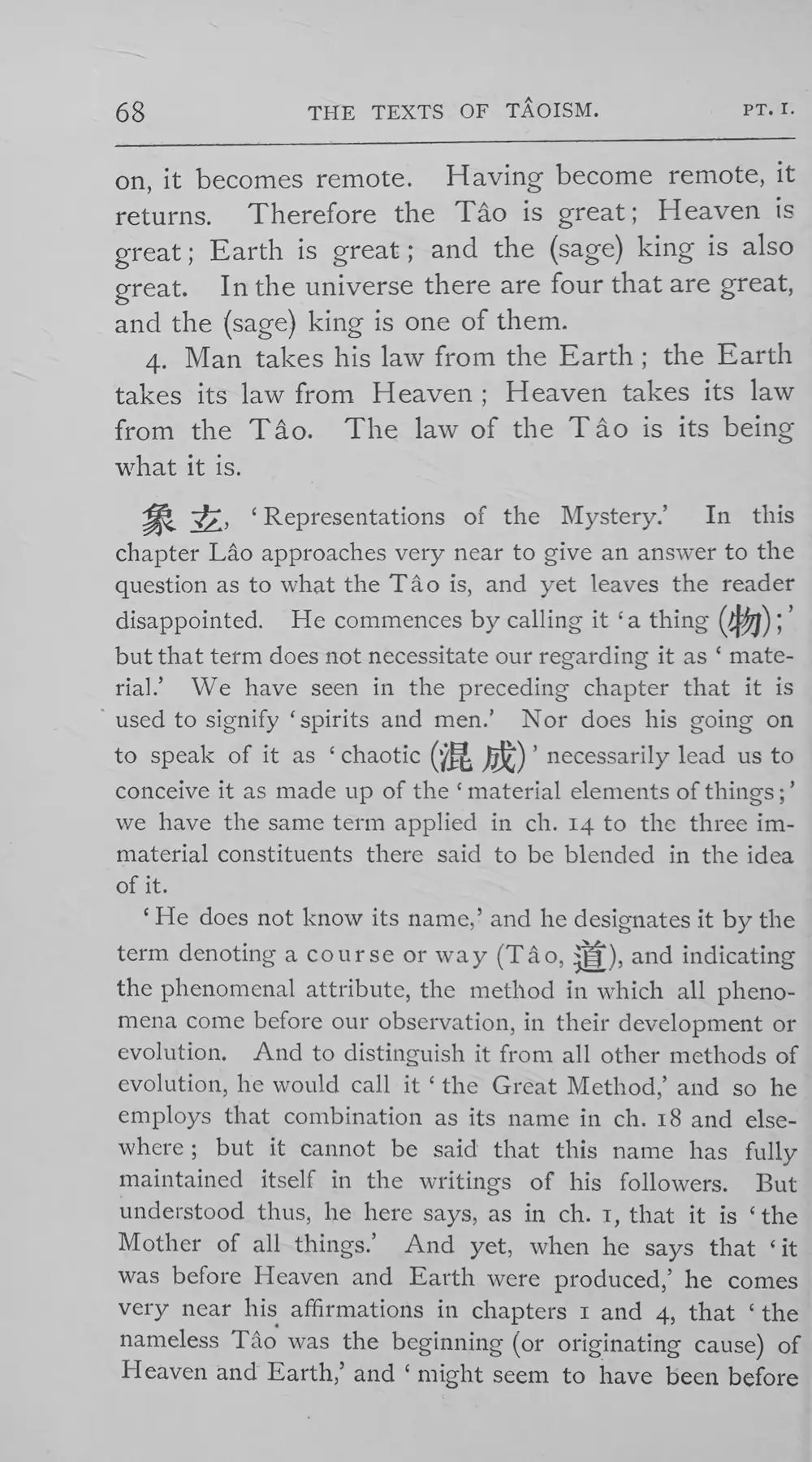
4. Man takes his law from Earth; Earth takes its law from Heaven; Heaven takes its law from the Tao. The law of the Tâo is its being what it is.
象玄, ‘Representations of the Mystery.’ In this chapter Lao comes very near to answering the question of what the Tâo is, and yet leaves the reader disappointed. He begins by calling it ‘a thing (物)’; but that term does not oblige us to regard it as ‘material.’ We saw in the preceding chapter that it is used to mean ‘spirits and men.’ Nor does his going on to speak of it as ‘chaotic (混成)’ necessarily lead us to conceive of it as made up of the ‘material elements of things’; the same term is applied in ch. 14 to the three immaterial constituents there said to be blended in the idea of it.
‘He does not know its name,’ and he designates it by the term for a course or way (Tâo, 道), indicating the phenomenal attribute, the method by which all phenomena come before our observation in their development or evolution. And to distinguish it from all other methods of evolution, he would call it ‘the Great Method,’ and so he uses that combination as its name in ch. 18 and elsewhere; but it cannot be said that this name has fully held its ground in the writings of his followers. But understood in this way, he says here, as in ch. 1, that it is ‘the Mother of all things.’
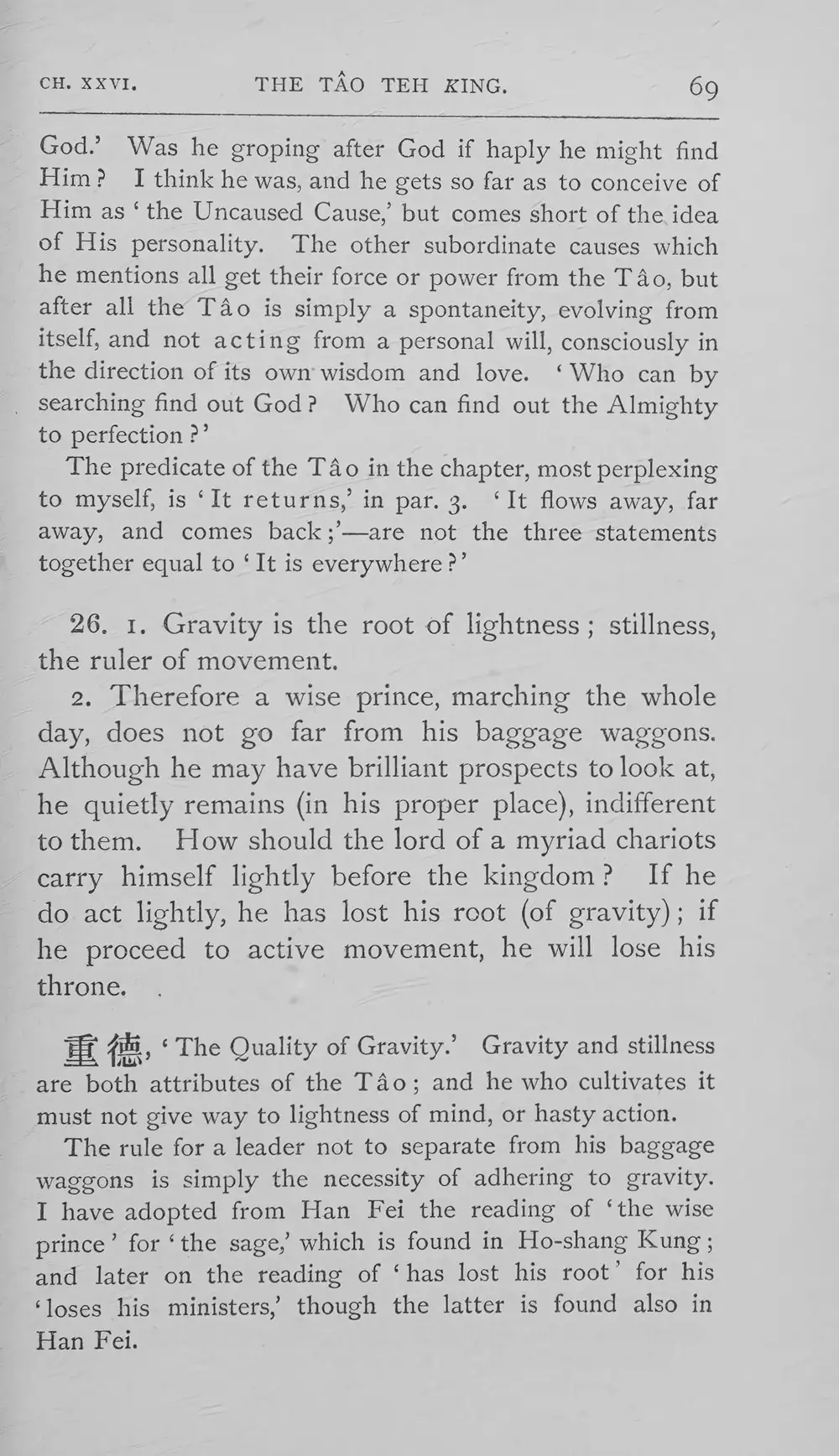
And yet, when he says that ‘it was before Heaven and Earth were produced,’ he comes very near his affirmations in chapters 1 and 4, that ‘the nameless Tao was the beginning (or originating cause) of Heaven and Earth,’ and ‘might seem to have been before God.’ Was he groping after God, if perhaps he might find Him? I think he was, and he gets as far as conceiving of Him as ‘the Uncaused Cause,’ but falls short of the idea of His personality.
The other subordinate causes he mentions all draw their force or power from the Tâo; but after all the Tao is simply a spontaneity, evolving from itself, and not acting from a personal will, consciously, in the direction of its own wisdom and love. ‘Who can find out God by searching? Who can find out the Almighty to perfection?’