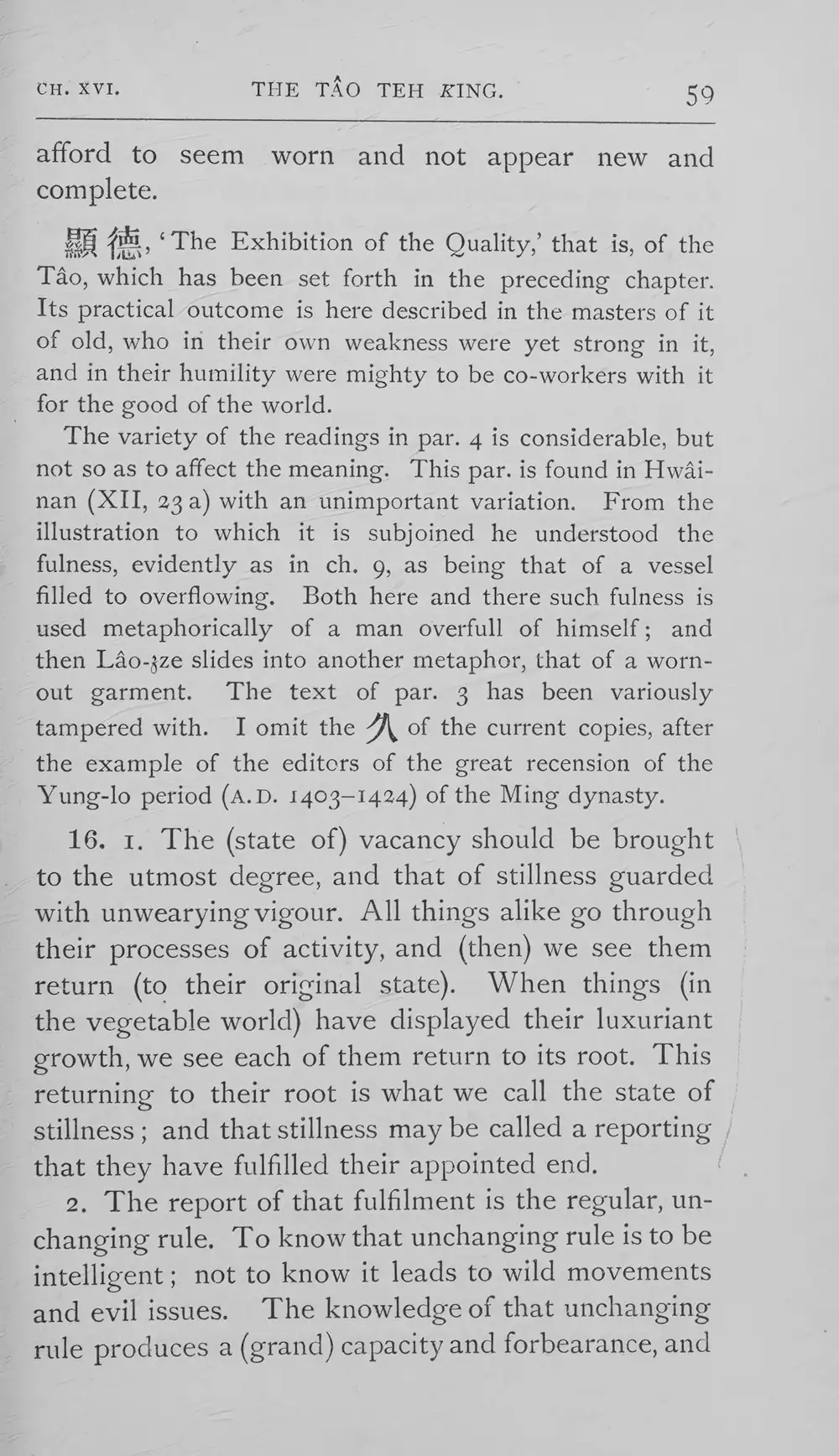
The two questions of par. 3 are built as a pair: stillness gradually clears muddy water, and the parallel clause most naturally says that movement gradually brings what is at rest to life. Legge’s ‘the condition of rest will gradually arise’ makes rest the product of both, which loses the balance of the pair. His note overleaf shows he was also working from a shortened text here, omitting a character on Ming editorial authority.
The Tâo Teh King — Sacred Books of China Part I, SBE Vol. 39 (trans. James Legge, 1891)
Open to all
page 58
No image is selected for this page; its own page image is shown.
page 58
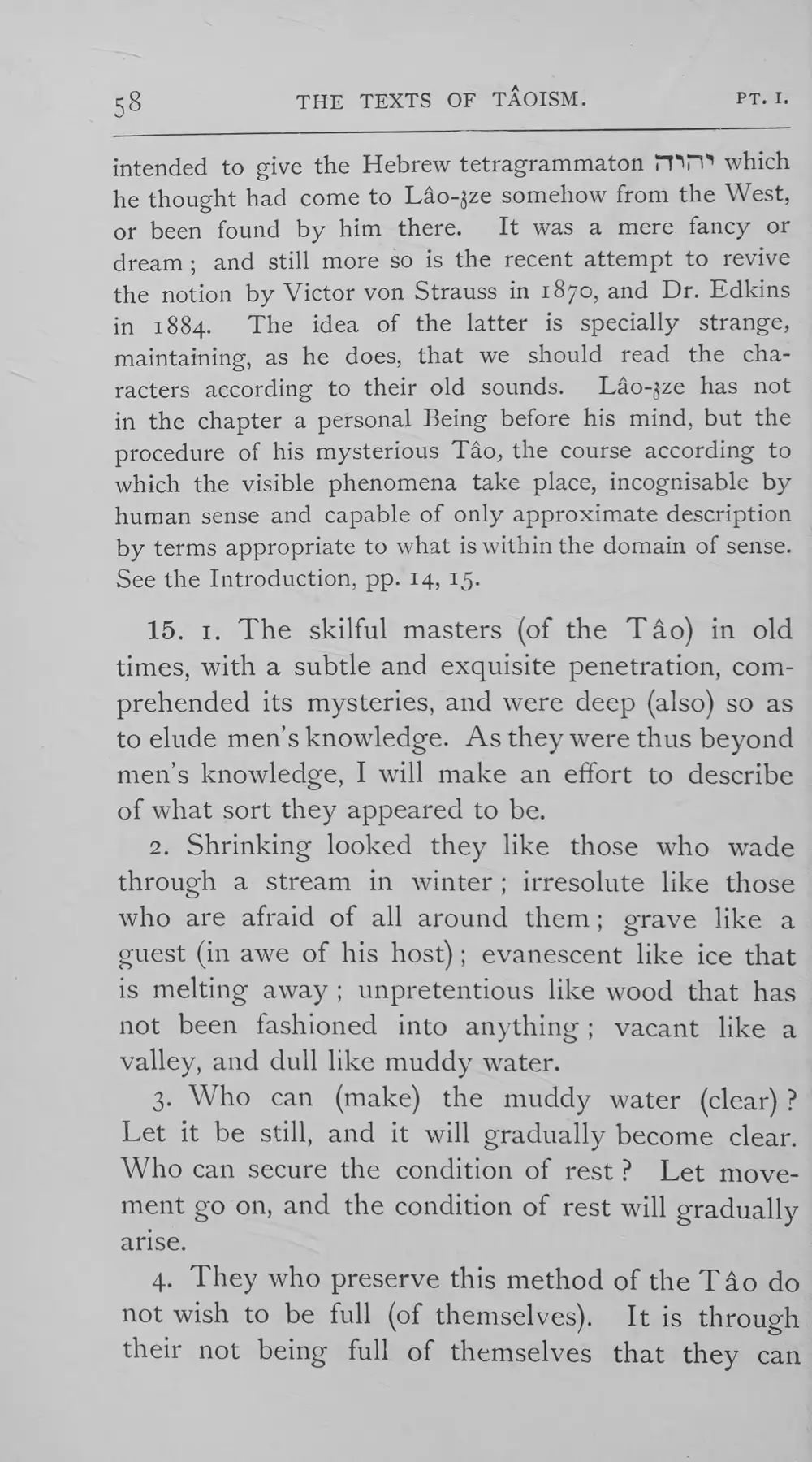
15. 1. The skilful masters (of the Tâo) in old times, with a subtle and exquisite penetration, understood its mysteries, and were deep (too), so as to elude men’s knowledge. Since they were thus beyond men’s knowledge, I will try to describe what they appeared to be like.
2. Shrinking they looked, like those who wade through a stream in winter; irresolute, like those who are afraid of everything around them; grave, like a guest (in awe of his host); evanescent, like ice that is melting away; unpretentious, like wood that has not been shaped into anything; vacant, like a valley; and dull, like muddy water.
3. Who can (make) the muddy water (clear)? Let it be still, and it will gradually become clear. Who can secure the condition of rest? Let movement go on, and the condition of rest will gradually come about.
4. Those who preserve this method of the Tâo do not wish to be full (of themselves). It is through their not being full of themselves that they can afford to seem worn and not to appear new and complete.