Legge prints the title 運夷 and says plainly that he cannot render it. The chapter titles come down with the Ho-shang Kung edition rather than from the author, and Legge treats them so throughout, judging some apt and others not. Leaving one untranslated with a confession is better practice than forcing an English label that would pass for the text’s own.
The Tâo Teh King — Sacred Books of China Part I, SBE Vol. 39 (trans. James Legge, 1891)
Open to all
page 53
No image is selected for this page; its own page image is shown.
page 53
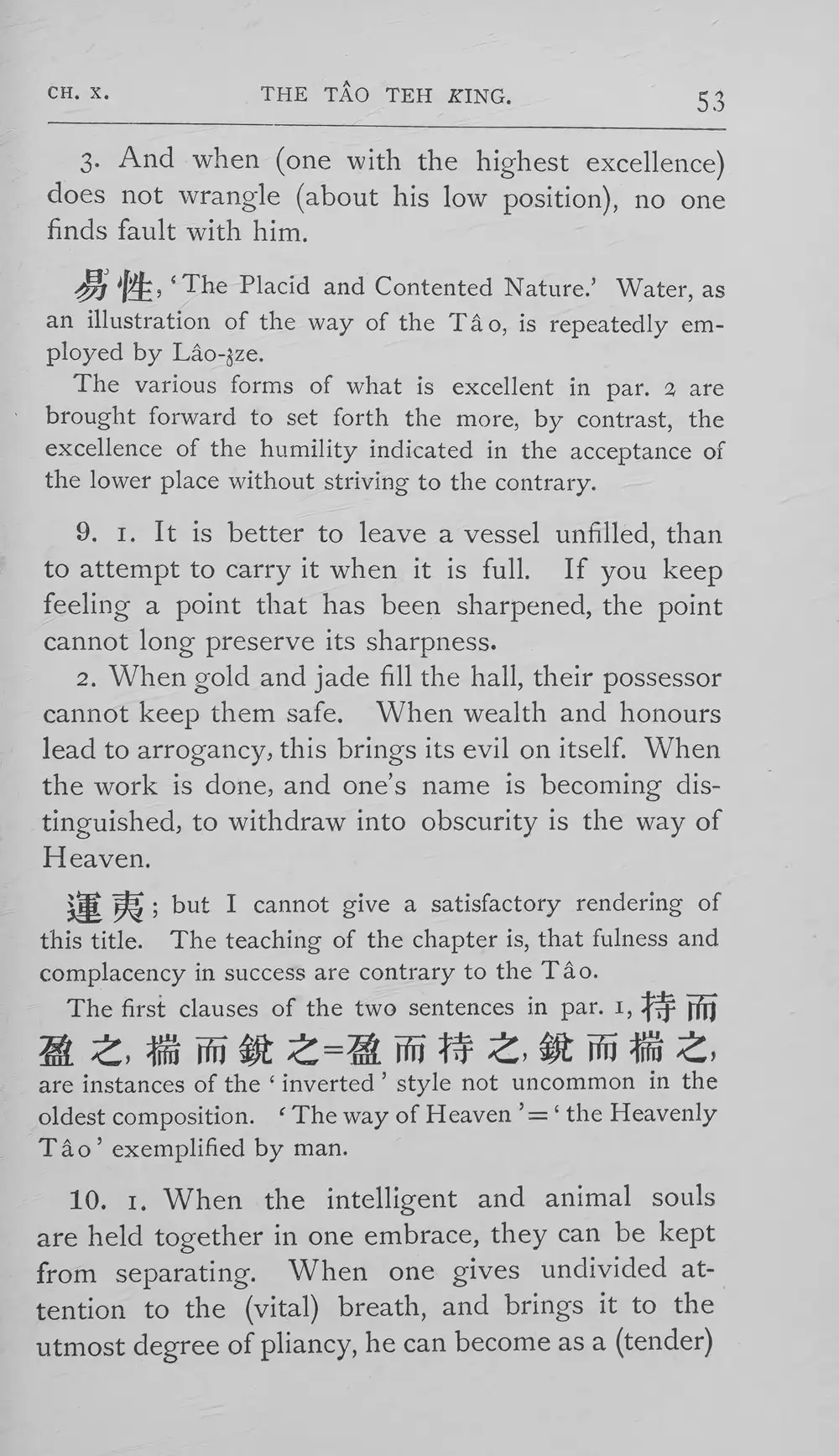
3. And when (one with the highest excellence) does not quarrel (about his low position), no one finds fault with him.
易性, ‘The Placid and Contented Nature.’ Lâo-ȝze repeatedly uses water as an illustration of the way of the Tâo.
The various forms of excellence in paragraph 2 are brought forward to set out all the more, by contrast, the excellence of the humility shown in accepting the lower place without striving to the contrary.
9. 1. It is better to leave a vessel unfilled than to try to carry it when it is full. If you keep feeling a point that has been sharpened, the point cannot keep its sharpness for long.
2. When gold and jade fill the hall, their owner cannot keep them safe. When wealth and honours lead to arrogance, this brings its own evil on itself. When the work is done, and one’s name is becoming distinguished, to withdraw into obscurity is the way of Heaven.
運夷 [Press: turning to the level; movement and levelling]; but I cannot give a satisfactory rendering of this title. The teaching of the chapter is that fulness and complacency in success are contrary to the Tao.
The first clauses of the two sentences in paragraph 1, 持而 [Press: holding and] 盈之 [Press: to fill it (to the brim)], 揣而銳之 [Press: to probe it and sharpen it] = 盈而持之 [Press: to fill it and hold it], 銳而揣之 [Press: to sharpen it and probe it], are instances of the ‘inverted’ style not uncommon in the oldest writing. ‘The way of Heaven’ = ‘the Heavenly Tao’ as exemplified by man.
10. 1. When the intelligent and animal souls are held together in one embrace, they can be kept from separating. When one gives undivided attention to the (vital) breath, and brings it to the utmost degree of pliancy, he can become like a (tender) babe. When he has cleansed away the most mysterious sights (of his imagination), he can become without a flaw.