The chapter offers self-forgetting as the means to self-preservation: the sage puts his person last ‘and yet that person is preserved’, and the closing question says his private ends ‘are realised’. Legge’s title note smooths this into ‘one’s best good is realised by not thinking of it’. The text is more pointed than the gloss: it does not abolish the self’s ends, it claims a surer way to them.
The Tâo Teh King — Sacred Books of China Part I, SBE Vol. 39 (trans. James Legge, 1891)
Open to all
page 52
No image is selected for this page; its own page image is shown.
page 52
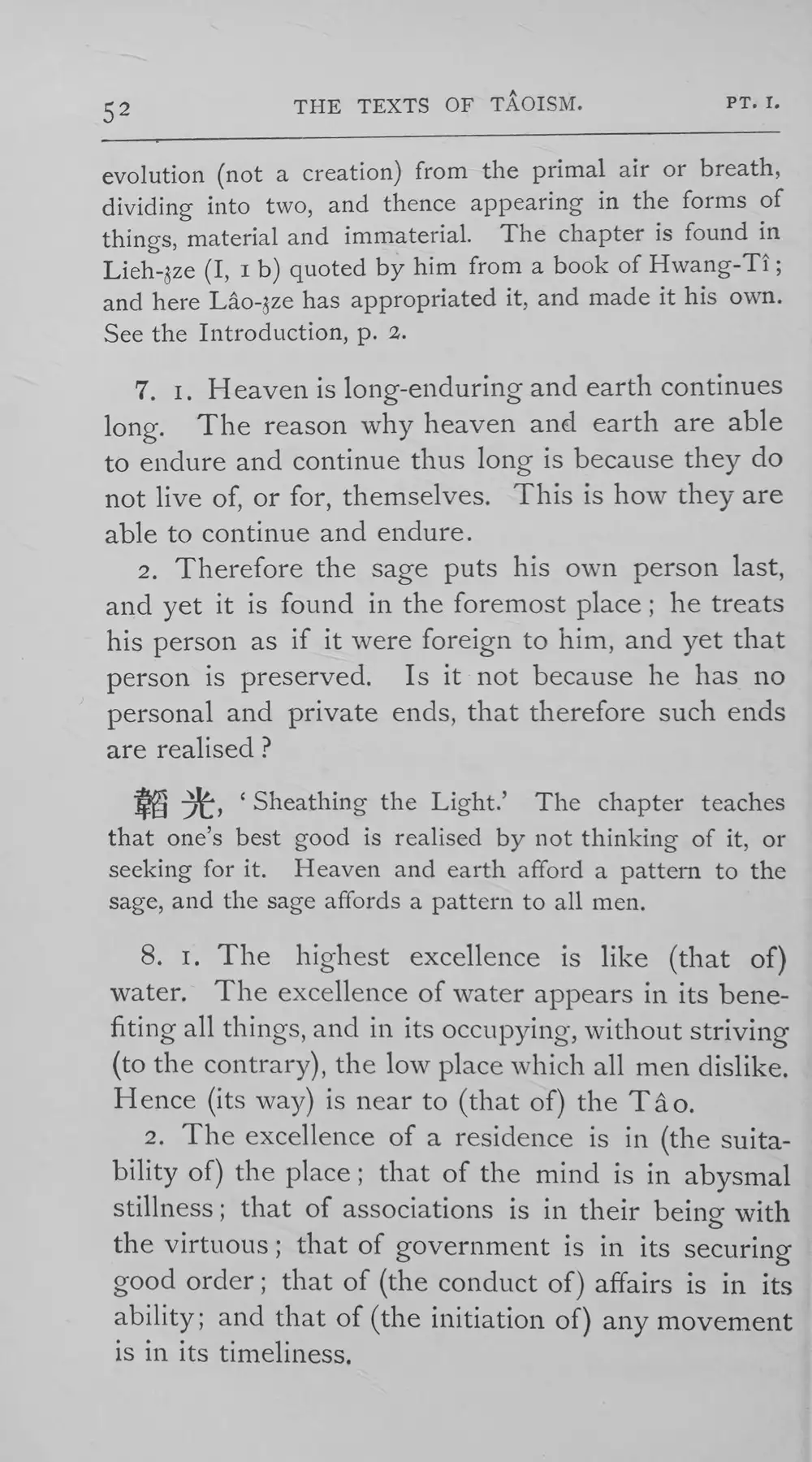
7. 1. Heaven endures long and earth continues long. The reason why heaven and earth are able to endure and continue so long is that they do not live of, or for, themselves. This is how they are able to continue and endure.
2. So the sage puts his own person last, and yet it is found in the foremost place; he treats his person as if it were foreign to him, and yet that person is preserved. Is it not because he has no personal and private ends that such ends are therefore realised?
韜光, ‘Sheathing the Light.’ The chapter teaches that one’s best good is realised by not thinking of it or seeking it. Heaven and earth give a pattern to the sage, and the sage gives a pattern to all men.
8. 1. The highest excellence is like (that of) water. The excellence of water shows in its benefiting all things, and in its occupying, without striving (to the contrary), the low place that all men dislike. Hence (its way) is near to (that of) the Tao.
2. The excellence of a dwelling lies in (the suitability of) the place; that of the mind in abysmal stillness; that of associations in their being with the virtuous; that of government in its securing good order; that of (the conduct of) affairs in its ability; and that of (the initiation of) any movement in its timeliness.