Legge calls the chapter something Lâo-ȝze ‘appropriated’ from a book of Hwang-Ti, because Lieh-ȝze quotes it under that name. The argument runs backwards from a later witness: the book of Lieh-ȝze is generally reckoned later than the King, so its ascription shows what a later writer believed, not where Lâo-ȝze found the lines. His parenthesis ‘evolution (not a creation)’ is the sounder point, a deliberate line drawn by a missionary translator against reading Genesis into the text.
The Tâo Teh King — Sacred Books of China Part I, SBE Vol. 39 (trans. James Legge, 1891)
Open to all
page 51
No image is selected for this page; its own page image is shown.
page 51
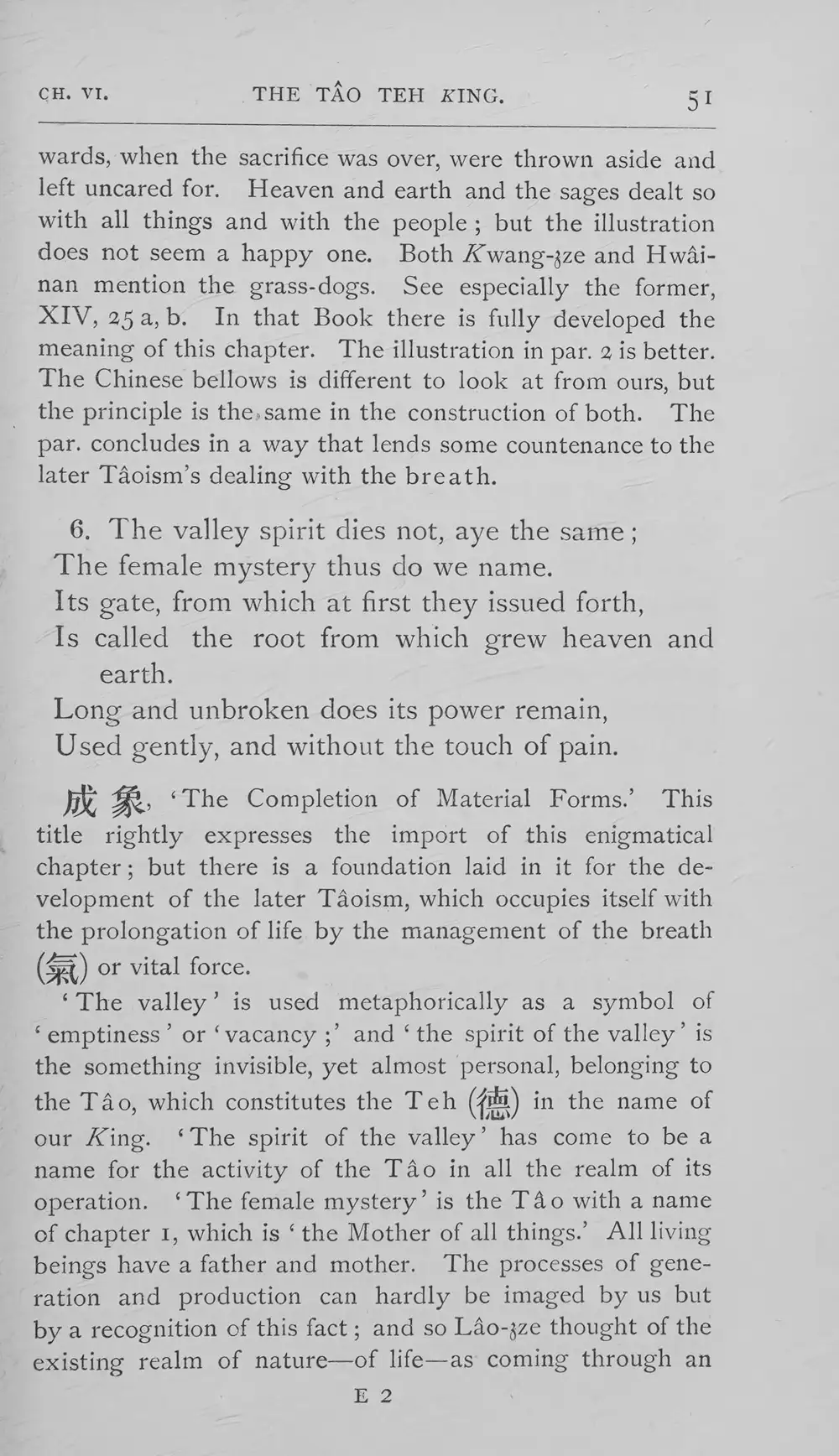
6. The valley spirit does not die, but stays ever the same;
The female mystery is what we name it.
Its gate, from which at first they issued forth,
Is called the root from which heaven and earth grew.
Long and unbroken its power remains,
Used gently, and without the touch of pain.
成象, ‘The Completion of Material Forms.’ This title rightly expresses the meaning of this enigmatic chapter; but a foundation is laid in it for the development of the later Taoism, which concerns itself with prolonging life by the management of the breath (氣) or vital force.
‘The valley’ is used metaphorically as a symbol of ‘emptiness’ or ‘vacancy;’ and ‘the spirit of the valley’ is the something invisible, yet almost personal, belonging to the Tâo, which constitutes the Teh (德 [Press: Teh, virtue; inner power]) in the name of our King. ‘The spirit of the valley’ has come to be a name for the activity of the Tâo in the whole realm of its operation. ‘The female mystery’ is the Tao with a name of chapter 1, which is ‘the Mother of all things.’
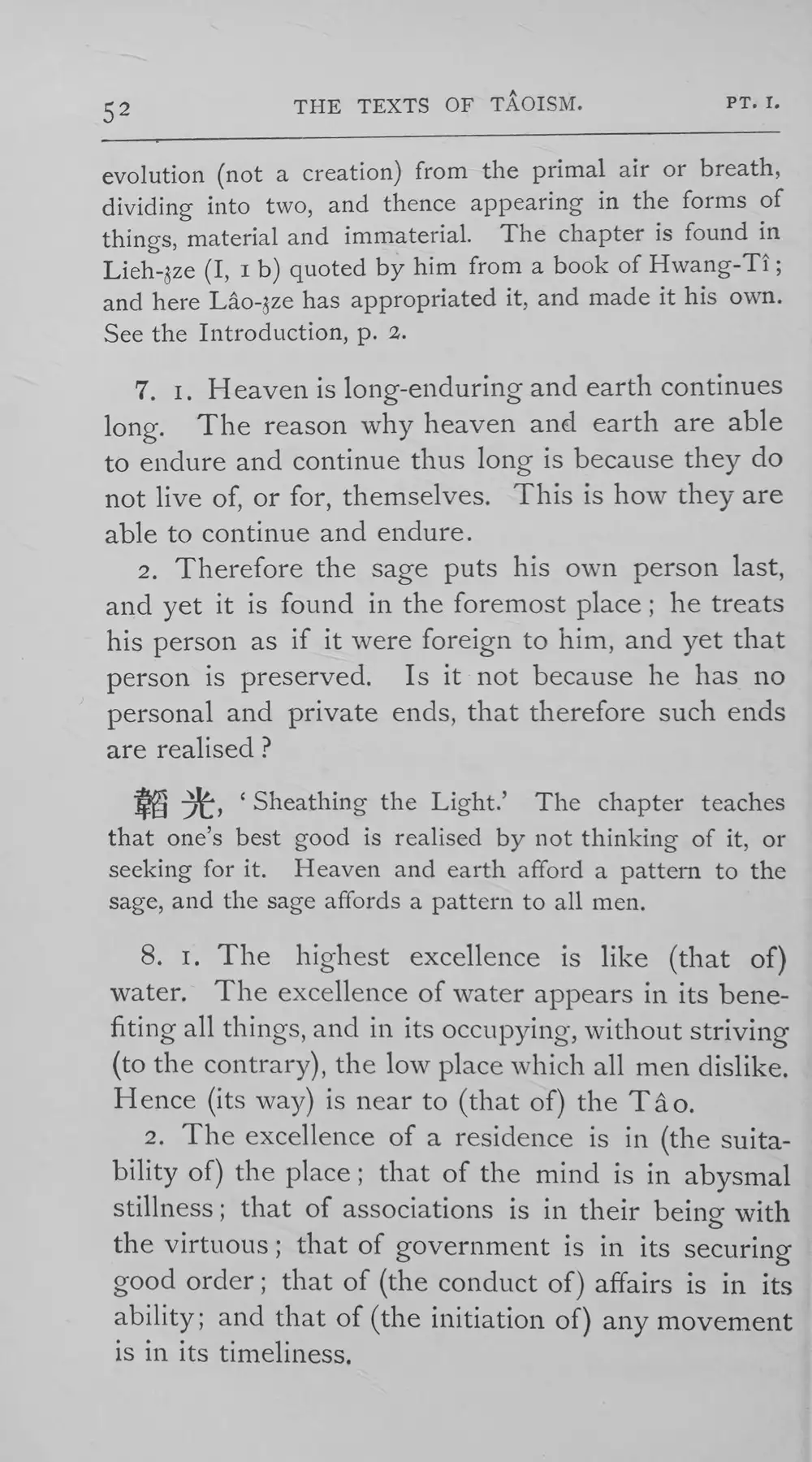
All living beings have a father and a mother. The processes of generation and production can hardly be imagined … of this fact; and so Lâo-ȝze thought of the existing realm of nature—of life—as coming through an evolution (not a creation) from the primal air or breath, dividing into two, and then appearing in the forms of things, material and immaterial. The chapter is found in Lieh-ȝze (I, 1b), quoted by him from a book of Hwang-Ti; and here Lâo-ȝze has taken it over and made it his own. See the Introduction, page 2.