Calling the five notes ‘the imperfect Chinese musical scale’ is a judgement from a European seven-note standard, not a description. A five-note scale is a complete system on its own terms, and the chapter’s point needs the five colours, notes and tastes as a closed set of sense-pleasures. The adjective is the period’s musical assumption, and nothing in the passage depends on it.
The Tâo Teh King — Sacred Books of China Part I, SBE Vol. 39 (trans. James Legge, 1891)
Open to all
page 55
No image is selected for this page; its own page image is shown.
page 55
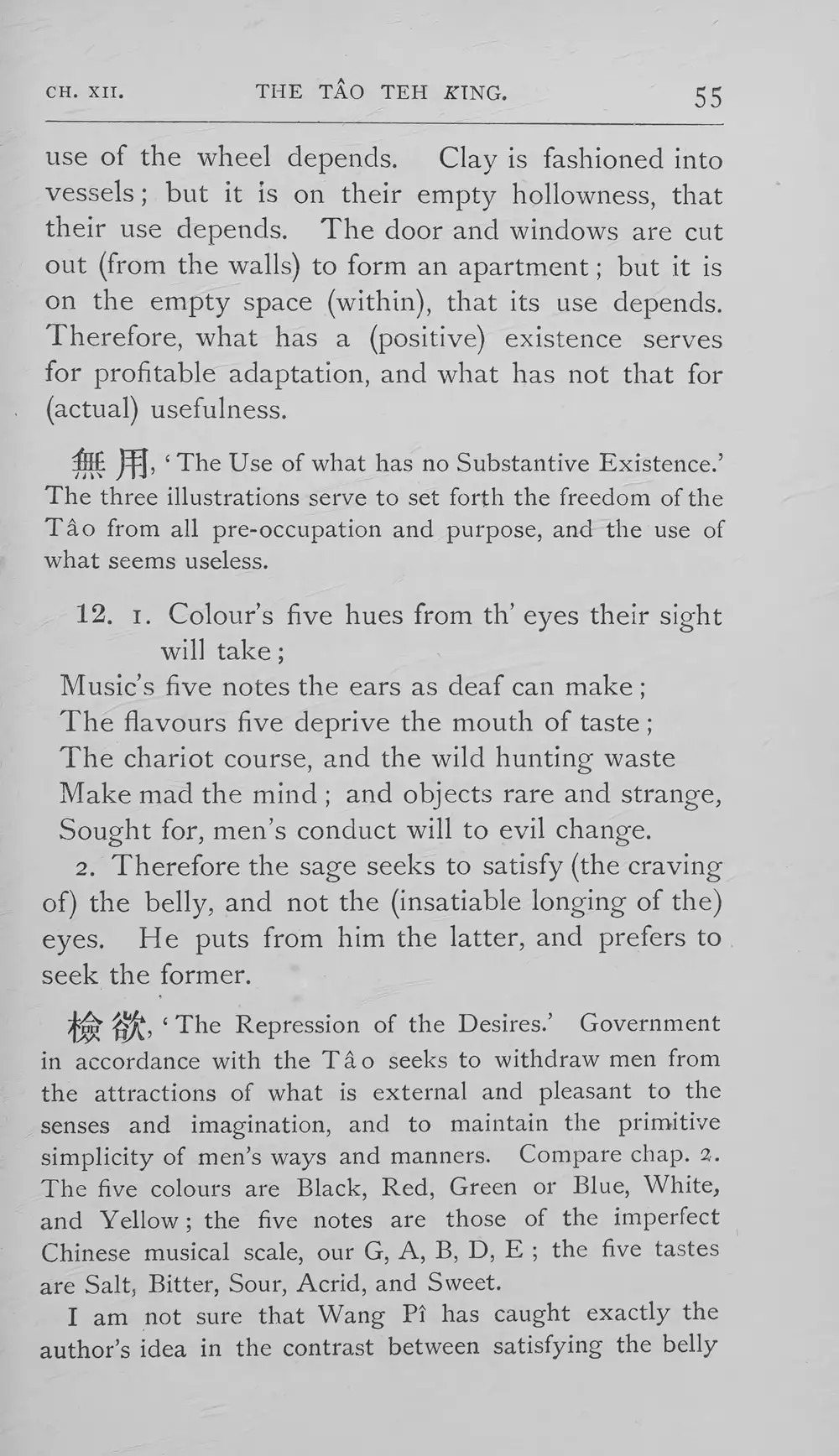
無用, ‘The Use of what has no Substantive Existence.’ The three illustrations serve to show the Tao’s freedom from all preoccupation and purpose, and the use of what seems useless.
12. 1. Colour’s five hues will take their sight from the eyes; music’s five notes can make the ears as if deaf; the five flavours rob the mouth of taste; chariot racing and the wild hunt waste and madden the mind; and rare and strange objects, once sought after, turn men’s conduct to evil.
2. Therefore the sage seeks to satisfy (the craving of) the belly, and not the (insatiable longing of the) eyes. He puts the latter away from him, and prefers to seek the former.
檢欲, ‘The Repression of the Desires.’ Government in accordance with the Tâo seeks to draw men away from the attractions of what is external and pleasing to the senses and the imagination, and to maintain the primitive simplicity of their ways and manners. Compare chap. 2. The five colours are Black, Red, Green or Blue, White, and Yellow; the five notes are those of the imperfect Chinese musical scale, our G, A, B, D, E; the five tastes are Salt, Bitter, Sour, Acrid, and Sweet.
I am not sure that Wang Pi has caught the author’s idea exactly in the contrast between satisfying the belly and satisfying the eyes; but what he says is ingenious: ‘In satisfying the belly one nourishes oneself; in gratifying the eyes one makes oneself a slave.’