Legge admits he could not make par. 2 of chapter 2 rhyme, though the Chinese rhymes throughout. So his verse renderings mark where his English succeeded, not where the Chinese is in verse: a chapter he gives in prose may still rhyme in the original. A reader comparing chapters should not infer the form of the King from the form of the English.
The Tâo Teh King — Sacred Books of China Part I, SBE Vol. 39 (trans. James Legge, 1891)
Open to all
page 49
No image is selected for this page; its own page image is shown.
page 49
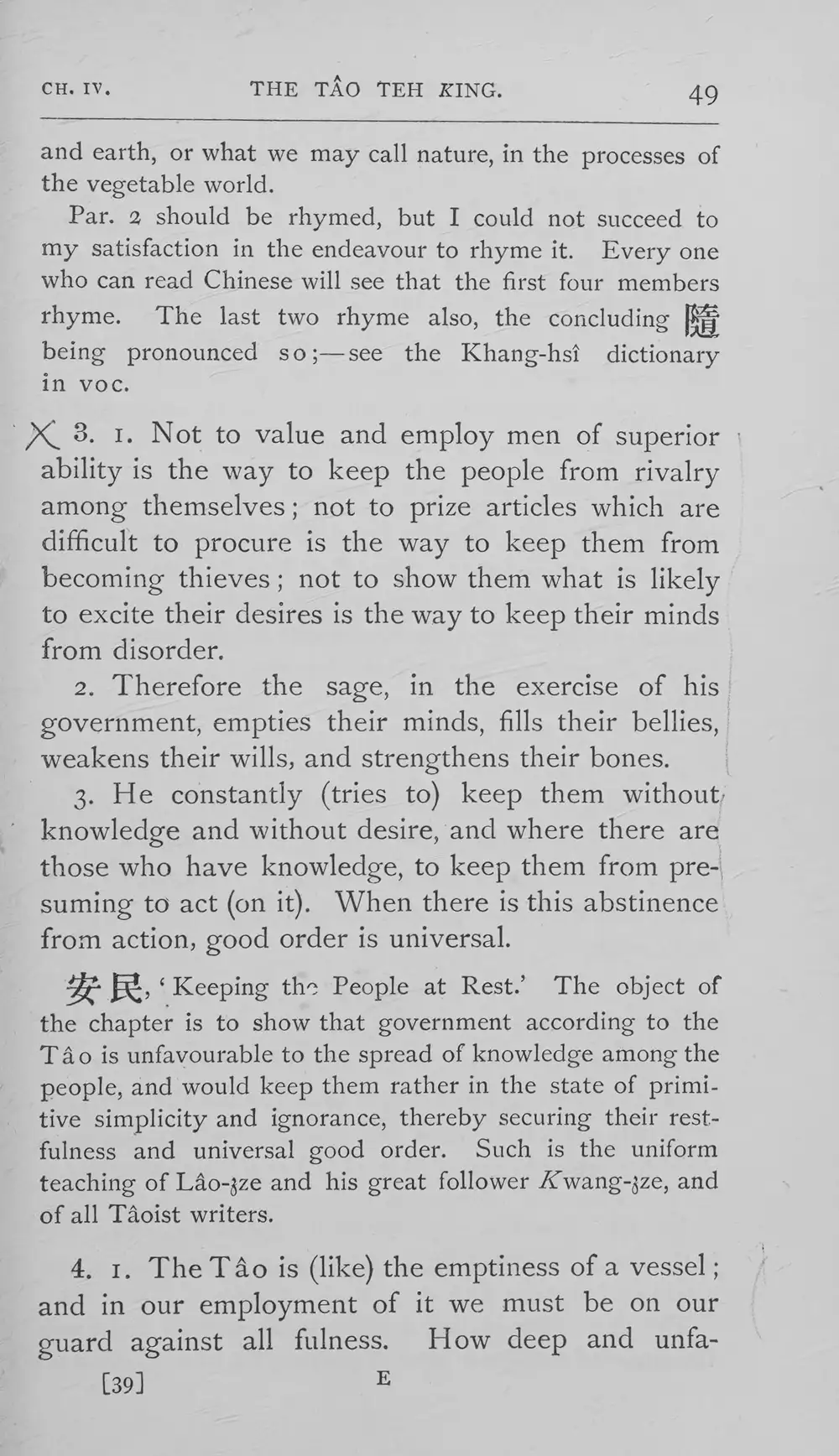
Paragraph 2 should be rhymed, but I could not succeed to my satisfaction in my attempt to rhyme it. Anyone who can read Chinese will see that the first four members rhyme. The last two rhyme as well, the closing 隨 [Press: to follow] being pronounced so;—see the Khang-hsi dictionary under the word.
3. 1. Not to value and employ men of superior ability is the way to keep the people from rivalry among themselves; not to prize articles that are hard to obtain is the way to keep them from becoming thieves; not to show them what is likely to excite their desires is the way to keep their minds from disorder.
2. So the sage, in the exercise of his government, empties their minds, fills their bellies, weakens their wills and strengthens their bones.
3. He constantly (tries to) keep them without knowledge and without desire, and, where there are those who have knowledge, to keep them from presuming to act (on it). When there is this abstaining from action, good order is universal.
安民, ‘Keeping the People at Rest.’ The aim of the chapter is to show that government according to the Tao is unfavourable to the spread of knowledge among the people, and would rather keep them in the state of primitive simplicity and ignorance, so securing their restfulness and universal good order. Such is the uniform teaching of Lâo-ȝze and his great follower Kwang-ȝze, and of all Taoist writers.
4. 1. The Tâo is (like) the emptiness of a vessel; and in our use of it we must be on our guard against all fulness. How deep and unfathomable it is, as if it were the Honoured Ancestor of all things!
The supplied ‘(tries to)’ softens the text’s flat statement that the sage keeps the people without knowledge and desire. Yet Legge’s own note on the same page states the aim without softening: government by the Tao keeps people in ‘primitive simplicity and ignorance.’ The parenthesis is gentler than his commentary, and the commentary is closer to the Chinese.