Legge links the paired opposites of chapter 2, existence and non-existence, difficulty and ease, to the contraries of chapter 40, and reads the sage who “manages affairs without doing anything” as the same law in action. The link is well made: the chapter moves from pairs that define each other to a ruler who forces neither side, the structure the later chapter states as a rule. It shows Legge reading the book as a system, the strength and the risk of his notes.
The Tâo Teh King — Sacred Books of China Part I, SBE Vol. 39 (trans. James Legge, 1891)
Open to all
page 48
No image is selected for this page; its own page image is shown.
page 48
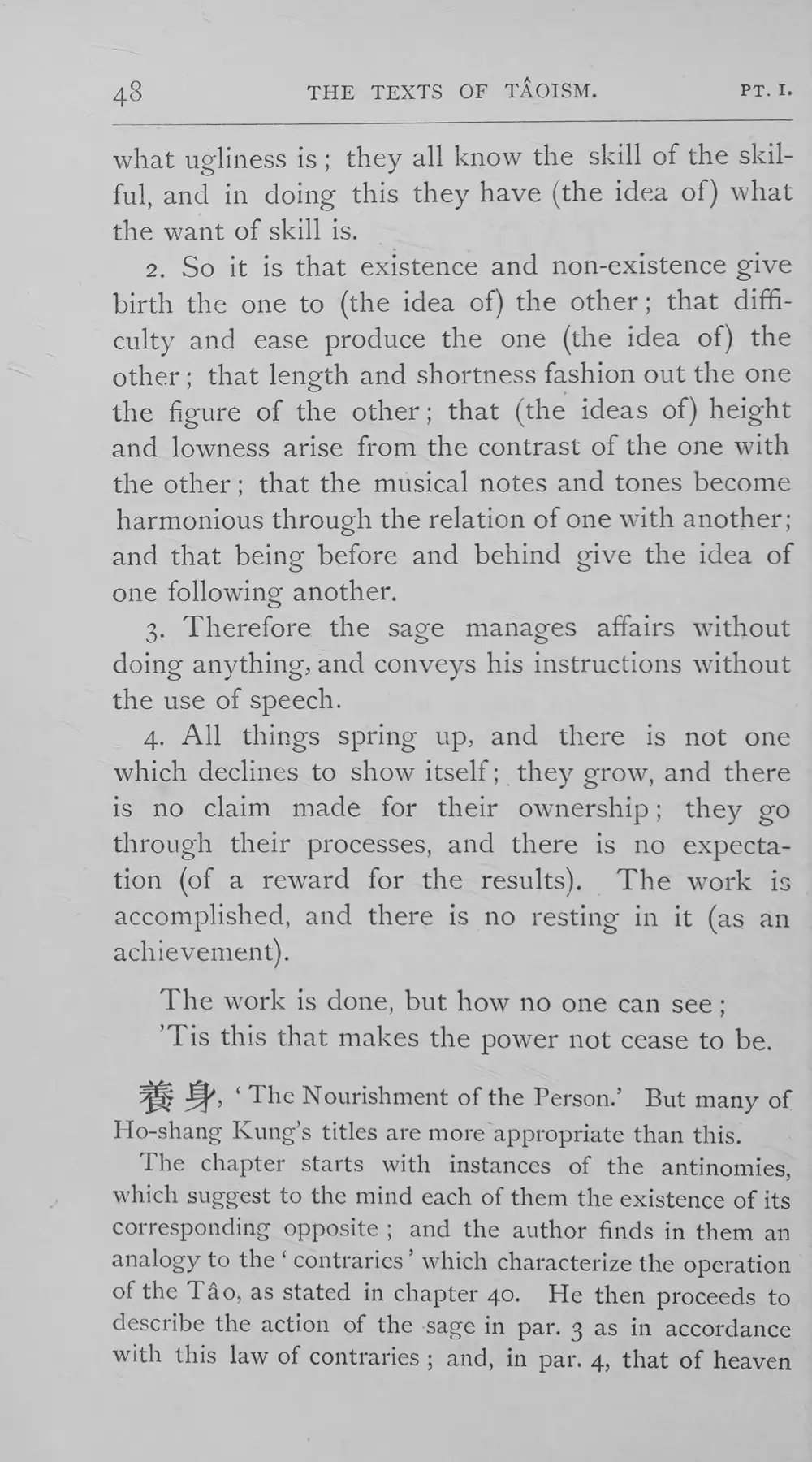
2. So it is that existence and non-existence give birth each to (the idea of) the other; that difficulty and ease produce each (the idea of) the other; that length and shortness shape each the figure of the other; that (the ideas of) height and lowness arise from the contrast of the one with the other; that musical notes and tones become harmonious through their relation to one another; and that being before and behind give the idea of one following another.
3. So the sage manages affairs without doing anything, and gives his instruction without the use of speech.
4. All things spring up, and not one of them declines to show itself; they grow, and no claim is made to own them; they go through their processes, and there is no expectation (of a reward for the results). The work is accomplished, and there is no resting in it (as an achievement).
The work is done, but how, no one can see;
It is this that keeps the power from ceasing to be.
養身, ‘The Nourishment of the Person.’ But many of Ho-shang Kung’s titles are more fitting than this one.
The chapter begins with instances of antinomies, each of which suggests to the mind the existence of its corresponding opposite; and the author finds in them an analogy to the ‘contraries’ that characterise the operation of the Tao, as stated in chapter 40. He then goes on to describe the action of the sage in paragraph 3 according to the law of contraries; and, in paragraph 4, that of heaven and earth, or what we may call nature, in the processes of the vegetable world.
Legge's comment on the title “The Nourishment of the Person”, that “many of Ho-shang Kung’s titles are more appropriate than this”, shows him using the inherited titles while judging them. The chapter concerns opposites that define each other and a sage who acts without claiming; nothing in it is about nourishing the body. The title reads the chapter as self-cultivation, which is the commentator's emphasis rather than the text's.