Legge's first sentence commits him: “The Tâo that can be trodden is not the enduring and unchanging Tâo.” Most readers take the second Tao in the line as a verb meaning to speak of, so that the line concerns language. Legge takes it as to tread, in keeping with his argument that the word's root sense is road, and so turns the opening from a statement about naming into one about practice. The next sentence, on the name that can be named, carries the point about language either way.
The Tâo Teh King — Sacred Books of China Part I, SBE Vol. 39 (trans. James Legge, 1891)
Open to all
page 47
No image is selected for this page; its own page image is shown.
page 47
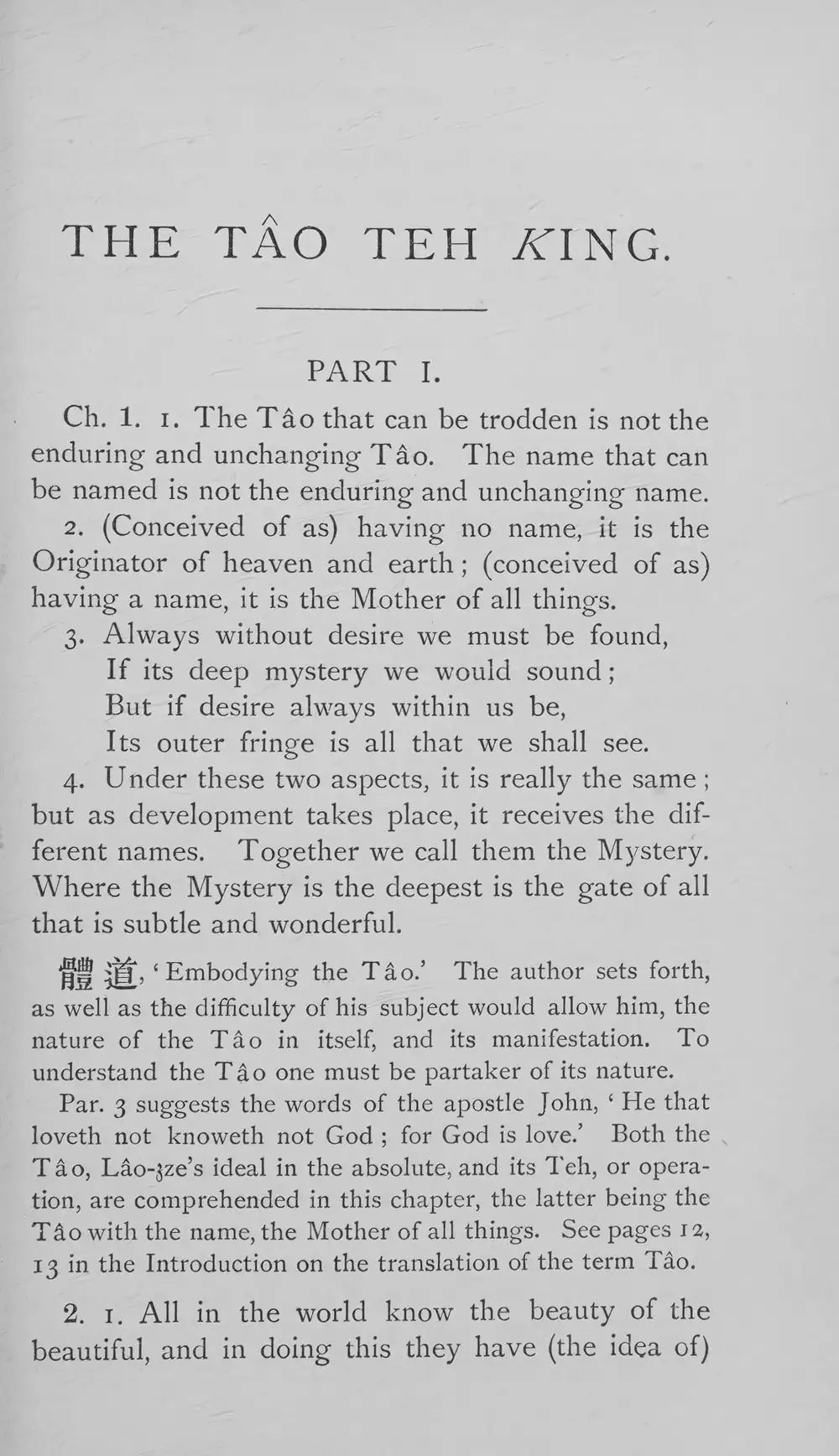
THE TAO TEH KING.
PART I.
Chapter 1. 1. The Tâo that can be trodden is not the enduring and unchanging Tâo. The name that can be named is not the enduring and unchanging name.
2. (Thought of as) having no name, it is the Originator of heaven and earth; (thought of as) having a name, it is the Mother of all things.
3. We must always be found without desire
If we would sound its deep mystery;
But if desire is always within us,
Its outer fringe is all that we shall see.
4. Under these two aspects it is really the same; but as development takes place it receives different names. Together we call them the Mystery. Where the Mystery is deepest is the gate of all that is subtle and wonderful.
體道, ‘Embodying the Tâo.’ The author sets out, as well as the difficulty of his subject allows him, the nature of the Tâo in itself and its manifestation. To understand the Tao one must share in its nature.
Paragraph 3 recalls the words of the apostle John, ‘He who does not love does not know God; for God is love.’ Both the Tao, Lâo-ȝze’s ideal in the absolute, and its Teh, or operation, are included in this chapter, the latter being the Tao with the name, the Mother of all things. See pages 12 and 13 of the Introduction on the translation of the term Tao.
2. 1. All in the world know the beauty of the beautiful, and in doing this they have (the idea of) what ugliness is; they all know the skill of the skilful, and in doing this they have (the idea of) what the want of skill is.
Legge's note finds that paragraph 3 “suggests the words of the apostle John”. The paragraph's claim is about desire: without it one sounds the mystery, with it one sees only the “outer fringe”. That is a condition of perception, not of love, and the parallel with John says more about the translator's habit of reading than about the chapter. His rhymed rendering of the paragraph, by contrast, keeps the contrast cleanly.