Legge's claim that in the Tao Teh King “Never once is Thien used in the sense of God” governs his translation, and he grounds it in grammar: in “The Tao of Heaven” the word is “more an adjective than a noun”. On this reading Heaven names a manner, quiet and without striving, not an agent. It is a defensible reading, and it explains why his version keeps Heaven wherever a Confucian text in his hands would have allowed God.
The Tâo Teh King — Sacred Books of China Part I, SBE Vol. 39 (trans. James Legge, 1891)
Open to all
page 16
No image is selected for this page; its own page image is shown.
page 16
Usage of the term Thien.
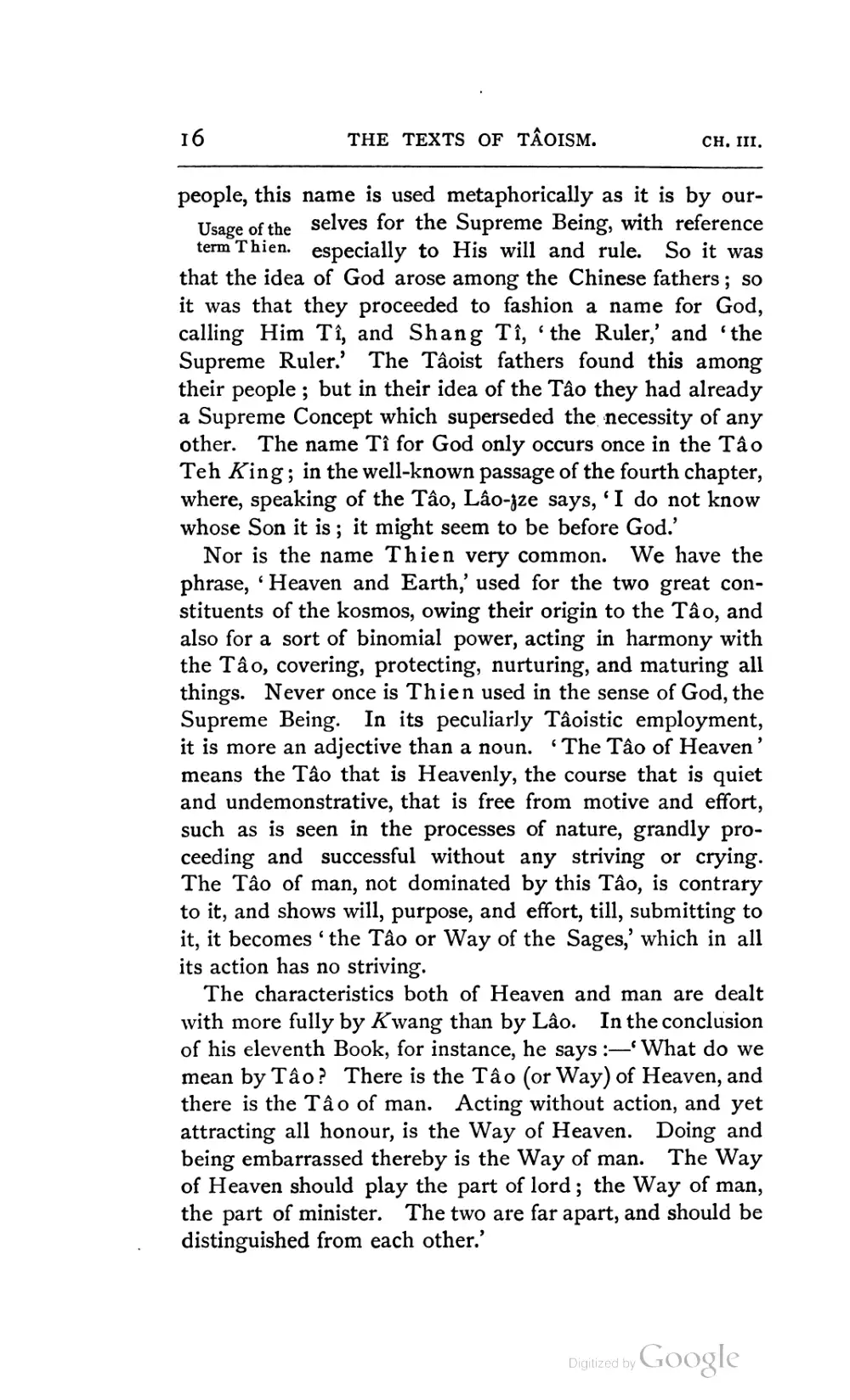
Nor is the name Thien very common. We have the phrase ‘Heaven and Earth’, used for the two great constituents of the kosmos, which owe their origin to the Tao, and also for a sort of binomial power acting in harmony with the Tao, covering, protecting, nurturing, and maturing all things. Never once is Thien used in the sense of God, the Supreme Being. In its peculiarly Taoistic use it is more an adjective than a noun. ‘The Tao of Heaven’ means the Tao that is Heavenly, the course that is quiet and undemonstrative, free from motive and effort, such as is seen in the processes of nature, proceeding grandly and succeeding without any striving or crying out. The Tao of man, not governed by this Tao, is contrary to it, and shows will, purpose, and effort, until, submitting to it, it becomes ‘the Tao or Way of the Sages, which in all its action has no striving’.
The characteristics both of Heaven and of man are dealt with more fully by Kwang than by Lao. In the conclusion of his eleventh Book, for instance, he says:—‘What do we mean by Tao? There is the Tao (or Way) of Heaven, and there is the Tao of man. Acting without action, and yet drawing all honour, is the Way of Heaven. Doing, and being encumbered by it, is the Way of man. The Way of Heaven should play the part of lord; the Way of man, the part of minister. The two are far apart, and should be distinguished from each other.’