The Tâo Teh King — Sacred Books of China Part I, SBE Vol. 39 (trans. James Legge, 1891)

Open to allEdited by F. Max Müller; translated by Müller, Legge, Bühler, West, Darmesteter, Palmer, Telang, Thibaut, Jolly, Rhys Davids, Oldenberg, Jacobi, Bloomfield and others1850 segments · 383 pp
page 14

No image is selected for this page; its own page image is shown.

The Tâo Teh King — Sacred Books of China Part I, SBE Vol. 39 (trans. James Legge, 1891), photo of the original · p. 14
Photo of the original · p. 14
The Tâo Teh King — Sacred Books of China Part I, SBE Vol. 39 (trans. James Legge, 1891), photo of the original · p. 15
Photo of the original · p. 15
page 14

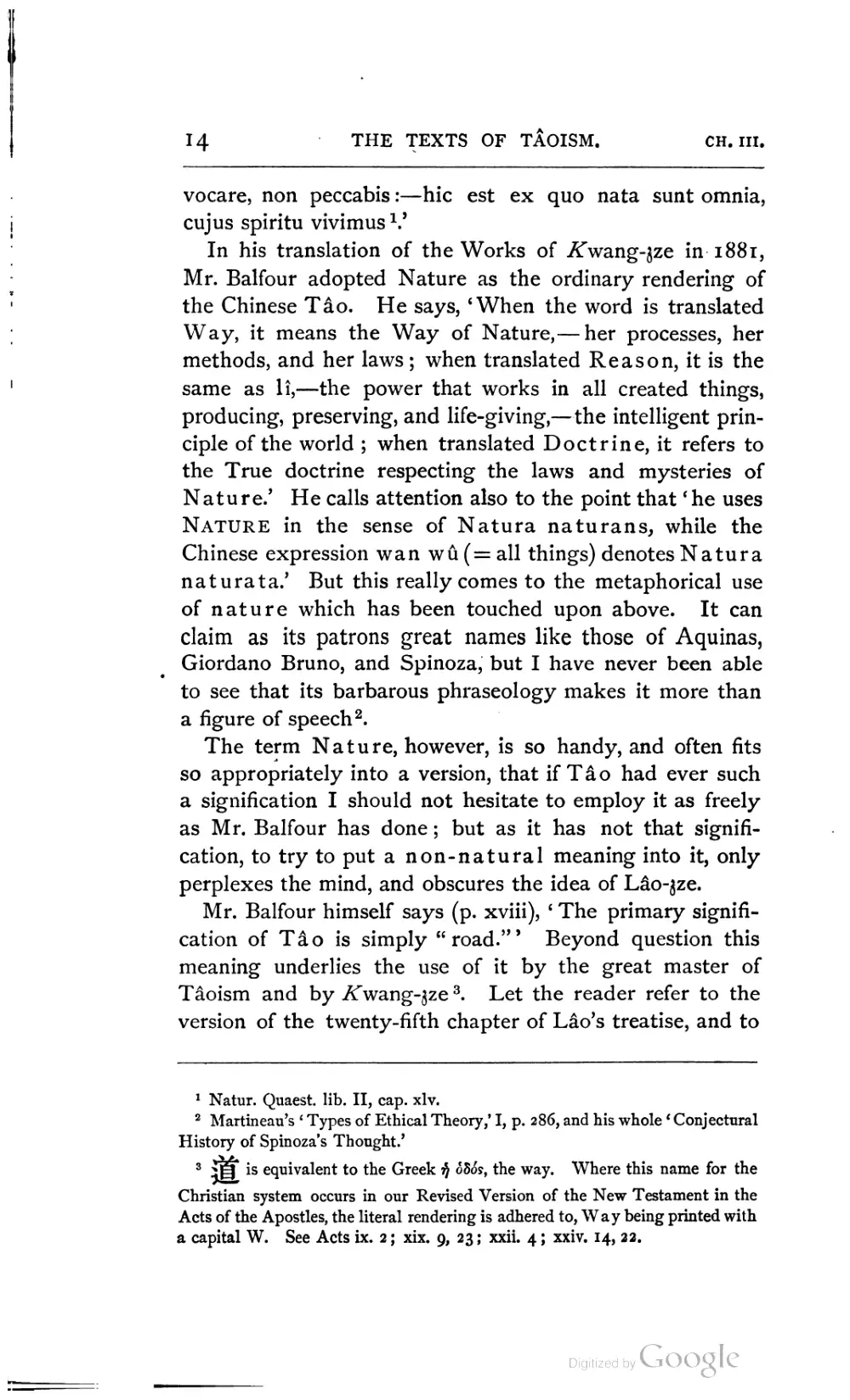
In his translation of the Works of Kwang-ȝze in 1881, Mr. Balfour adopted Nature as the usual rendering of the Chinese Tao. He says, ‘When the word is translated Way, it means the Way of Nature,—her processes, her methods, and her laws; when translated Reason, it is the same as li,—the power that works in all created things, producing, preserving, and giving life,—the intelligent principle of the world; when translated Doctrine, it refers to the true doctrine about the laws and mysteries of Nature.’ He also draws attention to the point that ‘he uses NATURE in the sense of nature naturing (Natura naturans), while the Chinese expression wan wû (= all things) denotes nature natured (Natura naturata)’.

But this really comes down to the metaphorical use of nature which has been touched on above. It can claim as its patrons great names such as Aquinas, Giordano Bruno, and Spinoza, but I have never been able to see that its barbarous phraseology makes it more than a figure of speech2.

The term Nature, however, is so handy, and often fits so aptly into a version, that if Tao had ever had such a meaning I should not hesitate to use it as freely as Mr. Balfour has done; but since it has no such meaning, trying to put a non-natural meaning into it only perplexes the mind and obscures the idea of Lâo-ȝze.

Mr. Balfour himself says (p. xviii), ‘The primary meaning of Tao is simply “road”.’ Beyond question this meaning underlies its use by the great master of Taoism and by Kwang-ȝze. Let the reader turn to the version of the … chapter of Lao’s treatise, and to the notes added to it.

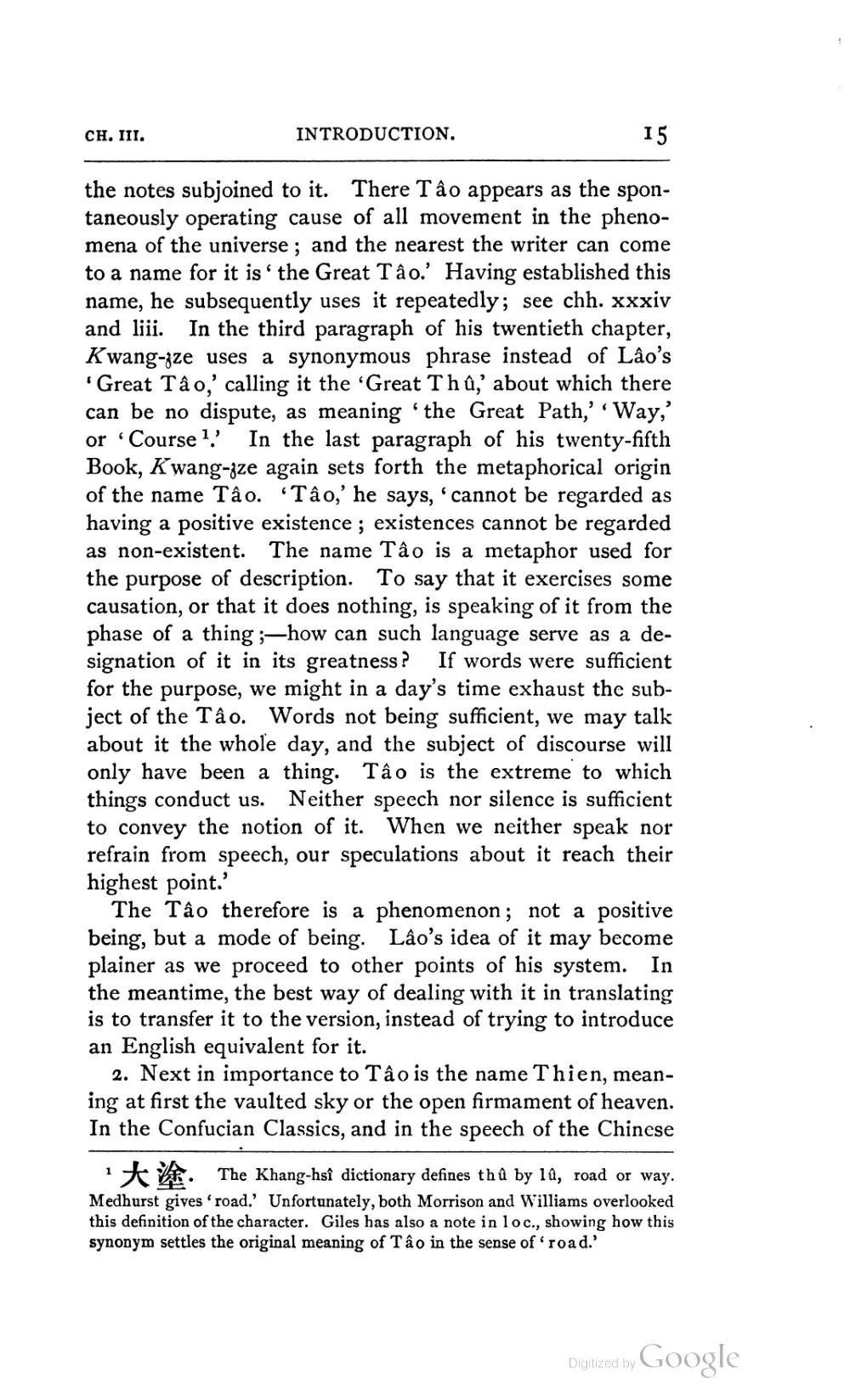
There Tâo appears as the spontaneously operating cause of all movement in the phenomena of the universe; and the nearest the writer can come to a name for it is ‘the Great Tao’. Having established this name, he afterwards uses it repeatedly; see chh. xxxiv and liii. In the third paragraph of his twentieth chapter, Kwang-ȝze uses a synonymous phrase instead of Lao’s ‘Great Tao’, calling it the ‘Great Thû’, about which there can be no dispute, as meaning ‘the Great Path’, ‘Way’, or ‘Course’.

In the last paragraph of his twenty-fifth Book, Kwang-ȝze again sets out the metaphorical origin of the name Tao. ‘Tao,’ he says, ‘cannot be regarded as having a positive existence; existences cannot be regarded as non-existent. The name Tao is a metaphor used for the purpose of description. To say that it exercises some causation, or that it does nothing, is to speak of it from the standpoint of a thing;—how can such language serve to designate it in its greatness? If words were sufficient for the purpose, we might exhaust the subject of the Tao in a day. Since words are not sufficient, we may talk about it the whole day long, and the subject of our talk will only have been a thing. Tao is the extreme to which things lead us. Neither speech nor silence is sufficient to convey the notion of it. When we neither speak nor refrain from speaking, our speculations about it reach their highest point.’
1 Natural Questions (Natur. Quaest.), Book II, ch. xlv.

2 Martineau’s ‘Types of Ethical Theory’, I, p. 286, and his whole ‘Conjectural History of Spinoza’s Thought’.

3 道 is equivalent to the Greek ἡ ὁδός, the way. Where this name for the Christian system occurs in our Revised Version of the New Testament, in the Acts of the Apostles, the literal rendering is kept, Way being printed with a capital W. See Acts ix. 2; xix. 9, 23; xxii. 43 xxiv. 14, 22.

Commentary
page 14 ·
Cross-Estate§103

The best evidence for leaving Tao untranslated is the sentence Legge quotes from Kwang-ȝze's twenty-fifth Book: “The name Tao is a metaphor used for the purpose of description.” If the text's own author treats the name as a figure for what words cannot reach, any English equivalent, Way, Reason or Nature, hardens the figure into a doctrine. Legge saw this, and it justifies his choice better than his theology does. Book XXV is in the second volume.

cites The Writings of Kwang-tze — Sacred Books of China Part II, SBE Vol. 40 (trans. James Legge, 1891)