“The Tao therefore is a phenomenon; not a positive being, but a mode of being.” The formula is Legge's, and it sits uneasily with what he has just quoted, where Tao is “the spontaneously operating cause of all movement”. A cause of all movement is more than a mode of being, and four pages on he reads Kwang-ȝze as saying that God “was what He is by virtue of Its operation”. The tension is in the texts; Legge's formula settles it too early.
The Tâo Teh King — Sacred Books of China Part I, SBE Vol. 39 (trans. James Legge, 1891)
Open to all
page 15
No image is selected for this page; its own page image is shown.
page 15
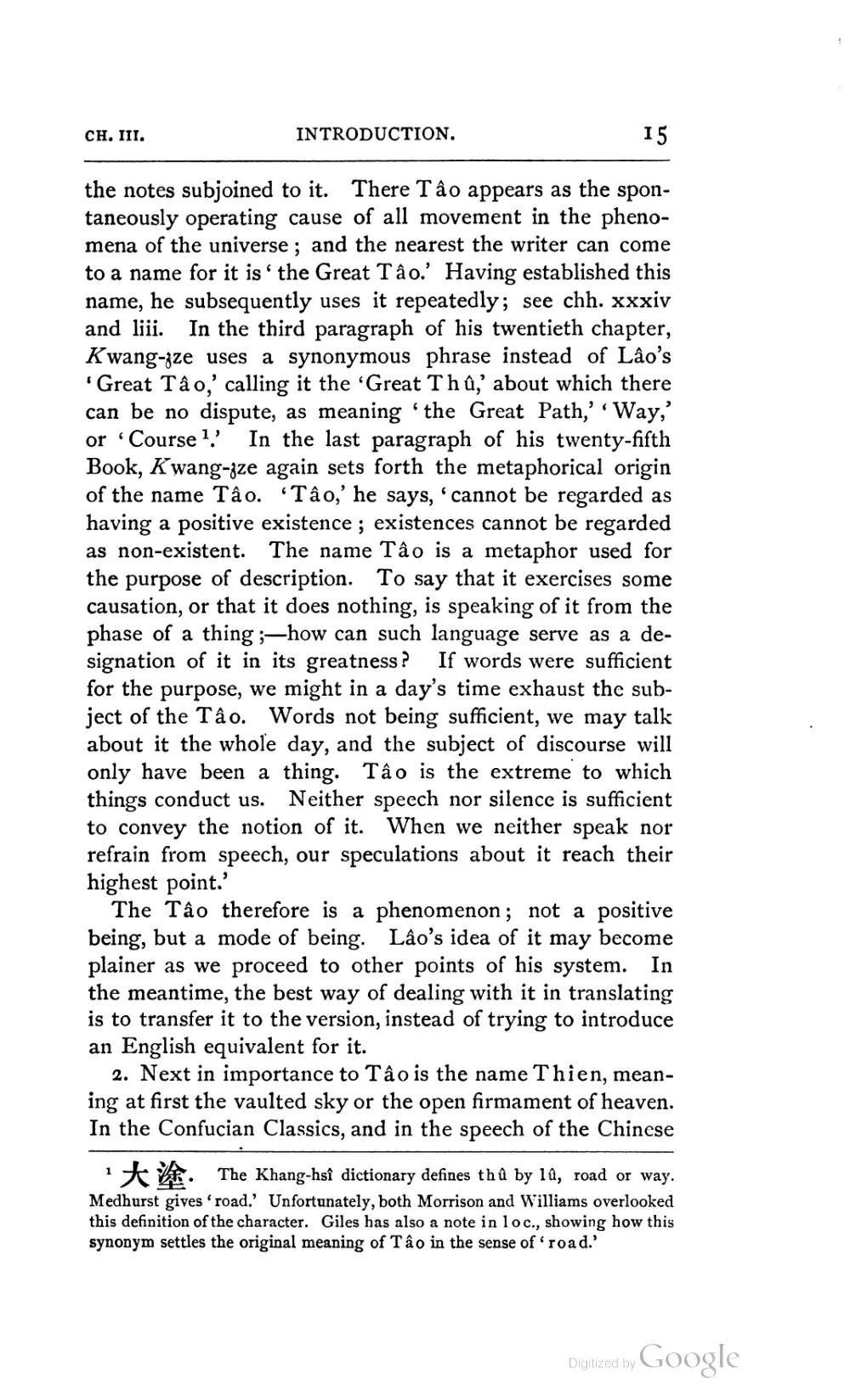
The Tao, therefore, is a phenomenon; not a positive being, but a mode of being. Lâo’s idea of it may become clearer as we go on to other points of his system. In the meantime, the best way of dealing with it in translating is to carry it over into the version, rather than trying to introduce an English equivalent for it.
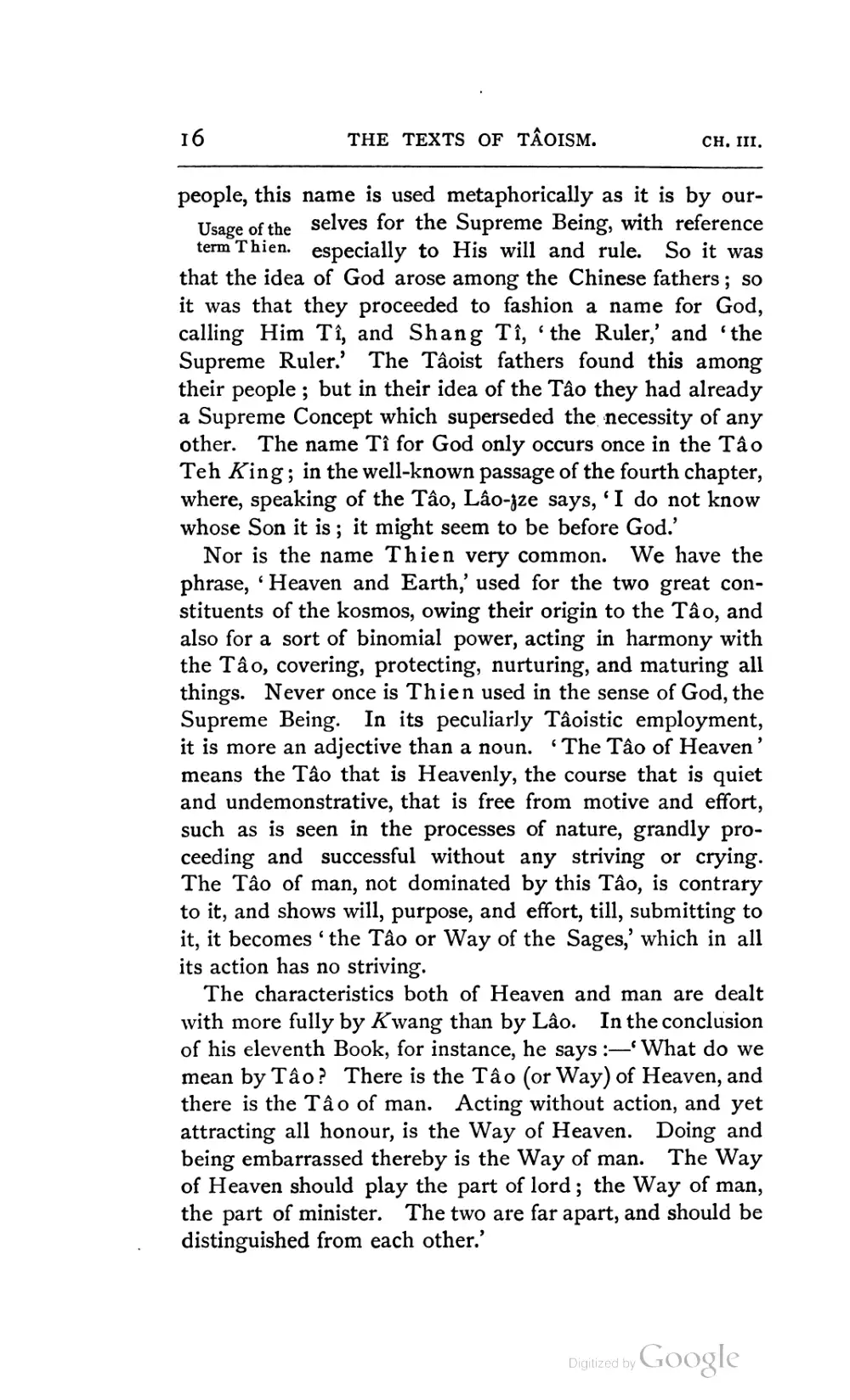
2. Next in importance to Tao is the name Thien, meaning at first the vaulted sky or the open firmament of heaven. In the Confucian Classics, and among the Chinese people, this name is used metaphorically, as it is by ourselves, for the Supreme Being, with reference especially to His will and rule. So it was that the idea of God arose among the Chinese fathers; so it was that they went on to fashion a name for God, calling Him Ti and Shang Ti, ‘the Ruler’ and ‘the Supreme Ruler’.
The Taoist fathers found this among their people; but in their idea of the Tao they already had a Supreme Concept which made any other unnecessary. The name Ti for God occurs only once in the Tao Teh King, in the well-known passage of the fourth chapter where, speaking of the Tao, Lâo-ȝze says, ‘I do not know whose Son it is; it might seem to be before God.’
1 大塗 [Press: a great road; a highway]. The Khang-hsî dictionary defines thû by lû, road or way. Medhurst gives ‘road’. Unfortunately, both Morrison and Williams overlooked this definition of the character. Giles also has a note on the passage, showing how this synonym settles the original meaning of Tao in the sense of ‘road’.
Legge's account of how “the idea of God arose among the Chinese fathers”, from the sky to Ti and Shang Ti, is the premise of his Confucian translations, where he renders those names as God, as in the Shû King on this shelf. Here it sets the Taoists apart: in Tao they had “a Supreme Concept which superseded the necessity of any other”. The contrast is useful, but it rests on an identification of Ti with God that Legge assumes rather than argues in this volume.