Legge's check on Giles is a model of method. A sentence that reads as translation, “God is a principle which exists by virtue of its own intrinsicality”, has, he says, no characters behind it in the text. He treats it as Giles's own definition slipped in by oversight, and turns it into evidence of what Giles meant by God. The inference is generous, and the textual point is one any reader with the Chinese can verify.
The Tâo Teh King — Sacred Books of China Part I, SBE Vol. 39 (trans. James Legge, 1891)
Open to all
page 18
No image is selected for this page; its own page image is shown.
page 18
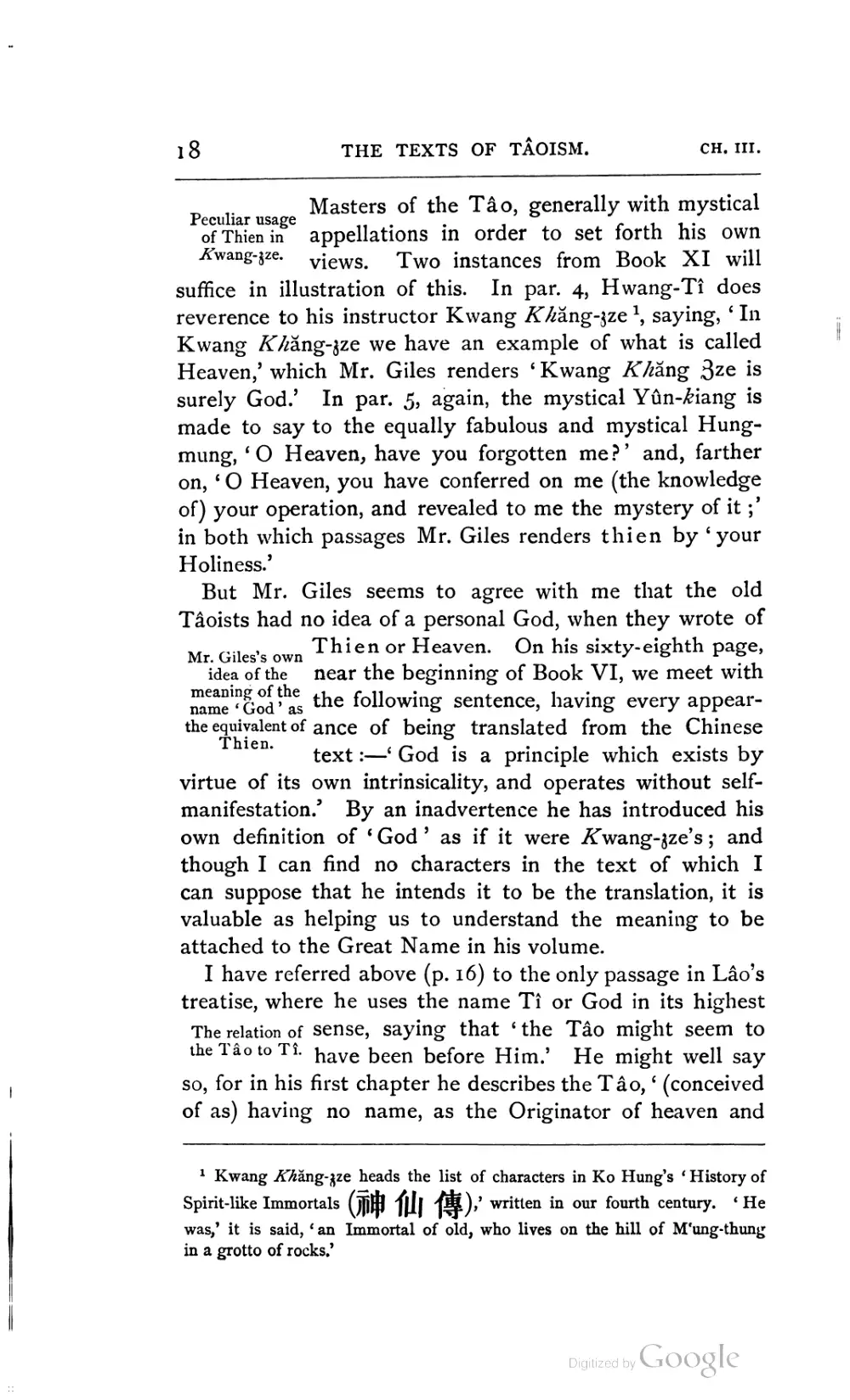
with mystical names, in order to set forth his own of Thien in.
Awang-3e.
But Mr. Giles seems to agree with me that the old Tâoists had no idea of a personal God when they wrote of Thien or Heaven. On his sixty-eighth page, near the beginning of Book VI, we meet with the following sentence, which has every appearance of being translated from the Chinese text:—‘God is a principle which exists by virtue of its own intrinsicality, and operates without self-manifestation.’ By an oversight he has introduced his own definition of ‘God’ as if it were Kwang-ȝze’s; and though I can find no characters in the text which I can suppose he intends it to translate, it is valuable as helping us to understand the meaning to be attached to the Great Name in his volume.
Mr. Giles’s own
I have referred above (p. 16) to the only passage in Lâo’s treatise where he uses the name Ti, or God, in its highest
sense, saying that ‘the Tao might seem to have been before Him’. He might well say so, for in his first chapter he describes the Tao, ‘(conceived of as) having no name, as the Originator of heaven and earth, and (conceived of as) having a name, as the Mother of all things’. The reader will also find the same predicates of the Tao at greater length in his fifty-first chapter.
the Tao toT!.
* Kwang Khăng-ȝze heads the list of characters in Ko Hung’s ‘History of Spirit-like Immortals (神仙傳)’, written in our fourth century. ‘He was,’ it is said, ‘an Immortal of old, who lives on the hill of M‘ung-thung in a grotto among the rocks.’