Legge holds that chapter 58 is “really the sequel” of 57, and the text bears him out. Its paragraph 2 opens “Shall we then dispense with correction?”, taking up the “(measures of) correction” by which a state may be ruled in 57.1; the question only makes sense as a reply. The chapter division, with its later title, hides the argument, and the two chapters should be read as one.
The Tâo Teh King — Sacred Books of China Part I, SBE Vol. 39 (trans. James Legge, 1891)
Open to all
page 102
No image is selected for this page; its own page image is shown.
page 102
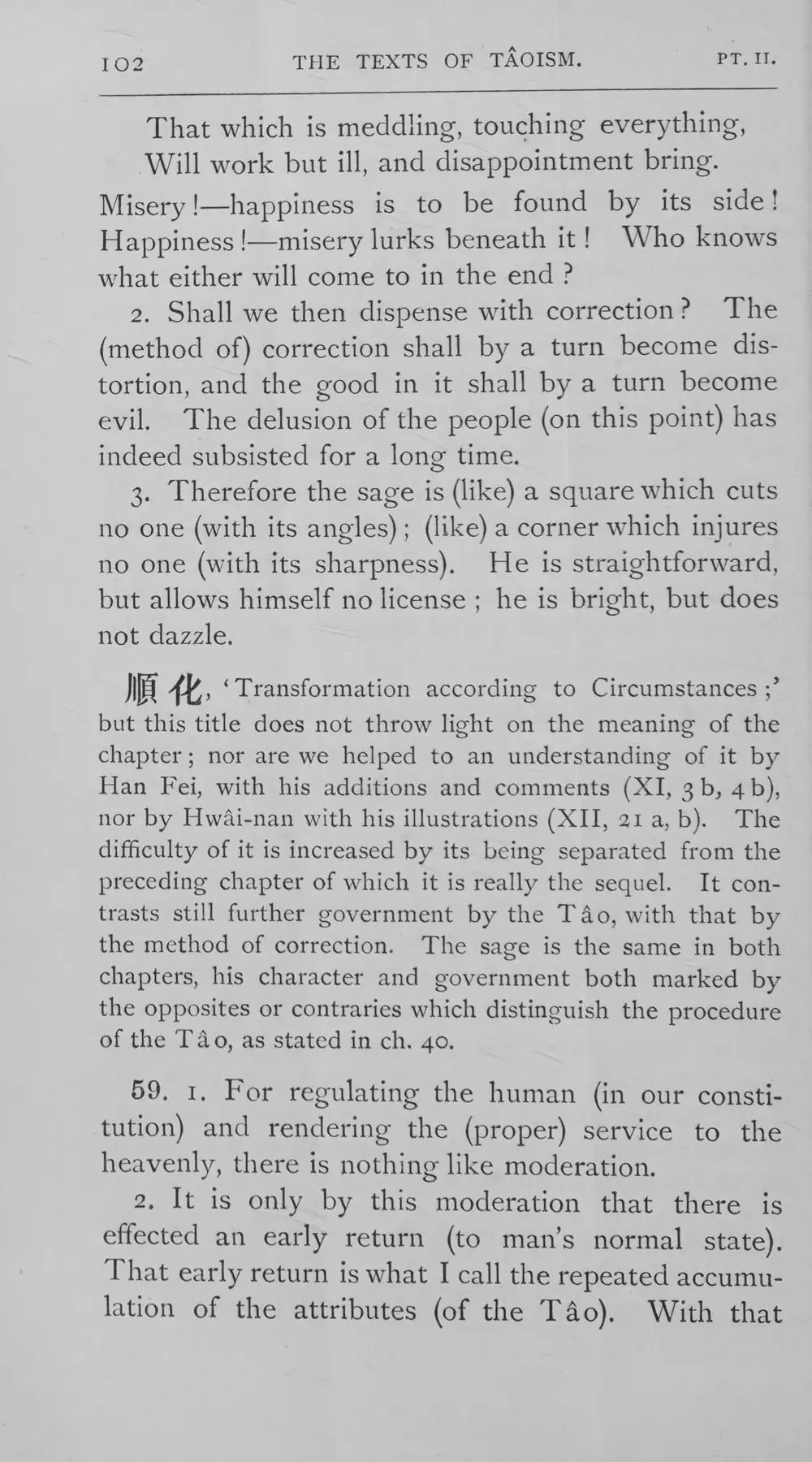
2. Shall we then dispense with correction? The (method of) correction shall by a turn become distortion, and the good in it shall by a turn become evil. The people’s delusion (on this point) has indeed lasted a long time.
3. Therefore the sage is (like) a square which cuts no one (with its angles); (like) a corner which injures no one (with its sharpness). He is straightforward, but allows himself no licence; he is bright, but does not dazzle.
順化, ‘Transformation according to Circumstances;’ but this title does not throw light on the meaning of the chapter; nor are we helped to understand it by Han Fei, with his additions and comments (XI, 3b, 4b), nor by Hwâi-nan with his illustrations (XII, 21a, b). Its difficulty is increased by its being separated from the preceding chapter, of which it is really the sequel. It contrasts further government by the Tâo with government by the method of correction. The sage is the same in both chapters, his character and government both marked by the opposites or contraries which distinguish the procedure of the Tâo, as stated in ch. 40.
59. 1. For regulating the human (in our constitution) and rendering the (proper) service to the heavenly, there is nothing like moderation.
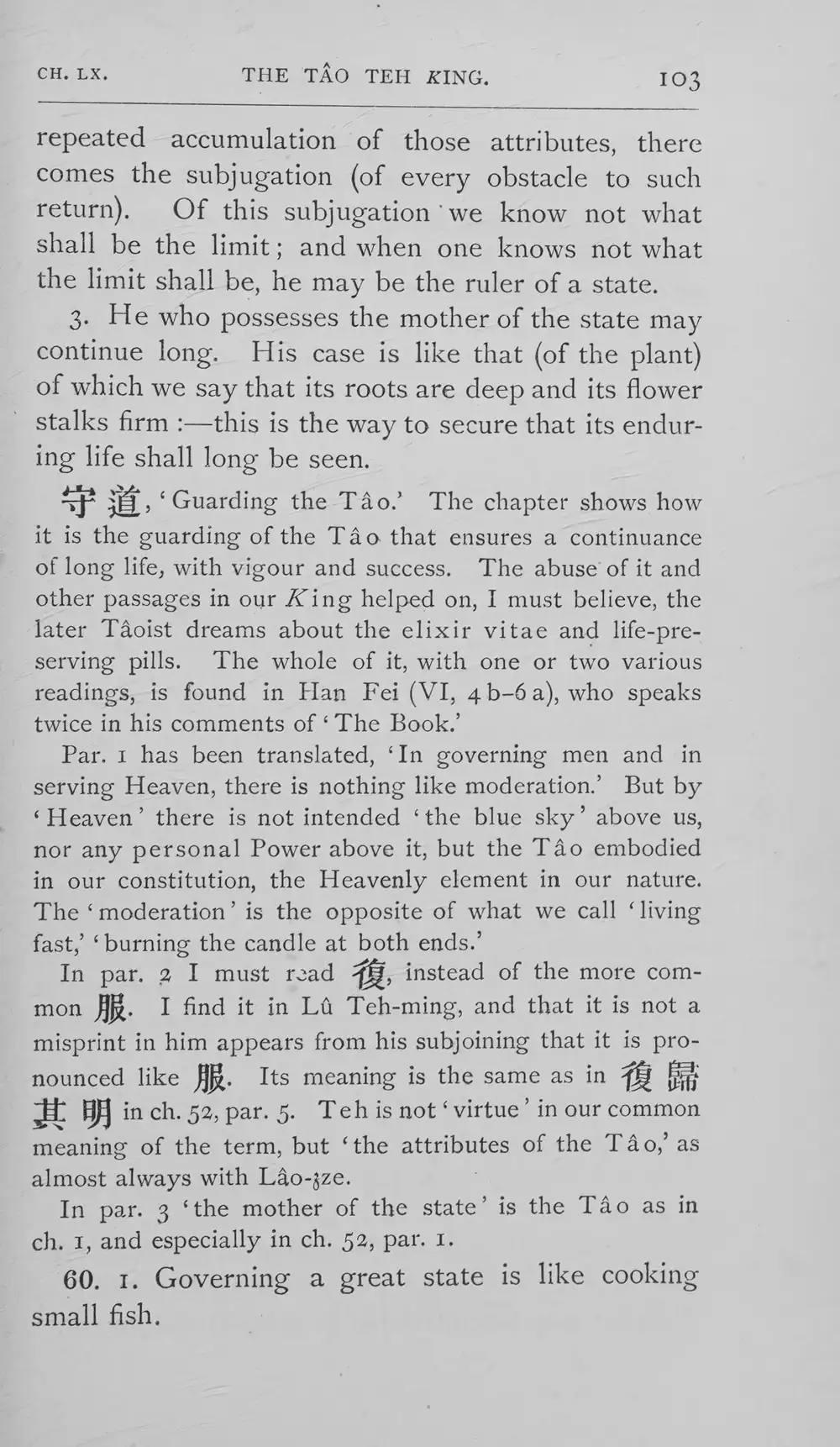
2. It is only by this moderation that an early return (to man’s normal state) is effected. That early return is what I call the repeated accumulation of the attributes (of the Tâo). With that repeated accumulation of those attributes, there comes the subjugation (of every obstacle to such return). Of this subjugation we do not know what the limit shall be; and when one does not know what the limit shall be, he may be the ruler of a state.