Without Legge's parentheses the line says flatly that he who knows does not speak, an odd claim at the head of a book that speaks at length. His supplied “(care to)” and “(ever ready to)” make it a remark about disposition, the knower's reluctance and the talker's eagerness, and so dissolve the paradox. The reading is defensible, but it is his: the English has resolved a tension the text may have meant to leave standing.
The Tâo Teh King — Sacred Books of China Part I, SBE Vol. 39 (trans. James Legge, 1891)
Open to all
page 100
No image is selected for this page; its own page image is shown.
page 100
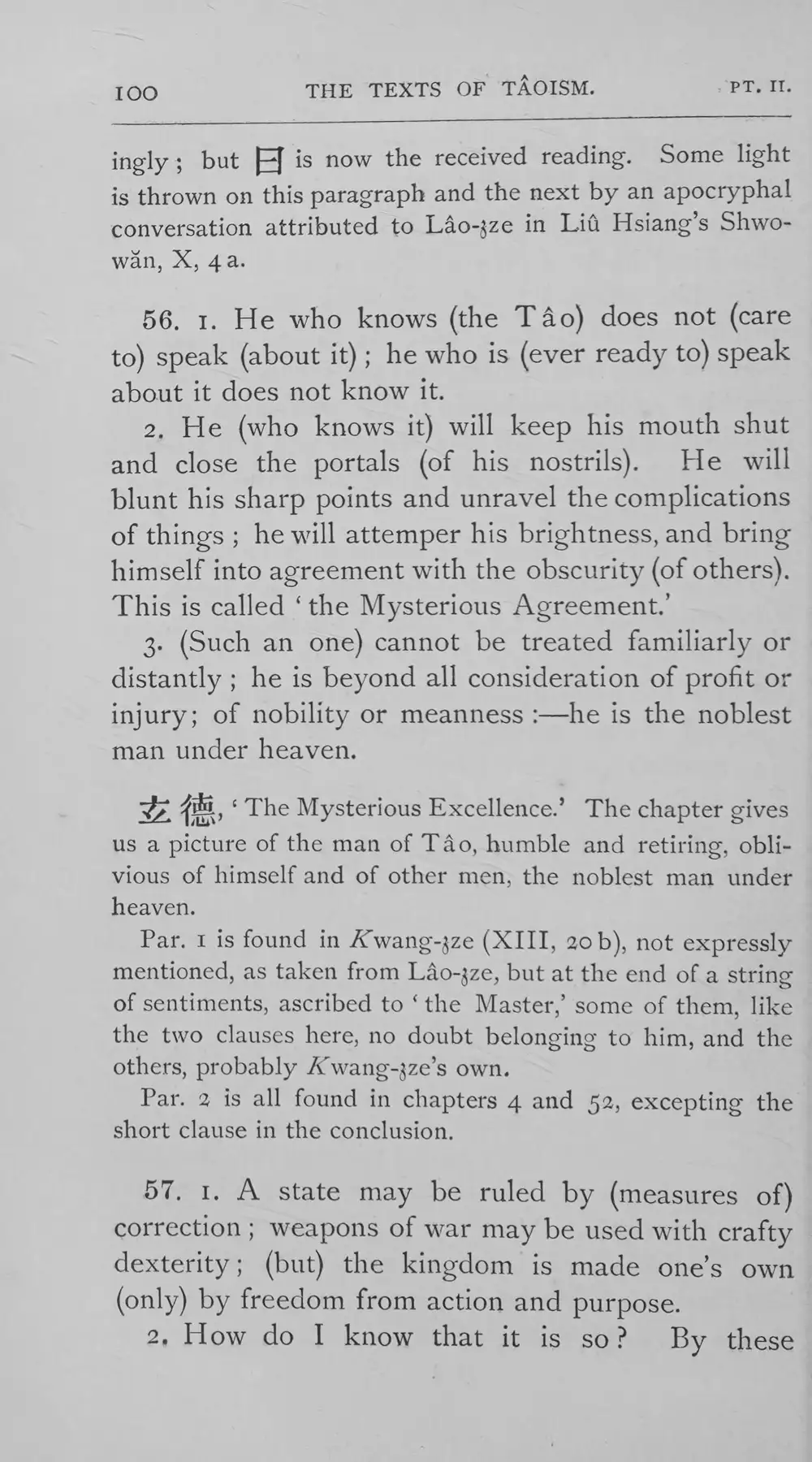
56. 1. He who knows (the Tâo) does not (care to) speak (about it); he who is (always ready to) speak about it does not know it.
2. He (who knows it) will keep his mouth shut and close the portals (of his nostrils). He will blunt his sharp points and unravel the complications of things; he will temper his brightness, and bring himself into agreement with the obscurity (of others). This is called ‘the Mysterious Agreement.’
3. (Such a one) cannot be treated familiarly or distantly; he is beyond all consideration of profit or injury, of nobility or meanness:—he is the noblest man under heaven.
玄德, ‘The Mysterious Excellence.’ The chapter gives us a picture of the man of Tâo, humble and retiring, oblivious of himself and of other men, the noblest man under heaven.
Par. 1 is found in Kwang-ȝze (XIII, 20b), not expressly mentioned as taken from Lâo-ȝze, but at the end of a string of sentiments ascribed to ‘the Master,’ some of them, like the two clauses here, no doubt belonging to him, and the others probably Kwang-ȝze’s own.
Par. 2 is all found in chapters 4 and 52, except the short clause at the end.
57. 1. A state may be ruled by (measures of) correction; weapons of war may be used with crafty dexterity; (but) the kingdom is made one’s own (only) by freedom from action and purpose.
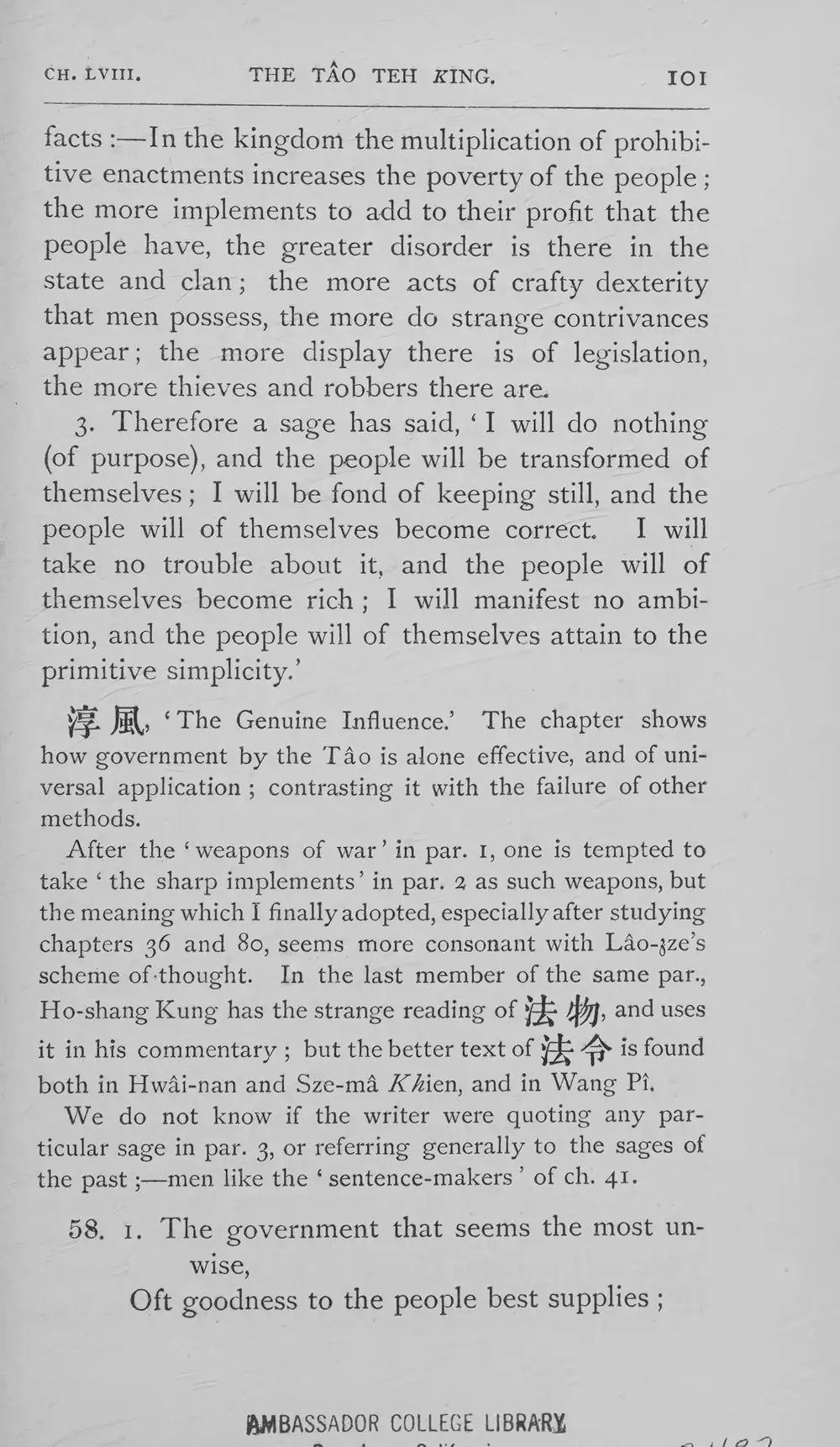
2. How do I know that it is so? By these facts:—In the kingdom, the multiplication of prohibitive enactments increases the poverty of the people; the more implements to add to their profit the people have, the greater the disorder in the state and clan; the more acts of crafty dexterity men possess, the more strange contrivances appear; the more display there is of legislation, the more thieves and robbers there are.