Legge glosses the small fish as ruling “in the most quiet and easy manner”. That catches the ease but not the warning: small fish fall apart if they are turned and stirred, so the image is about not handling. His gloss on the title, rule “free from all molestation seen and unseen”, states it better, and it is the reading that joins paragraph 1 to the spirits who, under such rule, do not hurt men.
The Tâo Teh King — Sacred Books of China Part I, SBE Vol. 39 (trans. James Legge, 1891)
Open to all
page 104
No image is selected for this page; its own page image is shown.
page 104
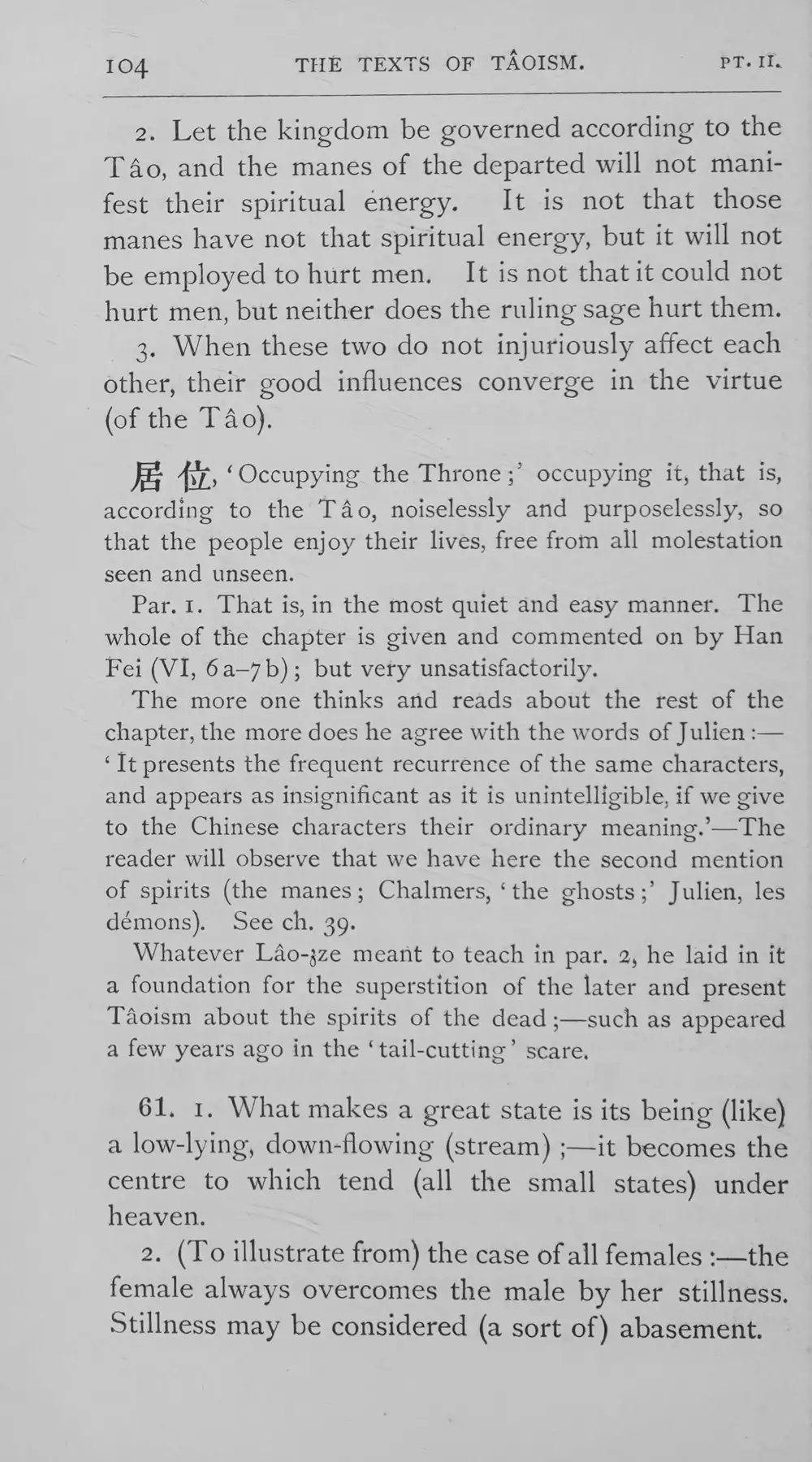
2. Let the kingdom be governed according to the Tâo, and the spirits (manes) of the departed will not show their spiritual energy. It is not that those spirits lack that spiritual energy, but it will not be used to hurt men. It is not that it could not hurt men, but neither does the ruling sage hurt them.
3. When these two do not injuriously affect each other, their good influences converge in the virtue (of the Tâo).
居位, ‘Occupying the Throne;’ occupying it, that is, according to the Tâo, noiselessly and without purpose, so that the people enjoy their lives, free from all molestation, seen and unseen.
Par. 1. That is, in the most quiet and easy manner. The whole of the chapter is given and commented on by Han Fei (VI, 6a-7b), but very unsatisfactorily.
The more one thinks and reads about the rest of the chapter, the more one agrees with the words of Julien:—‘It presents the frequent recurrence of the same characters, and appears as insignificant as it is unintelligible, if we give the Chinese characters their ordinary meaning.’—The reader will observe that we have here the second mention of spirits (the manes; Chalmers, ‘the ghosts;’ Julien, ‘the demons,’ les démons). See ch. 39.
Whatever Lâo-ȝze meant to teach in par. 2, he laid in it a foundation for the superstition of the later and present-day Tâoism about the spirits of the dead;—such as appeared a few years ago in the ‘tail-cutting’ scare.
61. 1. What makes a great state is its being (like) a low-lying, down-flowing (stream);—it becomes the centre towards which (all the small states) under heaven tend.
2. (To illustrate from) the case of all females:—the female always overcomes the male by her stillness. Stillness may be considered (a kind of) abasement.