Legge rejects “In governing men and in serving Heaven” and turns the pair inward, to the human and heavenly elements of one's own constitution. Yet the chapter ends with one who “may be the ruler of a state” and with “the mother of the state”, so the political reading he sets aside has the conclusion on its side. His version is a rule of self-cultivation that happens to qualify a ruler; the rejected one is a rule of government grounded in restraint, and the text supports both.
The Tâo Teh King — Sacred Books of China Part I, SBE Vol. 39 (trans. James Legge, 1891)
Open to all
page 103
No image is selected for this page; its own page image is shown.
page 103
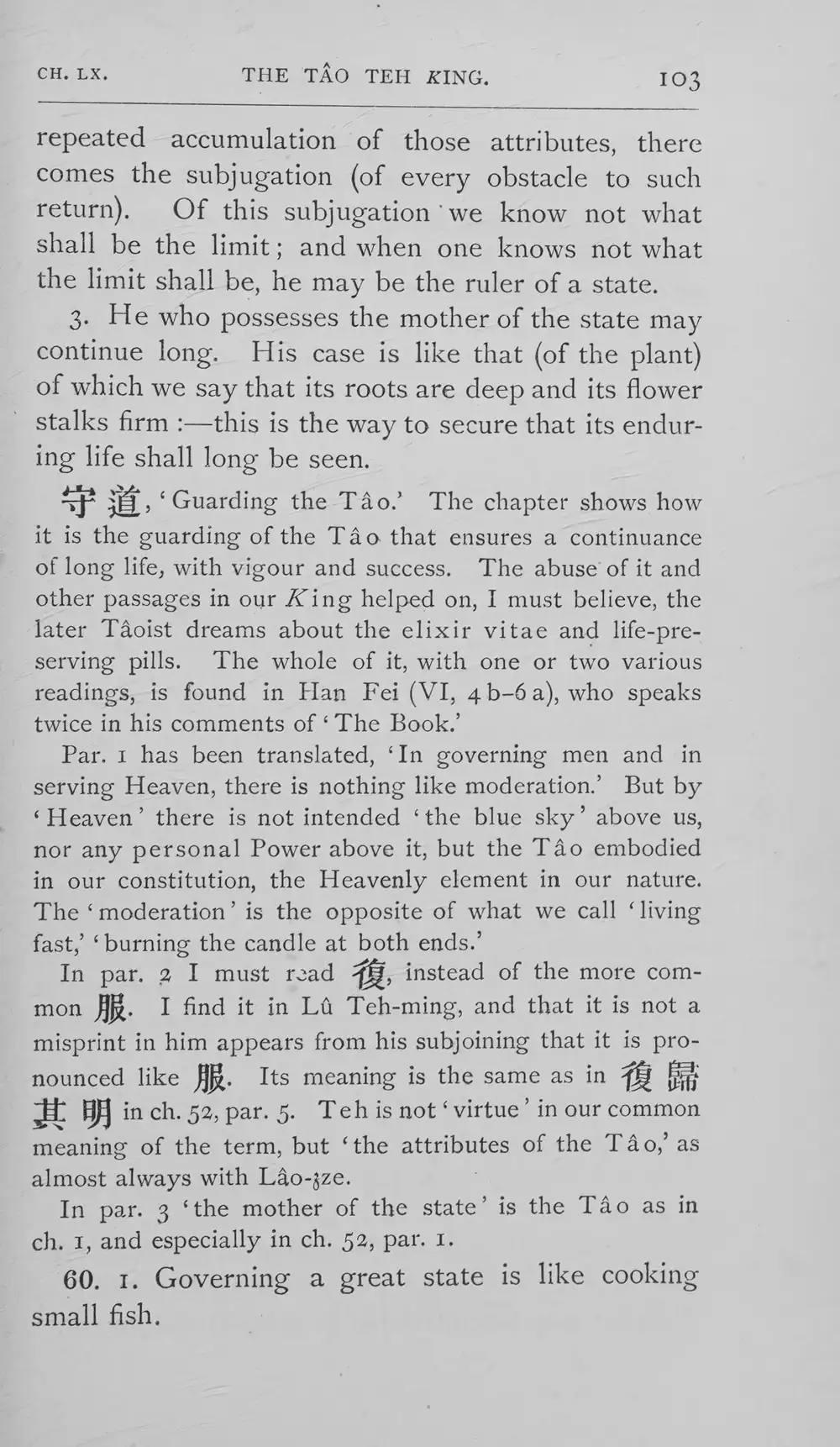
3. He who possesses the mother of the state may continue long. His case is like that (of the plant) of which we say that its roots are deep and its flower-stalks firm:—this is the way to ensure that its enduring life shall long be seen.
守道, ‘Guarding the Tâo.’ The chapter shows how it is the guarding of the Tâo that ensures a continuance of long life, with vigour and success. The abuse of it and of other passages in our King helped on, I must believe, the later Tâoist dreams about the elixir of life (elixir vitae) and life-preserving pills. The whole of it, with one or two various readings, is found in Han Fei (VI, 4b-6a), who twice speaks of ‘The Book’ in his comments.
Par. 1 has been translated, ‘In governing men and in serving Heaven, there is nothing like moderation.’ But by ‘Heaven’ is meant neither ‘the blue sky’ above us nor any personal Power above it, but the Tâo embodied in our constitution, the Heavenly element in our nature. The ‘moderation’ is the opposite of what we call ‘living fast,’ ‘burning the candle at both ends.’
In par. 2 I must read 復 [Press: to return; again], instead of the more common 服 [Press: to submit; to serve]. I find it in Lû Teh-ming, and that it is not a misprint in him appears from his adding that it is pronounced like 服 [Press: to submit; to serve]. Its meaning is the same as in 復歸 [Press: return to] 其明 [Press: its light] in ch. 52, par. 5. Teh is not ‘virtue’ in our common meaning of the term, but ‘the attributes of the Tâo,’ as almost always with Lâo-ȝze.
In par. 3, ‘the mother of the state’ is the Tâo, as in ch. 1, and especially in ch. 52, par. 1.
60. 1. Governing a great state is like cooking small fish.