The Satapatha-Brâhmana, Part IV — SBE Vol. 43 — trans. Julius Eggeling (1897)
The translator’s English as printed (Julius Eggeling). The original-language text is not held; names are romanised as the translator printed them.
47:2 Though, properly speaking, the Visvagyotis lies close to only one of the Disyâs, viz. the eastern one, it may at any rate be said to lie close to the range of the Disyâs. Here, too, the sense 'immediately after, not separated from them in respect of time,' would suit even better.
47:3 See VIII, 3, 1, 4 with note.
48:1
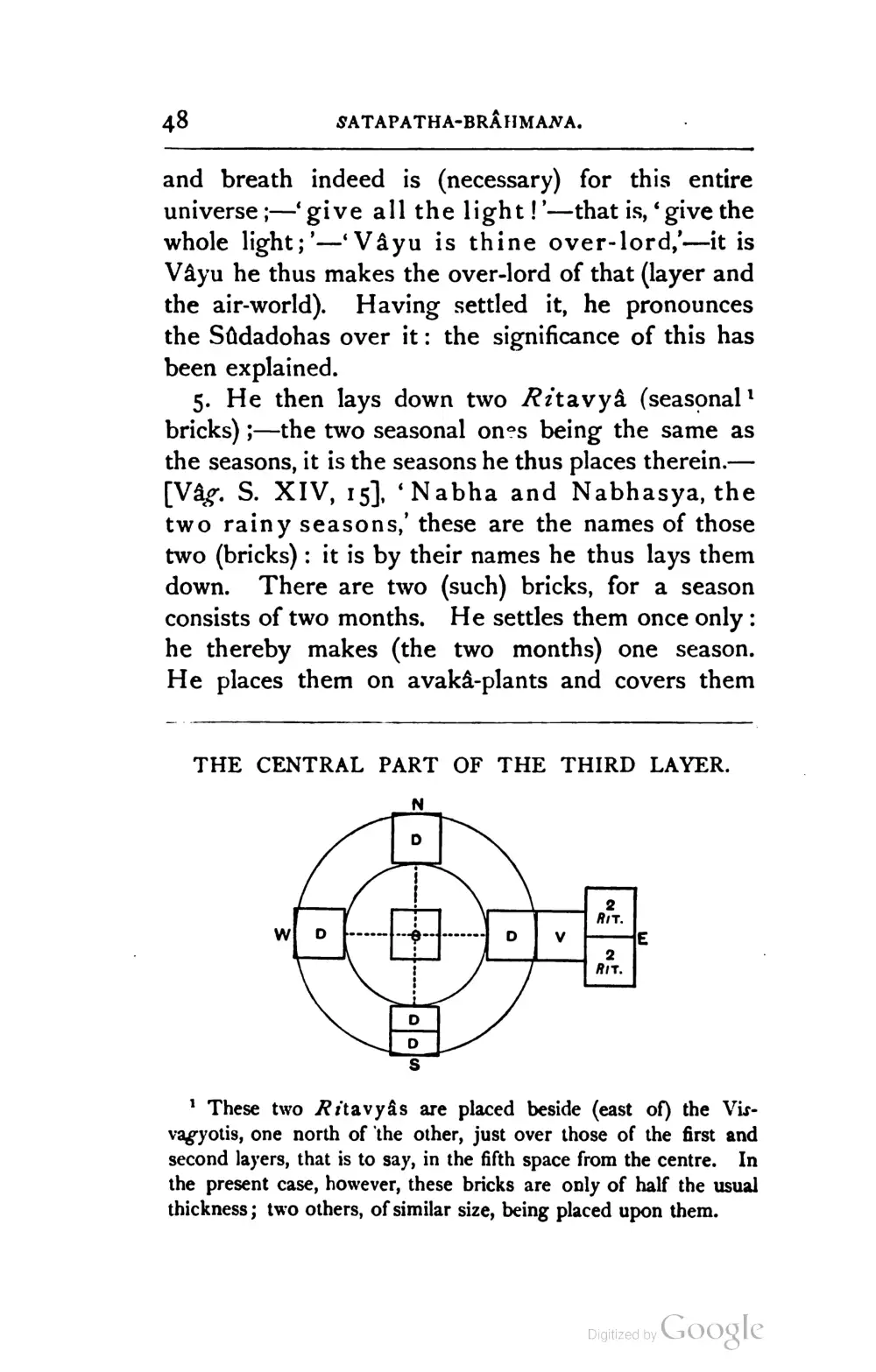
THE CENTRAL PART OF THE THIRD LAYER.
These two Ritavyâs are placed beside (east of) the Visvagyotis, one north of the other, just over those of the first and second layers, that is to say, in the fifth space from the centre. In the present case, however, these bricks are only of half the usual thickness; two others, of similar size; being placed upon them.
49:1 As in the case of the live tortoise, in the first layer; see VII, 5, 1, 11 with note--'Blyxa octandra, a grassy plant growing in marshy land ("lotus-flower," Weber, Ind. Stud. XIII, p. 250).'
50:1 That is to say, the three sets of bricks are not separated by any others from the Svayamâtrinnâ.
51:1 The ten Prânabhrits are placed--five on each side of the spine--either along the edge of the altar, or so as to leave the space of one foot between them and the edge, to afford room for another set of bricks, the Vâlakhilyâs.
8:3:3
THIRD BRÂHMANA.
8:3:3:11. He then lays down the Khandasyâ (metres’ bricks). Now the metres are cattle, and the middle-most layer is the air: he thus places cattle in the air, whence cattle have their abode in the air.
8:3:3:22. And, again, as to why he lays down Khandasyâs,--the metres are cattle, and cattle are food, and the middlemost layer is the middle (of Agni, the altar): he thus places food in the middle (of Agni's body).
8:3:3:33. He lays them down by twelves,--for the Gagatî consists of twelve syllables, and the Gagatî is cattle, and the middlemost layer is the air: he thus places cattle in the air, whence cattle have their abode in the air.
8:3:3:44. And, again, why (he lays them down) by twelves,--the Gagatî consists of twelve syllables, and the Gagatî is cattle, and cattle is food, and the middlemost layer is the middle: he thus places food in the middle. He places them so as not to be separated from the Prânabhrits: he thus places the food so as not to be separated from the vital airs subsequently (to them he places them): he thus bestows food after (bestowing) the vital airs.
8:3:3:55. [He lays down the right set, with, Vâg. S. XIV, 18], 'The metre Measure;'--the measure (mâ), doubtless, is this (terrestrial) world, for this world is, as it were, measured (mita);--'the metre Fore-measure!'--the fore-measure (pramâ), doubtless, is the air-world, for the air-world is, as it were, measured forward from this world;--'The metre Countermeasure,'--the counter-measure (pratimâ), doubtless, is yonder (heavenly) world, for yonder world is, as it were, counter-measured in the air;--'The metre Asrîvayas,'--'asrîvayas,' doubtless, is food: whatever food there is in these worlds that is 'asrîvayas.' Or, whatever food (anna) flows (sravati) from these worlds that is 'asrîvayas.' Hereafter, now, he puts down only defined metres.
8:3:3:66. 'The Paṅkti metre! the Ushnih metre! the Brihatî metre! the Anushtubh metre! the Virâg metre! the Gâyatrî metre! the Trishtubh metre! the Gagatî metre!' these eight defined metres, including the Virâg, he puts down.--[The back set, with, Vâg. S. XIV, 19], 'The metre Earth! the metre Air! the metre Heaven! the metre Years! the metre Stars! the metre Speech! the metre Mind! the metre Husbandry! the metre Gold! the metre Cow! the metre Goat! the metre Horse!' he thus puts down those metres which are sacred to those particular deities.--[The left set, with, Vâg. S. XIV, 20], 'The deity Fire! the deity Wind! the deity Sun! the deity Moon! the deity Vasavah! the deity Rudrâh! the deity Âdityâh! the deity Marutah! the deity Visve Devâh! the deity Brihaspati! the deity Indra! the deity Varuna!'--these deities, doubtless, are metres: it is these he thus lays down.
8:3:3:77. He lays down both defined and undefined (metres). Were he to lay down such as are all defined, then the food would have an end, it would fail; and (were he to lay down) such as are all undefined, then the food would be invisible, and one would not see it at all. He lays down both defined and undefined ones: hence the defined (certain) food which is eaten does not fail.
8:3:3:88. These then are those (sets of) twelve he lays down,--that makes thirty-six, and the Brihatî consists of thirty-six syllables: this is that same Brihatî, the air, which the gods then saw as a third layer. In that (brihatî set of bricks) the gods come last (or, are highest).
8:3:3:99. And, again, as to why he lays down these bricks. When Pragâpati became relaxed, all living beings went from him in all directions.
No commentary for this page.