The Satapatha-Brâhmana, Part IV — SBE Vol. 43 — trans. Julius Eggeling (1897)
The translator’s English as printed (Julius Eggeling). The original-language text is not held; names are romanised as the translator printed them.
41:4 For the connection of these deities with the third layer, and the air, see also VI, 2, 3, 3. Visvakarman is likewise the deity by which the Visvagyotis-brick, representing Vâyu (the wind), the regent of the air-world, is settled; see VIII, 3, 2, 3.
42:1 See part iii, p. 155, note 8.
43:1 Viz. by the concluding formula, 'With the help of that deity, Aṅgiras-like, lie thou steady!' see part iii, p. 302, note 3.
43:2 Viz. Vâg. S. XII, 55 (Rig-veda S. VIII, 69, 3), 'At his birth the well-like milking, speckled ones mix the Soma, the clans of the gods in the three spheres of the heavens.' See part iii, p. 307, note 2.
43:3 VIII, 7, 4, 1 seq.
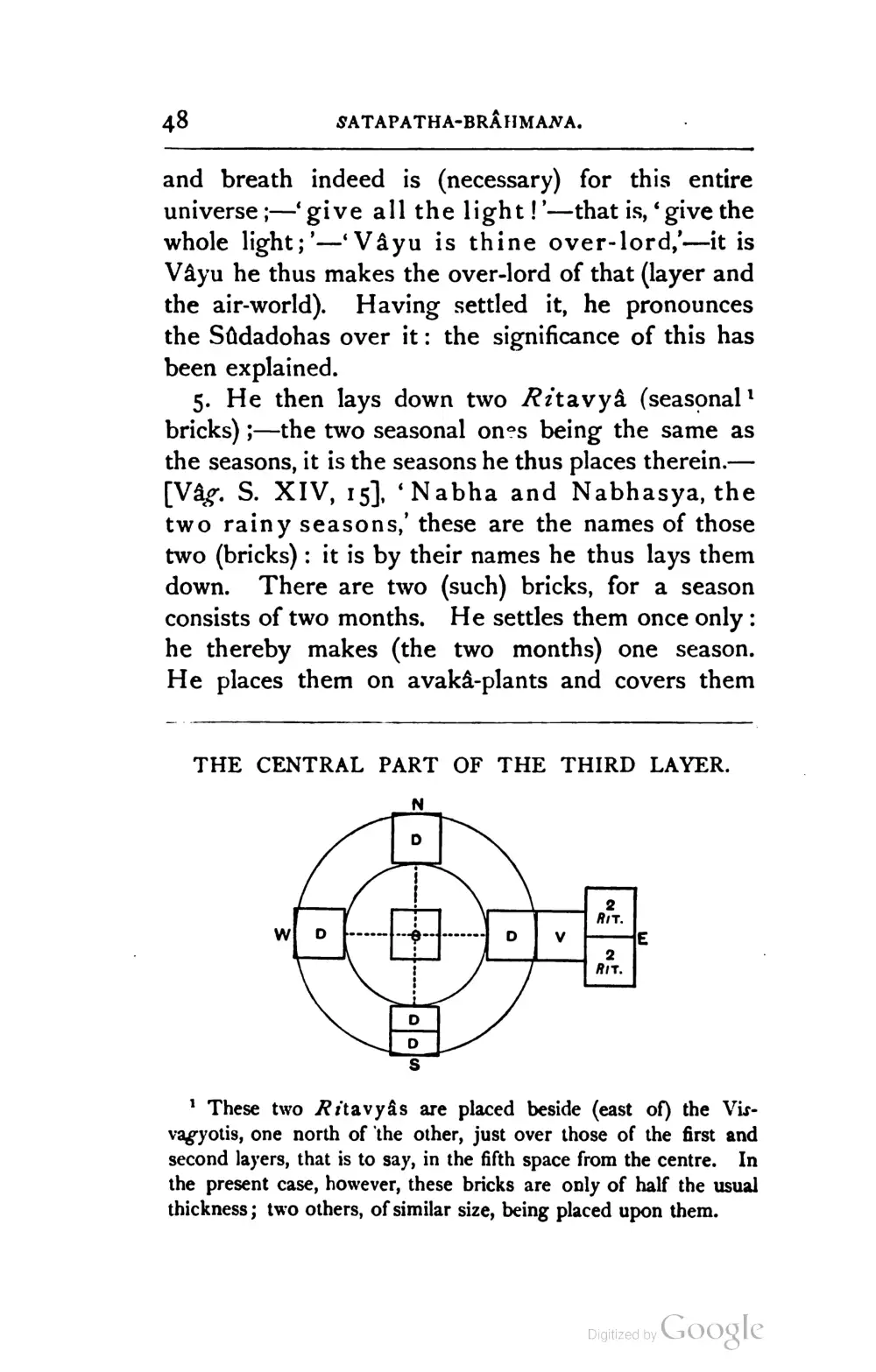
43:4 The five Disyâs are placed on the spines in the four directions at the retahsik range, just over where the five Vaisvadevî bricks were placed in the second layer (see the sketch, p. 24). Between them and the central (naturally-perforated) brick there is thus an empty space a foot square, and the two southern Disyâs are half-bricks lying north and south of each other.
44:1 See VI, 2, 3, 4. The second naturally-perforated brick represents the air-world with which Vâyu, the wind, is most closely associated.
44:2 That is to say, he laid them down on the site of the altar, before the first layer was commenced, viz. the darbha-bunch in the centre of the 'body' of the altar, where the two spines (anûka) intersect each other (VII, 2, 3, 1 seqq.); and the clod-bricks (logeshtakâ) on the four ends of the two spines (VII, 3, 1, 23 seqq.), that is, in the middle of each of the four sides of the square of which the body' consists.
44:3 The symbolic interpretation here seems somewhat confused, inasmuch as the Disyâs, which are now apparently identified with the sun, have just been stated to represent the regions. At VI, 7, 1, 17 the sun was represented as the central point of the universe to which these three worlds are linked by means of the quarters (as by the strings of a scale). The clod-bricks, on the other hand, were indeed, in VII, 3, I, 13, identified with the regions (quarters); and the bunch of grass, being laid down in the centre, might be regarded as marking the fifth region, that upwards from here. Cf. IX, 5, 1, 36.
44:4 The lotus-leaf is placed in the centre of the altar when the first layer is about to be laid down. See VII, 4, 1, 7 seqq., where it is explained as representing the foundation of the fire-altar, or rather, the womb whence Agni is born.
45:1 That is, not separated therefrom by other special bricks; though the full space of one brick is left between the Disyâs and the central brick. Perhaps, however, 'anantarhita' here means 'immediately after.'
45:2 That is, the second of the three svayam-âtrinnâs, the one in the third layer.
45:3 Uttara seems here and elsewhere to have a double meaning, viz. that of subsequent, and upper, or left, inasmuch as looking towards these bricks from the centre of the altar, they are placed to the left of the particular section of the anûkas.
45:4 See p. 26, note 3.
45:5 The metres are commonly represented as cattle.
46:1 That is all (four-footed) animals that dwell on, not in, the earth. The Gâyatrî metre, at any rate, is also represented as a bird which fetches the Soma from heaven, but it is not the air as such that is intended here, but the face of the earth.
8:3:2
SECOND BRÂHMANA.
8:3:2:11. He then lays down a Visvagyotis (all-light brick). Now the middle Visvagyotis is Vâyu , for Vâyu (the wind) is all the light in the air-world: it is Vâyu he thus places therein. He places it so as not to be separated from the regional (bricks): he thus places Vâyu in the regions, and hence there is wind in all the regions.
8:3:2:22. And, again, as to why he lays down the Visvagyotis,--the Visvagyotis, doubtless, is offspring (or creatures), for offspring indeed is all the light: he thus lays generative power (into that world). He places it so as not to be separated from the regional ones : he thus places creatures in the regions, and hence there are creatures in all the regions.
8:3:2:33. [He lays it down, with, Vâg. S. XIV, 14], 'May Visvakarman settle thee!' for Visvakarman saw this third layer ;--'on the back of the air, thee the brilliant one!' for on the back of the air that brilliant Vâyu indeed is.
8:3:2:44. 'For all up-breathing, down-breathing, through-breathing,'--for the Visvagyotis is breath, and breath indeed is (necessary) for this entire universe;--'give all the light!'--that is, 'give the whole light;'--'Vâyu is thine over-lord,'--it is Vâyu he thus makes the over-lord of that (layer and the air-world). Having settled it, he pronounces the Sûdadohas over it: the significance of this has been explained.
No commentary for this page.