The Satapatha-Brâhmana, Part IV — SBE Vol. 43 — trans. Julius Eggeling (1897)
The translator’s English as printed (Julius Eggeling). The original-language text is not held; names are romanised as the translator printed them.
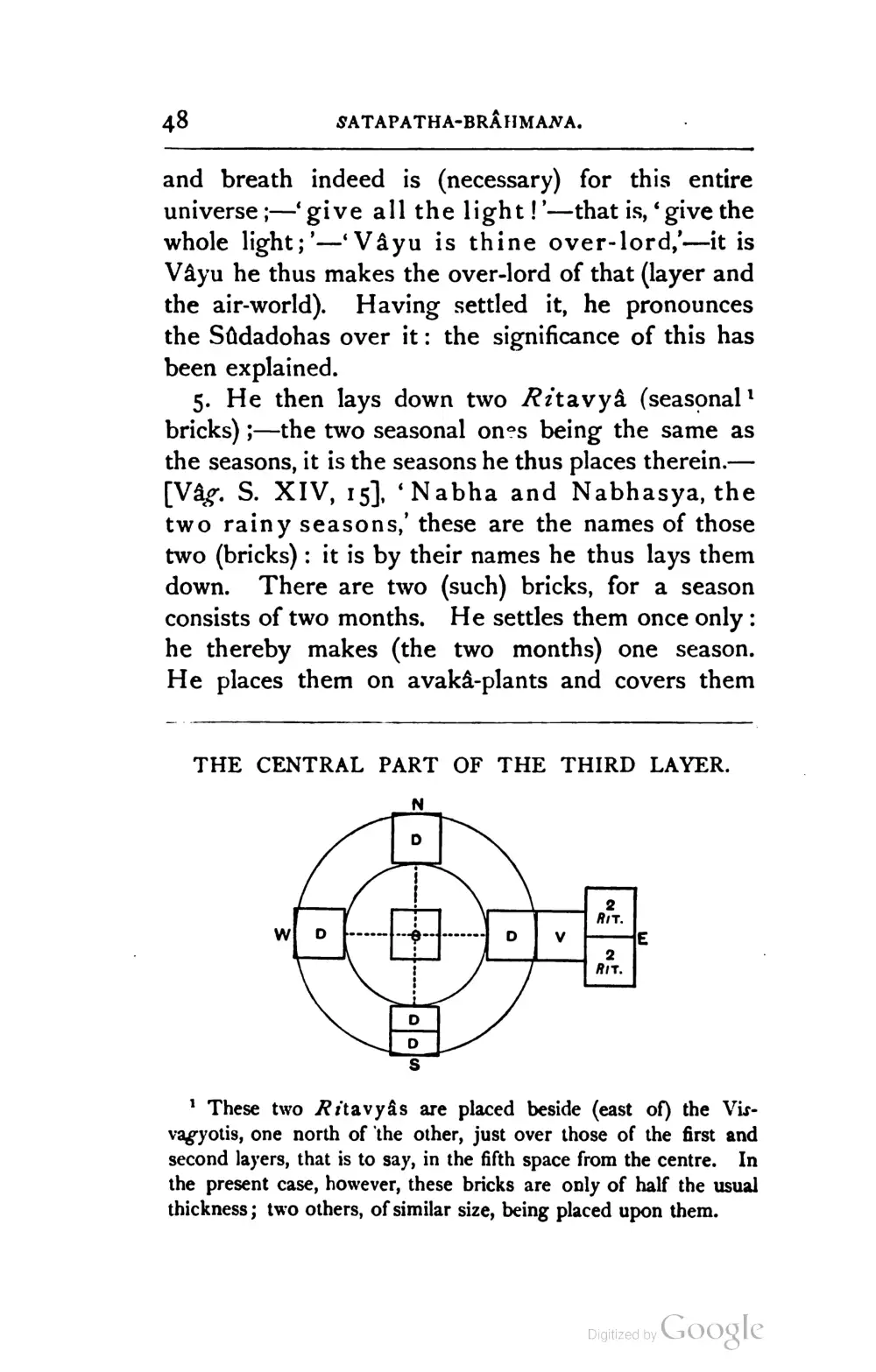
8:3:2:55. He then lays down two Ritavyâ (seasonal bricks);--the two seasonal ones being the same as the seasons, it is the seasons he thus places therein.[Vâg. S. XIV, 15], 'Nabha and Nabhasya, the two rainy seasons,' these are the names of those two (bricks): it is by their names he thus lays them down. There are two (such) bricks, for a season consists of two months. He settles them once only: he thereby makes (the two months) one season. He places them on avakâ-plants and covers them with avakâ-plants ; for avakâ-plants mean water he thus bestows water on that season, whence it rains most abundantly in that season.
8:3:2:66. Then the two upper ones, with (Vâg. S. XIV, I6), 'Isha and Ûrga, the two autumnal seasons,'--these are the names of those two (bricks): it is by their names he thus lays them down. There are two (such) bricks, for a season consists of two months. He settles them only once: he thereby makes (the two months) one season. He places them on avakâ-plants, for the avakâ-plants mean water: he thus bestows water before that season, whence it rains before that season. He does not cover them afterwards, whence it does not likewise rain after (that season).
8:3:2:77. And as to why he places these (four bricks) in this (layer),--this fire-altar is the year, and the year is the same as these worlds, and the middlemost layer is the air (-world) thereof; and the rainy season and autumn are the air (-world) thereof: hence when he places them in this (layer), he thereby restores to him (Agni) what (part) of his body these (formed),--this is why he places them in this (layer).
8:3:2:88. And, again, as to why he places them in this (layer),--this Agni (the fire-altar) is Pragâpati, and Pragâpati is the year. Now the middlemost layer is the middle of this (altar), and the rainy season and the autumn are the middle of that (year): hence when he places them in this (layer), he thereby restores to him (Agni-Pragâpati) what part of his body these (formed),--this is why he places them in this (layer).
8:3:2:99. There are here four seasonal (bricks) he lays down in the middlemost layer; and two in each of the other layers,--animals (cattle) are four-footed, and the middlemost layer is the air: he thus places animals in the air, and hence there are animals that have their abode in the air.
8:3:2:1010. And, again, why there are four,--animals are four-footed, and animals are food; and the middle-most layer is the middle (of Agni's body): he thus puts food in the middle.
8:3:2:1111. And, again, why there are four,--'antariksha' (air) consists of four syllables, and the other layers (kiti) consist of two syllables; hence as much as the air consists of, so much he makes it in laying it down.
8:3:2:1212. And, again, why there are four,--this Agni (altar), doubtless, is an animal: he thus makes the animal biggest towards the middle; whence an animal is biggest towards the middle.
8:3:2:1313. There are here four Ritavyâs, the Visvagyotis being the fifth, and five Disyâs,--this makes ten: the Virâg consists of ten syllables, and the Virâg is food, and the middlemost layer is the middle;--he thus puts food in the middle (of the body). He lays them down so as not to be separated from the naturally-perforated one , for the naturally-perforated one is the vital air: he thus places the food so as not to be separated from the vital air. Subsequently (to the central brick) he lays them down: subsequently to (or upon) the vital air he thus places food.
8:3:2:1414. He then lays down the Prânabhrit (bricks);--the Prânabhrits (breath-holders), doubtless, are the vital airs: it is the vital airs he thus lays into (Agni's body). There are ten of them, for there are ten vital airs. He places them in the forepart (of the altar),--for there are these vital airs in front,--with (Vâg. S. XIV, 17), 'Protect my vital strength! protect mine up-breathing! protect my down-breathing! protect my through-breathing! protect mine eye! protect mine ear! increase my speech! animate my mind! protect my soul (or body)! give me light!'--He lays them down so as not to be separated from the seasonal ones, for the vital air is wind: he thus establishes the wind in the seasons.
Footnotes
47:1 The three Visvagyotis bricks, placed in (the fourth easterly place from the centre of) the first, third and fifth layer respectively, are supposed to represent the regents of the three worlds--earth, air and sky--which these three layers represent, viz. Agni, Vâyu and Âditya (Sûrya). See VI, 3, 3, 16.
No commentary for this page.