Legge sums up par. 2 as ‘Tao itself sprang from nothing’. His own translation says that existence sprang from It ‘as non-existent’: the source is still the Tao, in its unnamed phase. The summary makes non-being prior to the Tao, which the translation does not say and chapter 1’s nameless and named Tao, which he cites, does not require.
The Tâo Teh King — Sacred Books of China Part I, SBE Vol. 39 (trans. James Legge, 1891)
Open to all
page 84
No image is selected for this page; its own page image is shown.
page 84
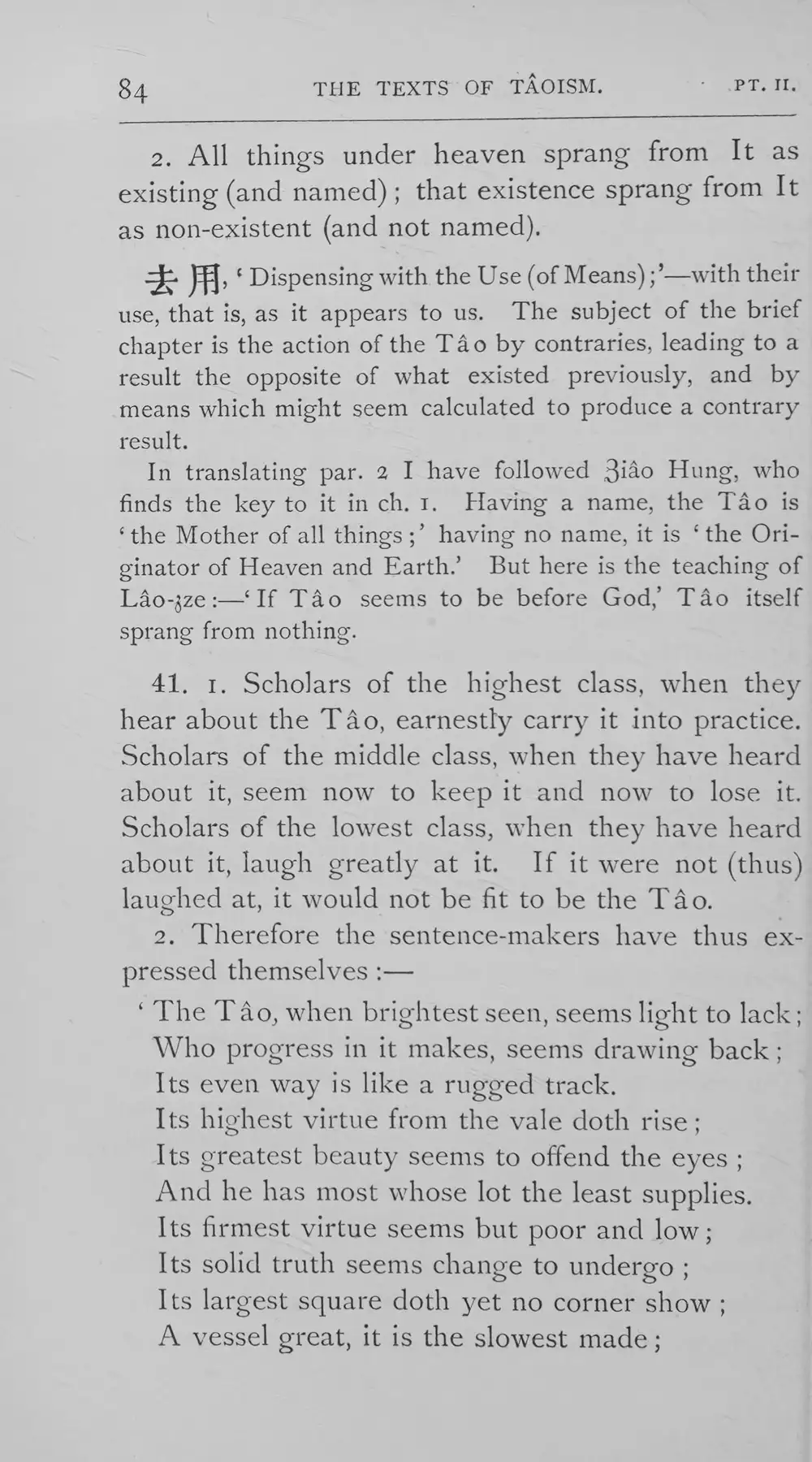
2. All things under heaven sprang from It as existing (and named); that existence sprang from It as non-existent (and not named).
去用, ‘Dispensing with the Use (of Means);’—with their use, that is, as it appears to us. The subject of this brief chapter is the action of the Tâo by contraries, leading to a result the opposite of what existed before, and by means that might seem calculated to produce the contrary result.
In translating par. 2 I have followed Ȝiâo Hung, who finds the key to it in ch. 1. Having a name, the Tâo is ‘the Mother of all things;’ having no name, it is ‘the Originator of Heaven and Earth.’ But here is the teaching of Lâo-ȝze:—‘If the Tâo seems to be before God, the Tâo itself sprang from nothing.’
41. 1. Scholars of the highest class, when they hear about the Tâo, earnestly put it into practice. Scholars of the middle class, when they have heard about it, seem now to keep it and now to lose it. Scholars of the lowest class, when they have heard about it, laugh loudly at it. If it were not (thus) laughed at, it would not be fit to be the Tâo.
2. Therefore the sentence-makers have put it this way:—
‘The Tâo, when most brightly seen, seems to lack light; Whoever makes progress in it seems to be drawing back; Its level way is like a rugged track. Its highest virtue rises from the valley; Its greatest beauty seems to offend the eye; And he has most whose lot supplies the least. Its firmest virtue seems but poor and low; Its solid truth seems to undergo change; Its largest square yet shows no corner; A great vessel, it is the slowest made; Loud is its sound, but it never said a word; A great semblance, the shadow of a shade.’