Legge lists readings of the One, Two and Three, Heaven congealed from the Tao, the primordial ether and its Yin and Yang, spiritual intelligences, and ends ‘I dare not hazard a guess’ about the Three. The candour is right. His own evidence helps his reading of the One: Hwainan quotes the passage starting from ‘One produced Two’, omitting the Tao, which suggests the One could stand for the source itself.
The Tâo Teh King — Sacred Books of China Part I, SBE Vol. 39 (trans. James Legge, 1891)
Open to all
page 86
No image is selected for this page; its own page image is shown.
page 86
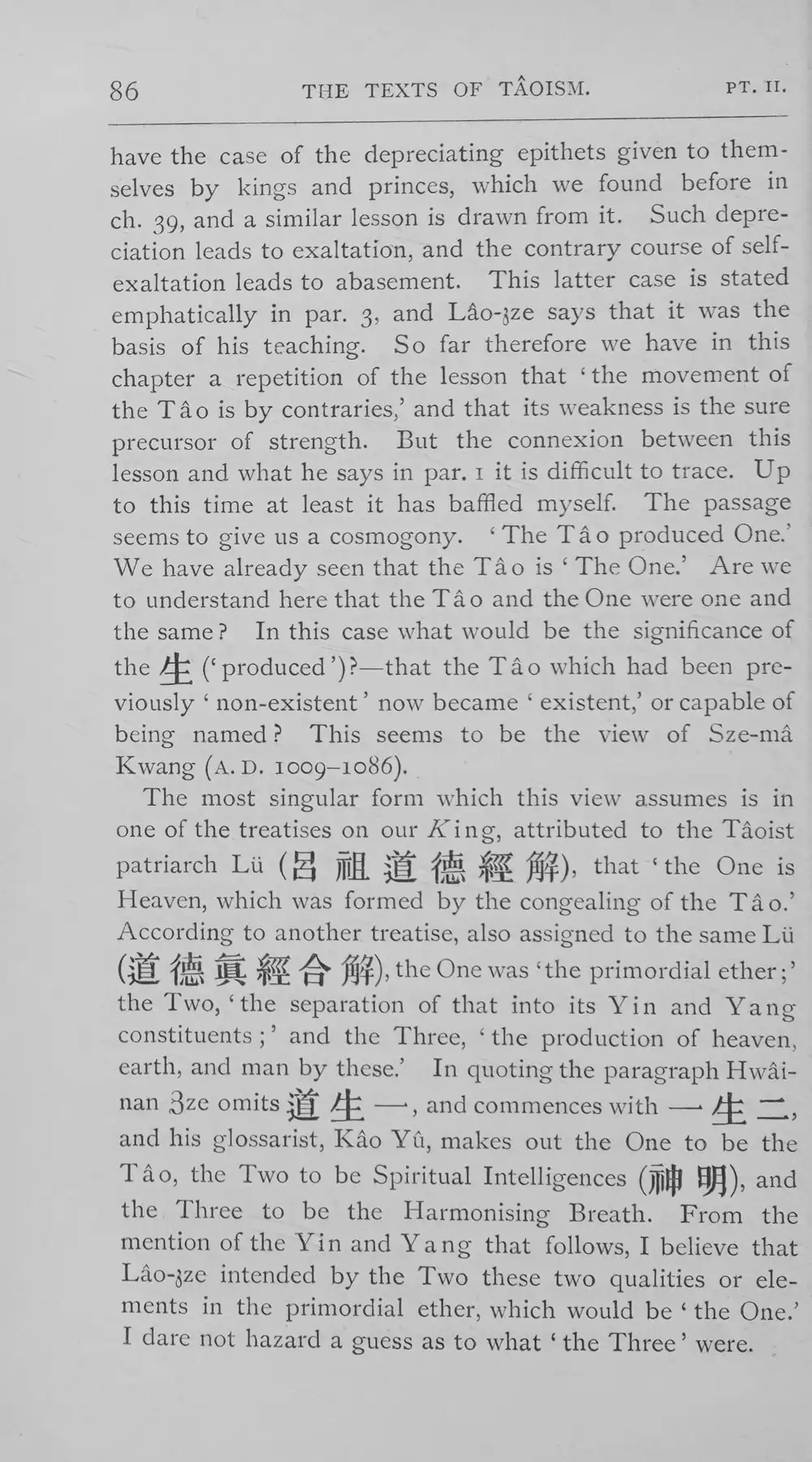
The most singular form this view takes is in one of the treatises on our King attributed to the Tâoist patriarch Lü (呂祖道德經解 [Press: Patriarch Lü's Explanation of the Tâo Teh King (a title)]), that ‘the One is Heaven, which was formed by the congealing of the Tâo.’ According to another treatise, also ascribed to the same Lü (道德眞經合解 [Press: Combined Explanations of the True Classic of the Tâo and Teh (a title)]), the One was ‘the primordial ether;’ the Two, ‘the separation of that into its Yin and Yang constituents;’ and the Three, ‘the production of heaven, earth, and man by these.’
In quoting the paragraph, Hwâi-nan Ȝze omits 道生一 [Press: the Tâo produced One] and begins with 一生二 [Press: One produced Two]; and his glossarist, Kâo Yi, makes the One out to be the Tâo, the Two to be Spiritual Intelligences (神明), and the Three to be the Harmonising Breath. From the mention of the Yin and Yang that follows, I believe that Lâo-ȝze meant by the Two these two qualities or elements in the primordial ether, which would be ‘the One.’ I dare not hazard a guess as to what ‘the Three’ were.