The Tâo Teh King — Sacred Books of China Part I, SBE Vol. 39 (trans. James Legge, 1891)

Open to allEdited by F. Max Müller; translated by Müller, Legge, Bühler, West, Darmesteter, Palmer, Telang, Thibaut, Jolly, Rhys Davids, Oldenberg, Jacobi, Bloomfield and others1850 segments · 383 pp
page 83

No image is selected for this page; its own page image is shown.

The Tâo Teh King — Sacred Books of China Part I, SBE Vol. 39 (trans. James Legge, 1891), photo of the original · p. 83
Photo of the original · p. 83
page 83

法本, ‘The Origin of the Law.’ In this title there is a reference to the Law given to all things by the Tâo, as described at the end of chapter 25. And the Tâo provides that law through its passionless, undemonstrative nature, by which, in its spontaneity, doing nothing for the sake of doing, it yet does all things.

The difficulty of translation lies in the third paragraph. The way in which princes and kings speak disparagingly of themselves is cited to show how they have indeed got the spirit of the Tâo; and I accept the last epithet as given by Ho-shang Kung, ‘naveless’ (轂), instead of 穀 (= ‘the unworthy’), which is found in Wang Pî and has been adopted by nearly all later editors. To see its fitness here, we have only to refer back to chapter 11, where the thirty spokes and the nave, empty to receive the axle, are spoken of, and it is shown how the usefulness of the carriage comes from that emptiness of the nave.

This also enables us to give a fair and consistent explanation of the difficult clause that follows, in which too I have followed the text of Ho-shang Kung. For his 車 [Press: carriage], Wang Pî has 輿 [Press: carriage (the body of a cart)], which is also found in a quotation of it by Hwâi-nan Ȝze; but this need not affect the meaning. In translating the clause we are helped by a somewhat similar illustration about a horse in the twenty-fifth of Kwang-ȝze’s Books, par. 10.
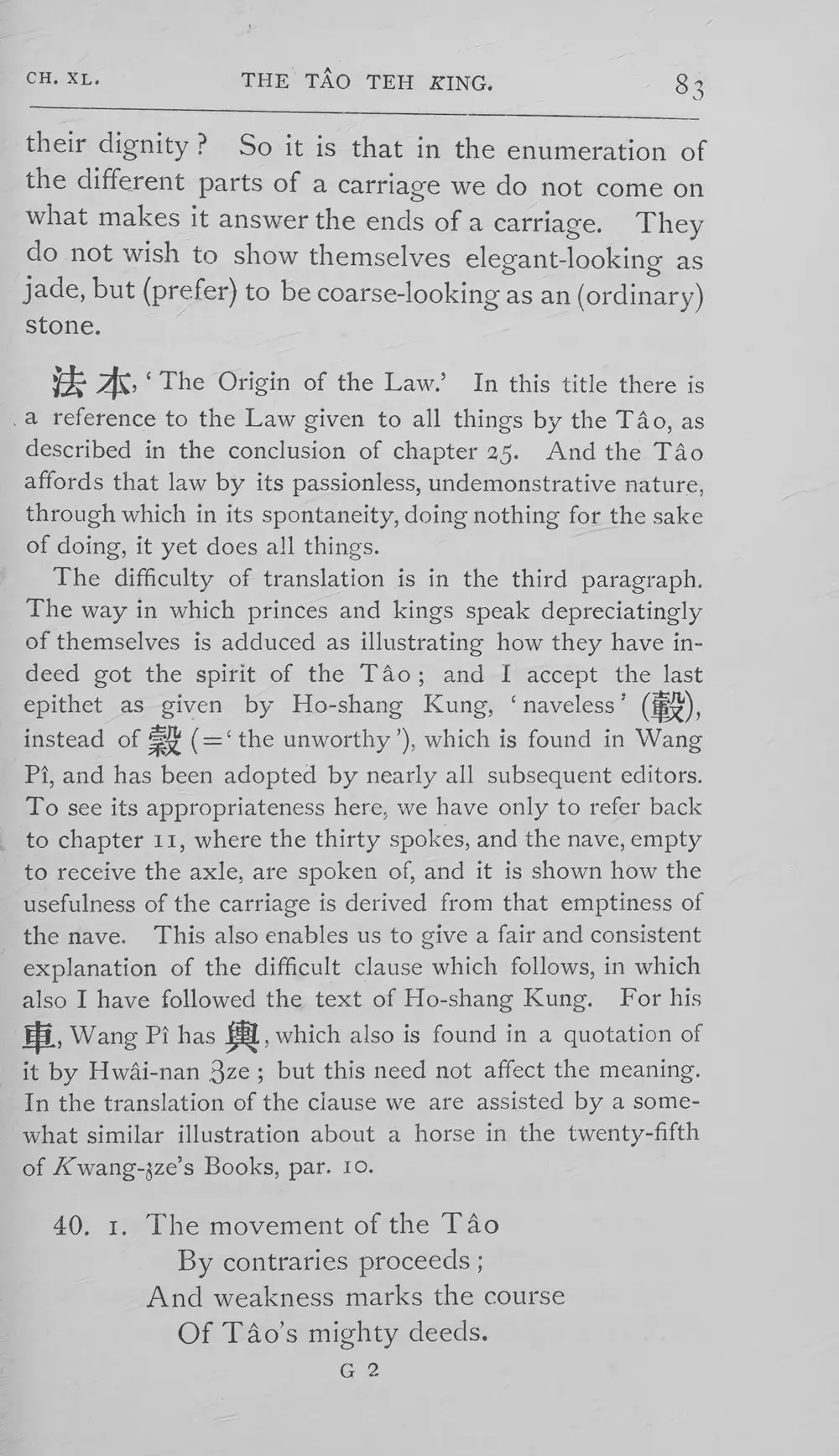
40. 1. The movement of the Tâo
Proceeds by contraries;
And weakness marks the course
Of the Tâo’s mighty deeds.

Commentary
page 83 ·
Cross-Estate§102

Legge explains the clause about enumerating a carriage’s parts from Kwang-ȝze’s twenty-fifth Book, translated in the companion volume, where naming a horse’s parts does not give you the horse. The parallel is apt: the clause argues that the whole is not found by listing its parts, as the carriage is useful by its empty nave. It supports his choice of ‘naveless’ from inside the tradition rather than by conjecture.

cites The Writings of Kwang-tze — Sacred Books of China Part II, SBE Vol. 40 (trans. James Legge, 1891)