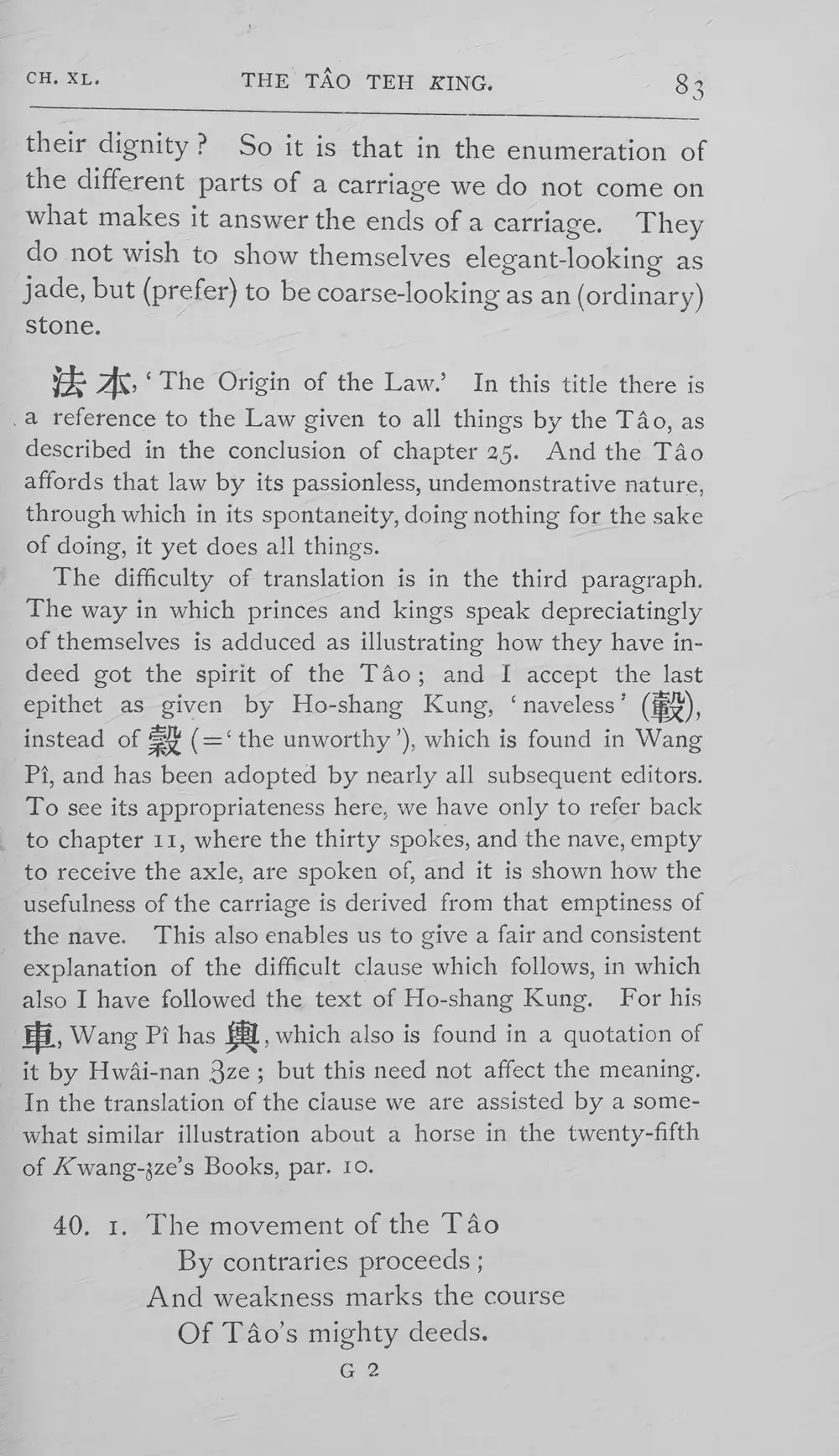
‘Carriages without a nave’ is Legge’s choice of Ho-shang Kung’s 轂 over Wang Pi’s 穀, ‘the unworthy’, and he defends it on p. 83 from chapter 11, where the empty nave makes the wheel useful. The reading ties two chapters together by the King’s own image, which is the strongest kind of argument for a variant. Chapter 42 (p. 85) repeats the phrase, and he renders it the same way there.
The Tâo Teh King — Sacred Books of China Part I, SBE Vol. 39 (trans. James Legge, 1891)
Open to all
page 82
No image is selected for this page; its own page image is shown.
page 82
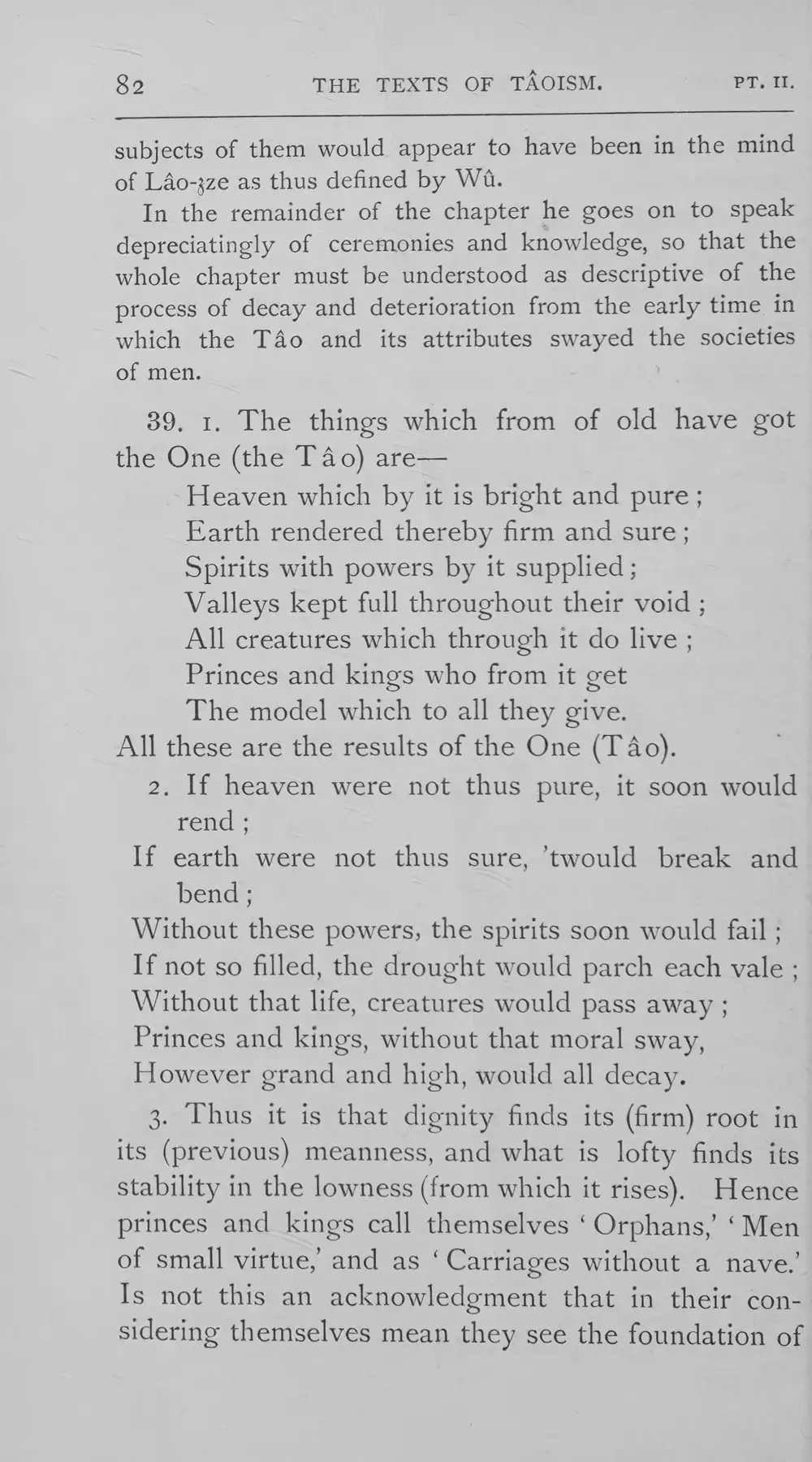
In the rest of the chapter he goes on to speak disparagingly of ceremonies and knowledge, so that the whole chapter must be understood as describing the process of decay and deterioration from the early time when the Tâo and its attributes held sway over the societies of men.
39. 1. These are the things which from of old have got the One (the Tâo):—
Heaven, which by it is bright and pure;
Earth, made by it firm and sure;
Spirits, with powers it supplies;
Valleys, kept full throughout their void;
All creatures, which live through it;
Princes and kings, who get from it
The model which they give to all.
All these are the results of the One (the Tâo).
2. If heaven were not thus pure, it soon would split;
If earth were not thus sure, it would break and bend;
Without these powers, the spirits soon would fail;
If not so filled, drought would parch each valley;
Without that life, creatures would pass away;
Princes and kings, without that moral sway,
However grand and high, would all decay.
3. Thus it is that dignity finds its (firm) root in its (previous) meanness, and what is lofty finds its stability in the lowness (from which it rises). Hence princes and kings call themselves ‘Orphans’, ‘Men of small virtue’, and ‘Carriages without a nave’. Is this not an acknowledgment that in considering themselves mean they see the foundation of their dignity? So it is that in listing the different parts of a carriage we do not come on what makes it answer the ends of a carriage. They do not wish to show themselves elegant-looking as jade, but (prefer) to be coarse-looking as an (ordinary) stone.