January 1946; Year V opens with the wrapper's lower block reset in lighter mixed-case type — the first cover change since Nº 28.
→ ini:4.42
Fetching
One moment.
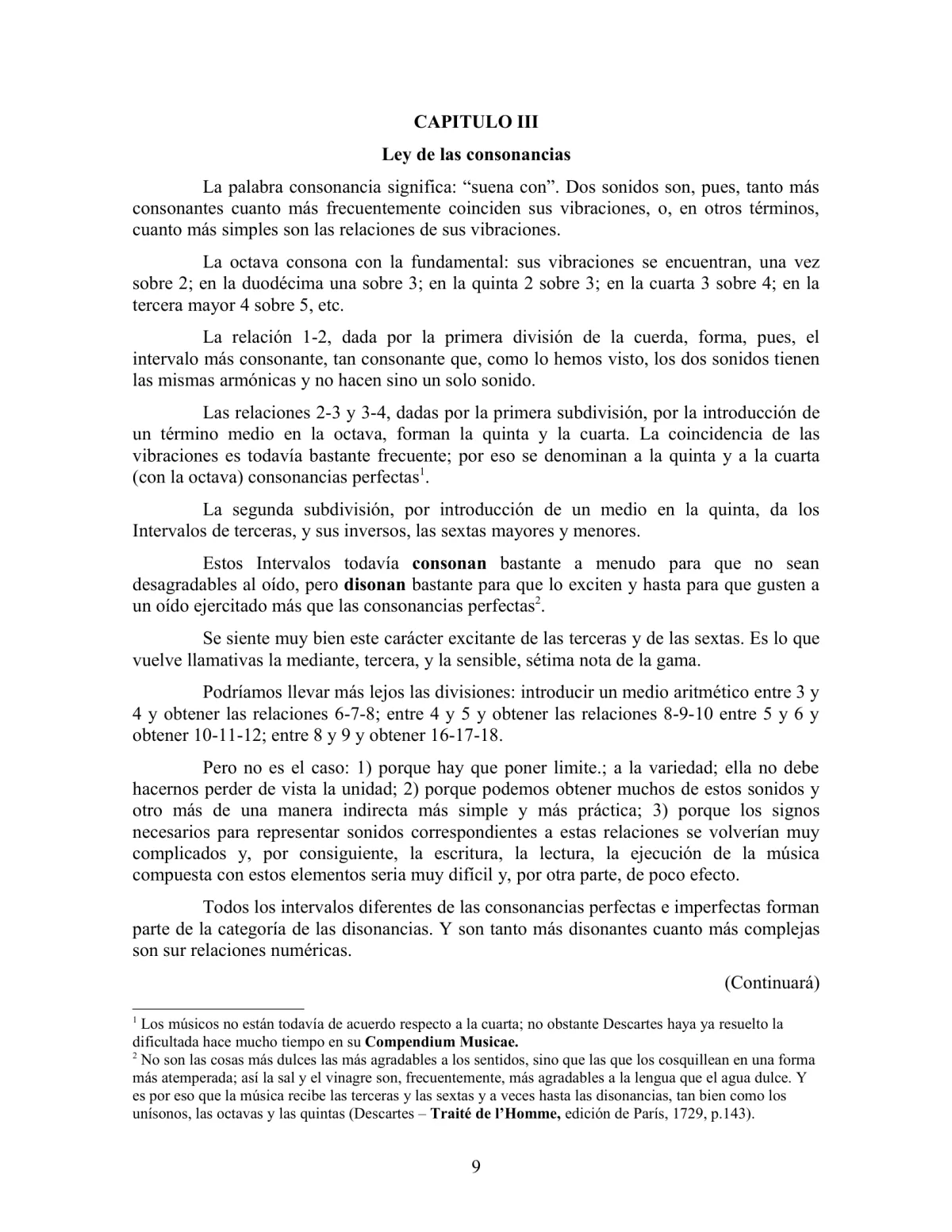
1CHAPTER III. Law of consonances. The word consonance signifies: "sounds with".
2Two sounds are, then, the more consonant the more frequently their vibrations coincide — or, in other terms, the simpler the relations of their vibrations are.
3The octave consounds with the fundamental: their vibrations meet once in 2; in the twelfth, once in 3; in the fifth, 2 in 3; in the fourth, 3 in 4; in the major third, 4 in 5, etc. The relation 1-2, given by the first division of the string, forms, then, the most consonant interval — so consonant that, as we have seen, the two sounds have the same harmonics and make but a single sound.
4The relations 2-3 and 3-4, given by the first subdivision — by the introduction of a middle term into the octave — form the fifth and the fourth.
5The coincidence of the vibrations is still fairly frequent; that is why the fifth and the fourth (with the octave) are called perfect consonances1.
6The second subdivision, by the introduction of a mean into the fifth, gives the intervals of thirds and their inverses, the major and minor sixths.
7These intervals still consound often enough not to be disagreeable to the ear, but dissound enough to excite it — and even to please a trained ear more than the perfect consonances2.
8This exciting character of the thirds and sixths is very well felt.
9It is what makes striking the mediant (third) and the leading note, seventh note of the scale.
10We could carry the divisions further: introduce an arithmetic mean between 3 and 4 and obtain the relations 6-7-8; between 4 and 5 and obtain the relations 8-9-10; between 5 and 6 and obtain 10-11-12; between 8 and 9 and obtain 16-17-18.
11But it is not the case: 1) because limits must be set to variety — it must not make us lose sight of unity; 2) because we can obtain many of these sounds, and others more, in an indirect manner, simpler and more practical; 3) because the signs necessary to represent sounds corresponding to these relations would become very complicated and, consequently, the writing, reading and execution of music composed with these elements would be very difficult and, moreover, of little effect.
12All the intervals different from the perfect and imperfect consonances form part of the category of dissonances.
13And they are the more dissonant the more complex their numerical relations are. (To be continued) 1 Musicians are not yet in agreement respecting the fourth — notwithstanding that Descartes long ago resolved the difficulty in his Compendium Musicae.
142 It is not the sweetest things that are most agreeable to the senses, but those that titillate them in a more tempered manner; thus salt and vinegar are frequently more agreeable to the tongue than fresh water.
15And that is why music receives the thirds and the sixths — and at times even the dissonances — as well as the unisons, the octaves and the fifths. (Descartes – Traité de l'Homme, Paris edition, 1729, p. 143.)
Our translation, period-faithful. Citable as our translation, never as the source.
January 1946; Year V opens with the wrapper's lower block reset in lighter mixed-case type — the first cover change since Nº 28.
→ ini:4.42
Masthead stereotype unchanged into the new year.
Seven articles; a new serial appears — Rouxel's kabbalistic theory of music, translated mid-stream (it opens at Chapter II).
Wilhelmsbad concluded: the templar legend ratified away, Willermoz's statutes taken as the model, Dittfurth's federation counter-proposal defeated, the ritual commission stacked with professed knights — and the one defeat: the "sacred mystery" of the number 3, sacrificed so the rest would pass.
→ ini:4.41
The congress's closing theatre: silhouettes cut, medals struck — "Magnus magister totius ordinis" / "tandem aurora lucessit" — and Brunswick and Hesse themselves initiated into martinism by Willermoz during the congress: the column's quiet coup de grâce.
The verdict, double: Daruty quoted for the triumph, Le Forestier for the truth — "a prime work of incoherence". The chronology's habit of letting its sources disagree in public is its scholarship.
Rouxel's kabbalistic music theory: the octave as the circle of all sounds, arithmetic means generating fifth and third, "1+1 does not give 2 in music" — Pythagorean harmonics presented as Kabbalah, with Descartes' Compendium Musicae in the footnotes.
The Descartes footnote on salt and vinegar pleasing more than fresh water — the thirds and sixths defended by seventeenth-century sensualism: the serial's learning is real and cited.
THE MOON through the twelve houses — seventh planet of the reference series, completing Saturn, Jupiter, Mars, Sun, Venus and Mercury.
The first Saint-Martin epigraph: "Spirit of man, learn to know thyself. Thou canst not die in essence…" — the review begins salting its pages with the Unknown Philosopher's own sentences, as the estate's Saint-Martin shelf does at full length.
→ thread:stmartin_tableau_naturel
The four Samsaras (Kriya, Iccha, Jnana, Yoga) mapped in a footnote onto the theosophical bodies — etheric double, astral, causal — with their Sanskrit koshas: the S.D.M. serial translating itself into the vocabulary its Montevideo readers already know.
Sankhya redefined against Kapila's school: the generic term for the three paths (Jnana, Bhakti, Kriya) versus Yoga as their synthesis — the Suddha school's central terminological claim, argued from Narada's Karika.
YOGAH KARMASU KAUSALAM re-read: not "Yoga gives skill in action" but "among the Karmas, Yoga demands the most elevated ability" — the commentary's most consequential reversal of the popular reading, carried by the praxis layer.
The sixfold Dharma table arrives with its columns broken by the retype — glossed as printed, not repaired: the reader sees the type as transmitted, and the gloss says why the rows read strangely.
"Light is a modality of the astral light" — the fototherapy instalment opens by folding photobiology into the occult cosmology, then delivers competent 1940s science: wavelength bands, Finsen therapy, photosensitisation.
The photodynamism catalogue — acridine and paramecia, eosin tadpoles, haematoporphyrin mice — real experimental photobiology transmitted intact; the serial's scientific spine at its strongest.
The Dialogues conclude: the Moral Conscience as "the memory of the human species", the Ego as pearl-necklace of lives, and I.N.R.I. — Igne Natura Renovatur Integra — resolving the dialogue; Anteo's two-finger salute to the golden circle closes Wronski's serial.
Serapio's litany: "what is, is because it is" hammered through fourteen counsels against spiritual vanity — superiority as separateness, flattery as sweet poison, the Master who "wants no adhesions". La Plata's A∴M∴ voice at its most aphoristic.
The closing Saint-Martin epigraph — libraries as pharmacies, "proof of his illnesses… never to render him invulnerable" — the review ending its number by quoting the master against book-learning itself.
→ thread:stmartin_tableau_naturel
GIDEE prospectus stereotype at page 23, unchanged into 1946.
→ ini:3.30
Library back cover and imprint open Year V as they closed Year IV.
"The numbers l and 2 are the beginning and end of music, its alpha and omega" — Rouxel's monochord arithmetic at its most kabbalistic; the compositor prints alta for alfa and a letter ell for the one, both mirrored.
The filter paragraph prints its two roles transposed (red passing chemical rays, blue killing thermal) — glossed as printed: the retype's physics faults are documented with the same discipline as its spelling.
The skin-action summary — hyperaemia, erythema, pigment as protection, sweat and sebum — dermatological photobiology in period vocabulary, the serial's clinical core.