1All the other numbers you may find in the study of the human body are only annexes of the preceding, as I hope to demonstrate.
2So as not to go astray, let us remain on ground as positive as possible, taking man at his origin, and see how Nature fabricates him.
3Today.
4This is known perfectly — one may say "hour by hour".
5And if it is exact to say that everything is true in the physical body, we shall easily find the rest by analogy.
6Well then — the human body is constructed by means of three envelopes or follicles, as I shall indicate: First appears the external follicle, which will form the brain, the spinal cord, the nerves, the epidermis and its derivatives — nails, glands of the skin, hair of body and head, lungs, teeth, and the external genital ways.
7I shall call it the "outside skin" or, scientifically, ectoderm.
8After this first envelope is born the internal follicle which, by evolution, will give birth to the digestive apparatus (intestine, liver, pancreas, stomach, salivary glands) and to the internal genital organs.
9We shall call it the "inside skin" or, scientifically, endoderm.
10If I employ banal terms to designate things all physicians know, it is because such terms will presently lead us to very clear classifications.
11When the "inside skin" has been born, the intermediate follicle appears in its turn.
12This middle envelope, called mesoderm, will originate the chest, all the organs of the circulatory apparatus, as well as the dermis, the muscles of animal life, the cartilaginous and connective tissues, the peritoneal epithelium, the skeleton, the mesentery, and the coelomic epithelium that clothes the whole surface of the intestinal tube.
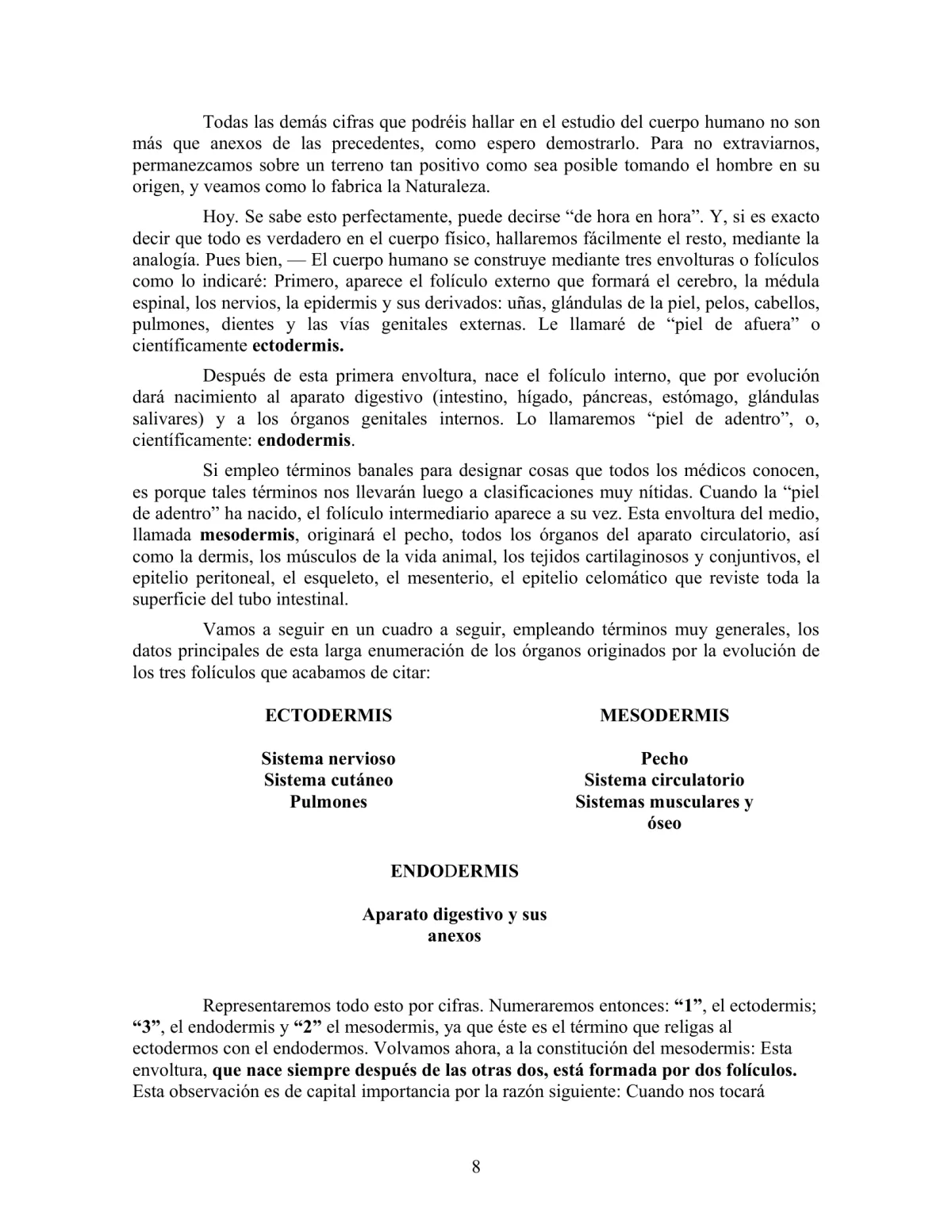
13We shall follow, in a table to come, employing very general terms, the principal data of this long enumeration of the organs originated by the evolution of the three follicles just cited — and we shall represent it all by numbers.
14We shall number, then: "1" the ectoderm; "3" the endoderm; and "2" the mesoderm, since this is the term that rejoins the ectoderm to the endoderm.
15Let us return now to the constitution of the mesoderm: this envelope, always born after the other two, is formed of two follicles.
16This observation is of capital importance for the following reason: when it falls to us · 8 — ENDODERM: digestive apparatus and its annexes. ECTODERM: nervous system, cutaneous system, lungs. MESODERM: chest, circulatory system, muscular and bony systems.
Our translation, period-faithful. Citable as our translation, never as the source.