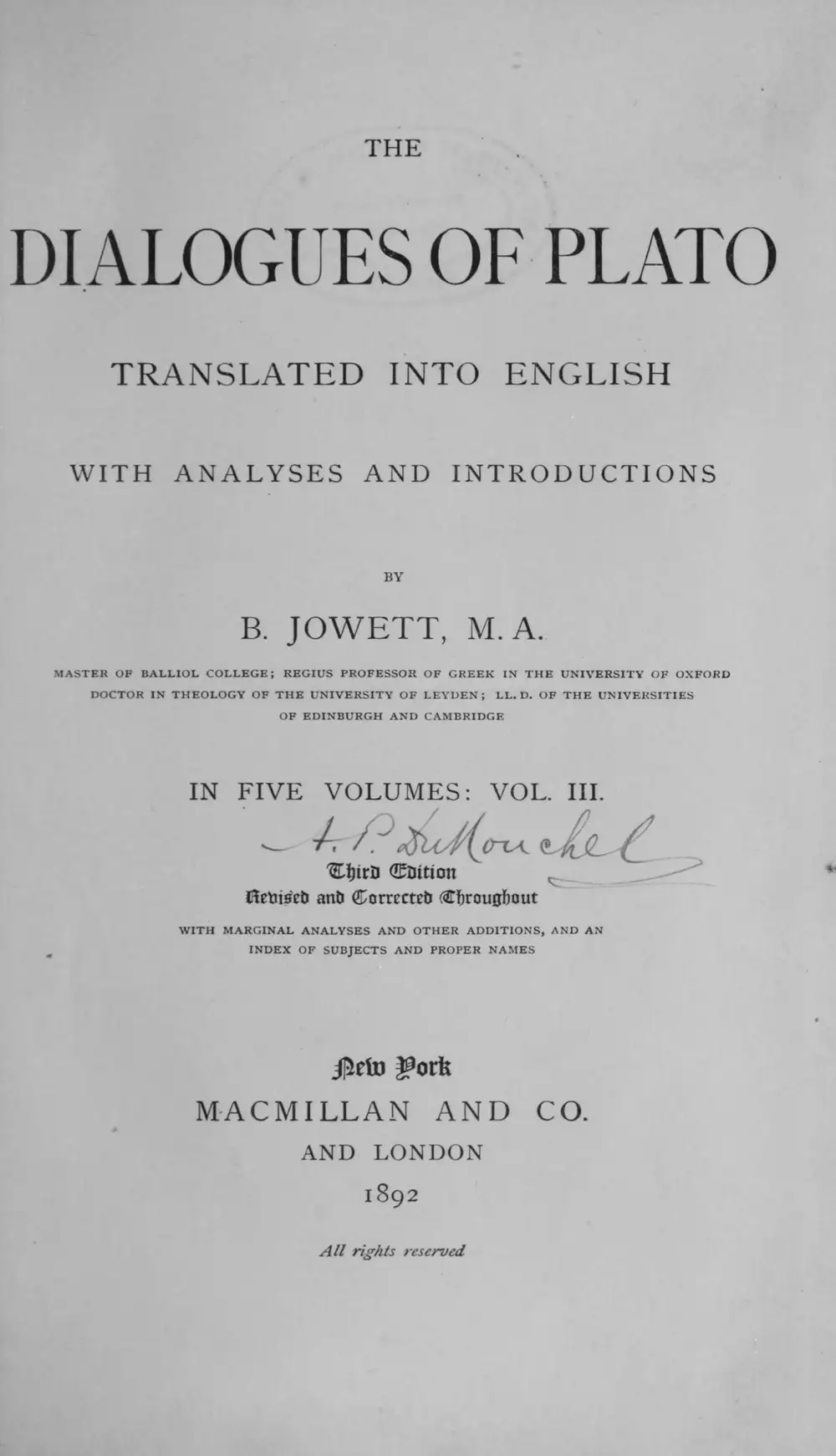
TRANSLATED INTO ENGLISH WITH ANALYSES AND INTRODUCTIONS
BY B. JOWETT, M.A.
Master of Balliol College; Regius Professor of Greek in the University of Oxford; Doctor in Theology of the University of Leyden; LL.D. of the Universities of Edinburgh and Cambridge
IN FIVE VOLUMES: VOL. III
Third Edition, Revised and Corrected Throughout, with Marginal Analyses and Other Additions, and an Index of Subjects and Proper Names
Macmillan and Co. and London, 1892. All rights reserved.
Copyright, 1892, by Macmillan & Co.
Printed at the De Vinne Press.
CONTENTS
Republic: Introduction and Analysis
Book I
II, III, IV, V, VI, VII, VIII, IX, X
Timaeus
Critias
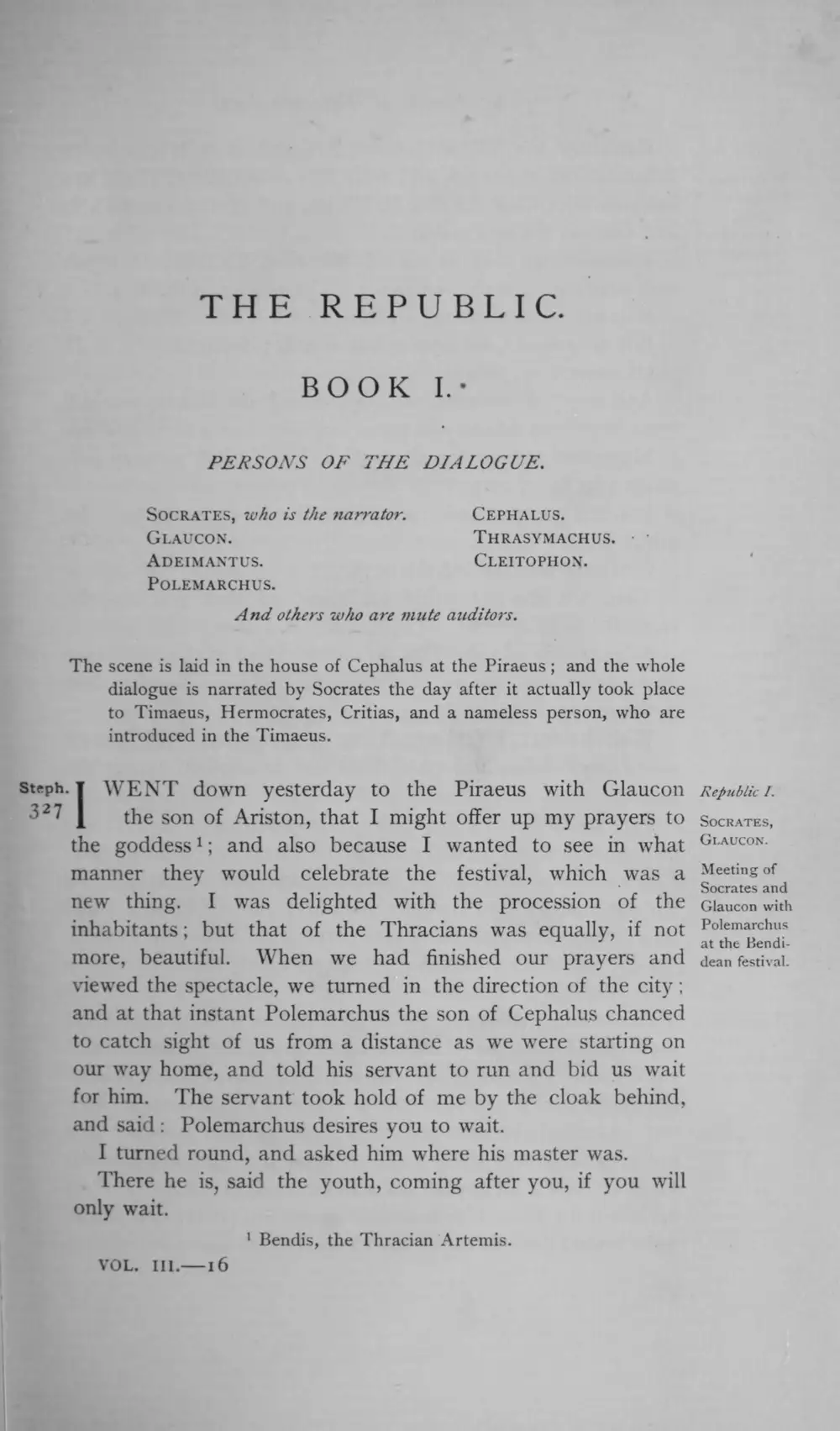
THE REPUBLIC
INTRODUCTION AND ANALYSIS
The Republic of Plato is the longest of his works except the Laws, and certainly the greatest of them. The Philebus and the Sophist come nearer to modern metaphysics; the Politicus, or Statesman, is more ideal; the form and institutions of the State are drawn out more clearly in the Laws; and as works of art the Symposium and the Protagoras stand higher.
But no other Dialogue of Plato has the same breadth of view and the same perfection of style; no other shows as much knowledge of the world, or holds more of those thoughts that are new as well as old, belonging not to one age only but to all. Nowhere in Plato is there deeper irony, a greater wealth of humour or imagery, or more dramatic power. Nor does any other of his writings attempt to weave life and speculation together, or to connect politics with philosophy. The Republic is the centre around which the other Dialogues may be grouped; here philosophy reaches the highest point (compare especially Books V, VI and VII) that ancient thinkers ever attained.
Plato among the Greeks, like Bacon among the moderns, was the first to conceive a method of knowledge, although neither of them always distinguished the bare outline or form of truth from its substance; and both had to be content with an abstract idea of science that was not yet realized. He was the greatest metaphysical genius the world has seen, and in him, more than in any other ancient thinker, the seeds of future knowledge are contained. The sciences of logic and psychology, which have given later ages so many instruments of thought, rest on the analyses of Socrates and Plato.
The principles of definition, the law of contradiction, the fallacy of arguing in a circle, the distinction between the essence and the accidents of a thing or notion, between means and ends, between causes and conditions; the division of the mind into the rational, the desiring and the spirited elements, or of pleasures and desires into the necessary and the unnecessary — theseand other great forms of thought are all to be found in the Republic, and were probably first invented by Plato. The greatest of logical truths, and the one that writers on philosophy most readily lose sight of, the difference between words and things, is insisted on by him most strenuously (compare Rep. 454 A; Polit. 261 E; Cratyl. 435, 436 ff.), although he has not always avoided confusing the two in his own writings (for example Rep. 463 E). But he does not bind up truth in logical formulae; logic is still veiled in metaphysics; and the science which he imagines to 'contemplate all truth and all existence' is very unlike the doctrine of the syllogism which Aristotle claims to have discovered (Sophistical Refutations, Soph. Elenchi 33. 18).
Nor must we forget that the Republic is only the third part of a still larger design, which was to have included an ideal history of Athens as well as a political and physical philosophy. The fragment of the Critias has given birth to a world-famous fiction, second in importance only to the tale of Troy and the legend of Arthur, and is said in fact to have inspired some of the early navigators of the sixteenth century. This mythical tale, whose subject was a history of the wars of the Athenians against the island of Atlantis, is supposed to be founded on an unfinished poem of Solon, to which it would have stood in the same relation as the writings of the logographers to the poems of Homer. It would have told of a struggle for Liberty (compare Tim. 25 C), meant to represent the conflict of Persia and Hellas. We may judge from the noble opening of the Timaeus, from the fragment of the Critias itself, and from the third book of the Laws, how Plato would have treated this high argument.
We can only guess why the great design was abandoned: perhaps because Plato became aware of some incongruity in a fictitious history, or because he had lost interest in it, or because advancing years kept him from completing it. And we may please ourselves with the fancy that, had this imaginary narrative ever been finished, we should have found Plato himself sympathising with the struggle for Hellenic independence (compare Laws, iii. 698 ff.), singing a hymn of triumph over Marathon and Salamis, perhaps making the reflection of Herodotus (v. 78) where he contemplates the growth of the Athenian empire: 'How brave a thing is freedom of speech,
ONE VOLUME, SEVERAL DIALOGUES. The title page reads “THE DIALOGUES OF PLATO TRANSLATED INTO ENGLISH WITH ANALYSES AND INTRODUCTIONS BY B. JOWETT … IN FIVE VOLUMES: VOL. III”, third edition, Macmillan 1892, “revised and corrected throughout”. What is held is Jowett’s third volume: his introductions and analyses with the Republic, the Timaeus and the Critias. Beal closed his own translation in this same collection with an appendix on exactly this hazard, one title standing over several works, and this issue’s title now names all three.
Jowett ranks the Republic first while conceding nearly every particular to another dialogue: the Laws is longer, the Sophist nearer metaphysics, the Symposium finer art. The claim rests on one thing only, that here and nowhere else philosophy is woven together with politics and life. That is a college master's reason. Jowett, Master of Balliol, taught this book to the young men who went on to govern, and his praise of a dialogue about the education of rulers reads also as a description of his own work.
Jowett calls Atlantis 'a world-famous fiction' and files it beside Troy and Arthur, so the most durable legend to come out of Plato enters this volume already labelled as invention. His reason is structural. The Republic is the first of three linked works: the Timaeus opens by recalling its city, and the Critias was to set that city at war with the island. The Critias breaks off in mid-sentence, just as Zeus has gathered the gods to speak. The question the Republic leaves open, whether the just city could exist anywhere, is the question the history would have answered with a story, and the story is the part that never got written.