Legge finds the mention of sacrifices “peculiar in our King” and notes they are “not presented to the Highest Object”, a category from his own theology rather than the text's. In the verse they are brought by sons “in lengthening line”: the ancestral rite is the measure of a family that lasts, the visible proof of what “Can never be uptorn”. Read so, the line is no religious intrusion but the chapter's first instance of the Tao's effect, which paragraph 2 extends from the family to the kingdom.
The Tâo Teh King — Sacred Books of China Part I, SBE Vol. 39 (trans. James Legge, 1891)
Open to all
page 98
No image is selected for this page; its own page image is shown.
page 98
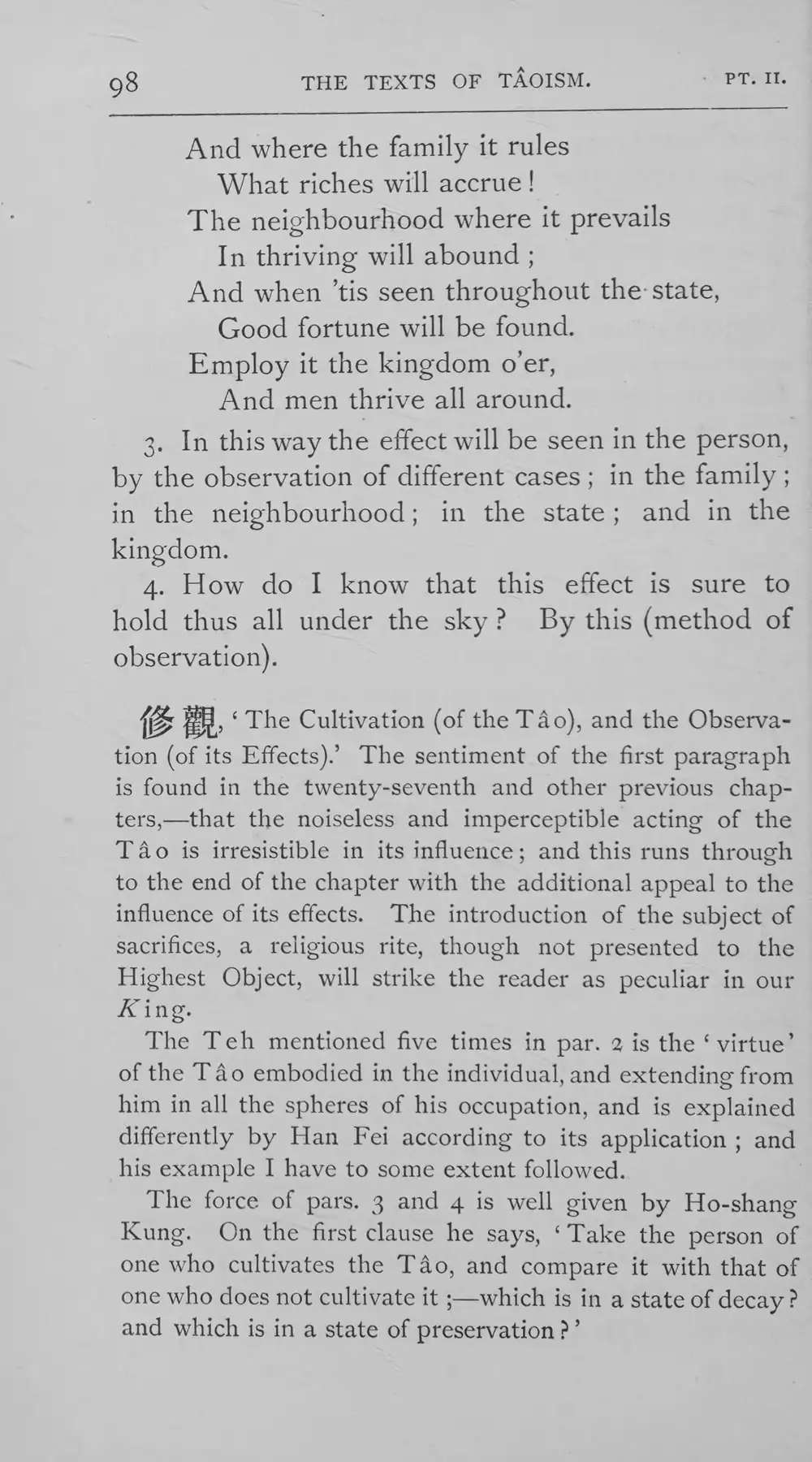
3. In this way the effect will be seen in the person, by observing different cases; in the family; in the neighbourhood; in the state; and in the kingdom.
4. How do I know that this effect is sure to hold thus all under the sky? By this (method of observation).
修觀, ‘The Cultivation (of the Tâo), and the Observation (of its Effects).’ The sentiment of the first paragraph is found in the twenty-seventh and other earlier chapters,—that the noiseless and imperceptible action of the Tâo is irresistible in its influence; and this runs through to the end of the chapter, with the added appeal to the influence of its effects. The introduction of the subject of sacrifices, a religious rite, though not presented to the Highest Object, will strike the reader as peculiar in our King.
The Teh mentioned five times in par. 2 is the ‘virtue’ of the Tâo embodied in the individual and extending from him into all the spheres of his occupation; Han Fei explains it differently according to its application, and I have to some extent followed his example.
The force of pars. 3 and 4 is well given by Ho-shang Kung. On the first clause he says, ‘Take the person of one who cultivates the Tâo, and compare it with that of one who does not cultivate it;—which is in a state of decay? and which is in a state of preservation?’