Legge reads the “I” of chapter 53 as Lâo-ȝze speaking of himself, and his support is an anecdote in Liû Hsiang's Shwo-wan, a Han collection. At chapter 80 he refuses a reading because it rests on “a custom of the Han dynasty, which is not remote enough”, and the same objection weighs against this evidence. Wû Khăng's “any man” in government is the reading the chapter can support from its own content, a contrast of two ways of ruling.
The Tâo Teh King — Sacred Books of China Part I, SBE Vol. 39 (trans. James Legge, 1891)
Open to all
page 97
No image is selected for this page; its own page image is shown.
page 97
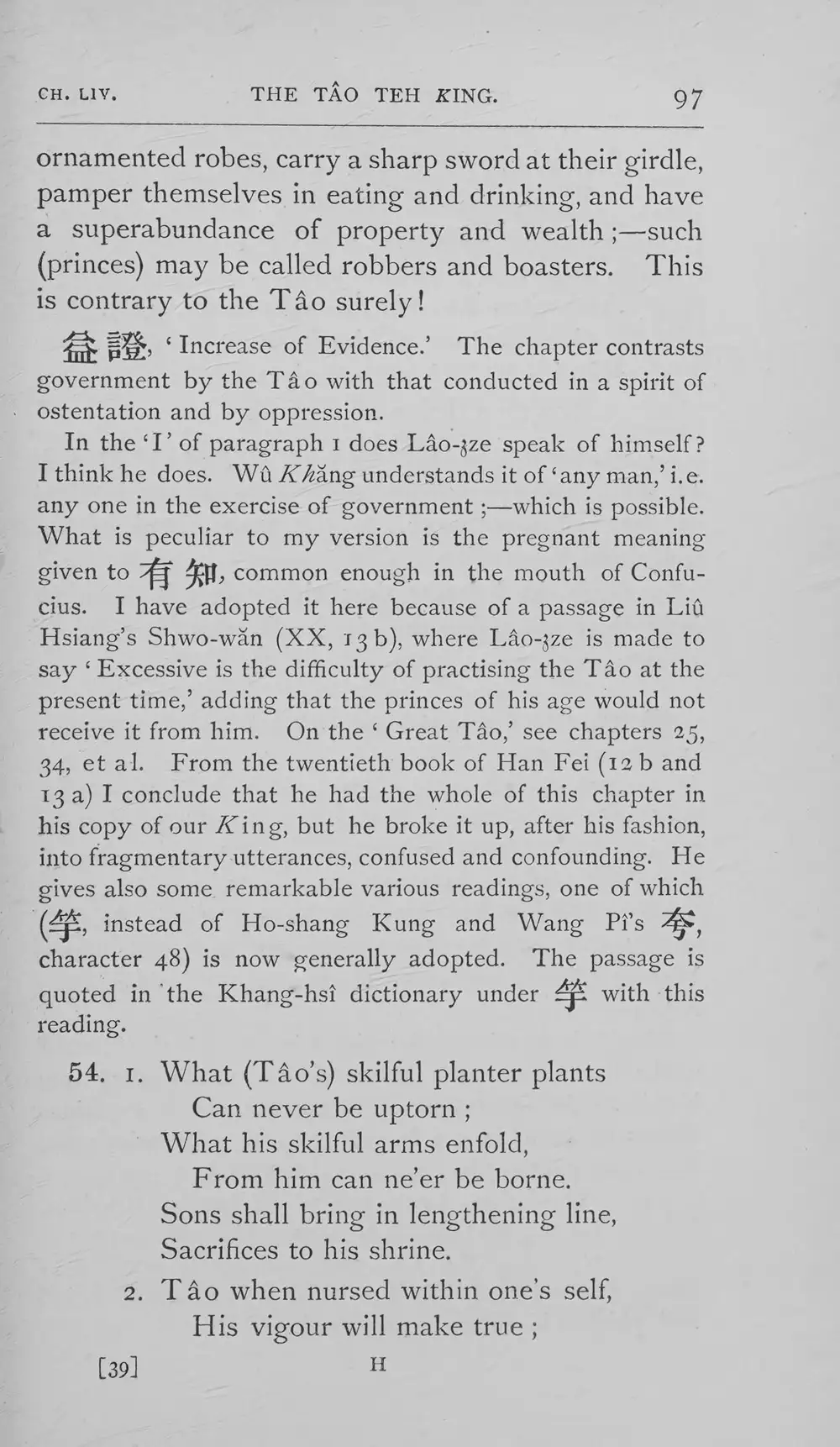
益證, ‘Increase of Evidence.’ The chapter contrasts government by the Tâo with government conducted in a spirit of ostentation and by oppression.
In the ‘I’ of paragraph 1, does Lâo-ȝze speak of himself? I think he does. Wû Khăng understands it of ‘any man,’ i.e. anyone exercising government;—which is possible. What is peculiar to my version is the pregnant meaning given to 有知 [Press: to have knowledge], common enough in the mouth of Confucius. I have adopted it here because of a passage in Liû Hsiang’s Shwo-wan (XX, 13b), where Lâo-ȝze is made to say, ‘Excessive is the difficulty of practising the Tâo at the present time,’ adding that the princes of his age would not receive it from him. On the ‘Great Tâo,’ see chapters 25, 34, and elsewhere.
From the twentieth book of Han Fei (12b and 13a) I conclude that he had the whole of this chapter in his copy of our King, but he broke it up, after his fashion, into fragmentary utterances, confused and confusing. He also gives some remarkable various readings, one of which (竽 [Press: yü, a reed mouth-organ], instead of Ho-shang Kung’s and Wang Pî’s 夸 [Press: boasting], character 48) is now generally adopted. The passage is quoted in the Khang-hsî dictionary under 竽 [Press: a reed mouth-organ (yu)] with this reading.
54. 1. What (the Tâo’s) skilful planter plants
Can never be uprooted;
What his skilful arms enfold
Can never be carried from him.
Sons shall bring, in lengthening line,
Sacrifices to his shrine.
2. The Tâo, when nursed within oneself,
Will make his vigour true;
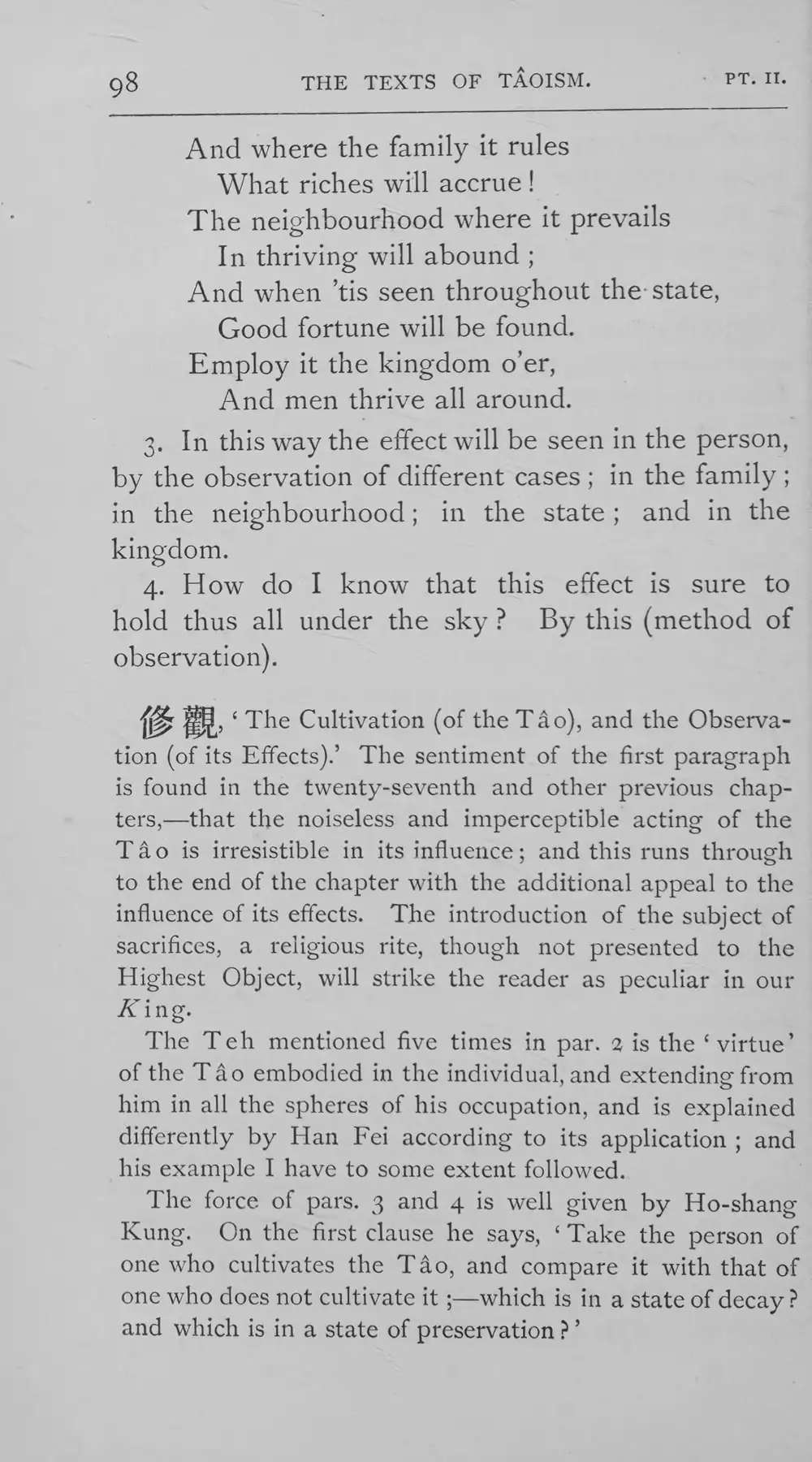
And where it rules the family,
What riches will accrue!
The neighbourhood where it prevails
Will abound in thriving;
And when it is seen throughout the state,
Good fortune will be found.
Employ it across the kingdom,
And men will thrive all around.